
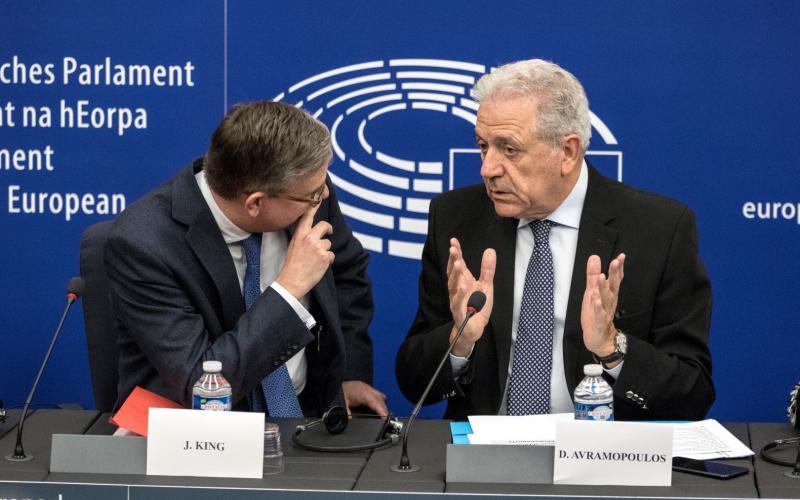
Dear all,
It’s almost a year since the tragic Berlin Christmas market attack, which left 12 people dead and 56 injured.
The attacker used 14 different identities to evade law enforcement authorities and was flagged in our systems with different names.
The same problem of multiple and false identities was observed in the Marseille stabbing attack in October.
These are threats that slipped through the nets of our migration, borders and security databases.
Perpetrators who were able to abuse the gaps and blind spots of our systems.
According to figures released today, more than 90% of Europeans agree that national authorities should share information with the authorities of the other EU Member States to better fight crime and terrorism.
However, at the moment, someone who previously entered the EU on a tourist visa could apply for asylum using a false identity – because that person would be registered in different databases which were not inter-linked.
We have already taken important steps over the last two years to improve the situation and to increase security:
– a better exchange of information between Member States,
– improvement of our existing systems, such as our proposed reforms of the Schengen Information System but also Eurodac,
– systematic checks at the external borders, and second line security checks at the hotspots.
But more has to happen.
Without interoperability, potentially vital connections between data can be missed.
This applies in the context of our migration hotspots, at our border crossing points, at police stations, or our consulates where non-EU nationals apply for a visa to come to Europe.
Today we say stop! Once interoperability becomes a reality, every border guard, every visa, immigration or police officer should have access to exactly the information they need, when they need it
– in full respect of data protection safeguards.
In this way, our actions on migration, borders
and security come together.
Our information systems in this area should no longer be isolated silos.
The border guard will receive hits on one screen, thanks to the “one stop shop” of the European Search Portal that we propose today.
Today, we are closing the gaps and connecting the dots of all our migration, border and security data systems.
We are not creating a new system, we are not collecting more information, and we are not creating Big Brother.
Not everyone will have access to all data – we are not changing the rules of access. Each official will still have access to the data he or she is entitled to have.
Interoperability is about better managing and better sharing the information we already have.
With interoperability, privacy and security are two sides of the same coin.
Today, around 200 million third-country nationals are visiting the Schengen area for a short-stay.
More than 2.5 million people applied for asylum in 2015 and 2016.
At the same time, some 10 million third-country nationals have a conviction record in an EU Member State and there are around 1 million alerts on persons
issued in the Schengen Information System.
Interoperability will help us safeguard the mobility of bona-fide travellers, improve the security of our citizens, and ensure protection for those who really need it.
But it will also enable us to immediately identify criminals and terrorists.
Those who are trying to abuse our systems will no longer be able to do so.
Those that use false identities will not be able to slip through the net.
From now onwards, our information systems will not only be more streamlined,
they will be smarter, faster and stronger – so Europe can remain open and mobile, but equally safe and secure.
We have no time to lose. We now need to work very closely with the Member States and Parliament to have the proposal adopted within 2018.
The technical work to develop interoperability has already started, so it can become operational as soon as possible.
I now pass the floor to Julian.