
Dear all,
Today, on World Refugee Day, we think of the more than 65 million people that are displaced globally because of war or persecution.
While we think of them on this day, their displacement however, is not just for one day. They are often displaced for many months and years. This is why our actions also cannot be limited in the short term.
As you know, the European Commission has been taking a number of important steps to address the challenges of the ongoing refugee crisis both inside and outside Europe.
In fact today, the EU Regional Trust Fund in Response to the Syrian Crisis is delivering new projects for €275 million to support Syrian refugees and their host communities in Turkey, Lebanon, Jordan, Iraq, the Western Balkans and Armenia.
The support from the EU Syria Trust Fund has now crossed the €1 billion mark.
In the span of two years, we have built a comprehensive and proactive approach to managing migration holistically. But we cannot remain in crisis-modus forever. We need to think about the future.
Migration is not just about challenges, it is also about opportunities. Refugees and migrants come with their own experiences, talents and skills. These can be real assets for our economies and societies overall.
While around a quarter of non-EU nationals in the EU have tertiary education degrees, almost two thirds of them are over-qualified for their jobs or even without a job. Investing in early labour market integration is therefore paramount.
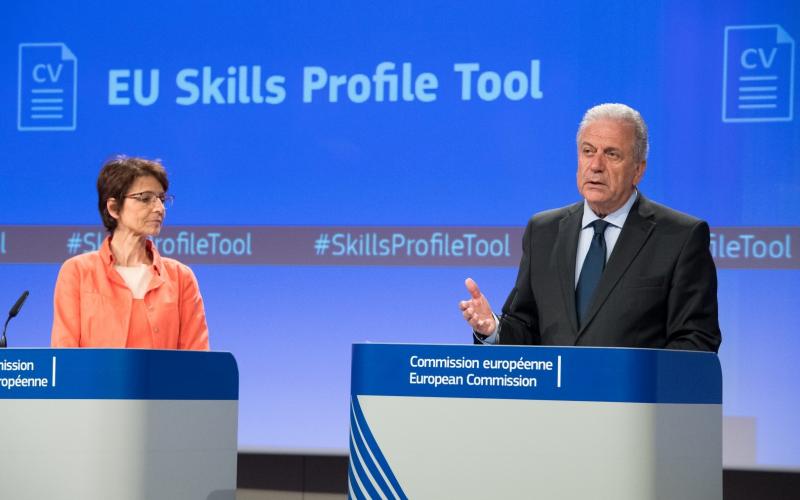
I am very happy to present to you today with my colleague Marianne Thyssen a joint effort to shorten the journey for newly arrived migrants and refugees to employment. What we launch today is the “skills profile tool”. This will help migrants to present their skills, qualifications, and experiences in a way that is well understood by different actors (employers, authorities, organisations, NGOs…) across the whole European Union. Marianne can tell you more about it.
Learning from the past, and particularly in the current context, we cannot start early enough with facilitating integration. Some EU countries already have well-developed integration policies, but others are more “new” to this.
And this is precisely where we can help.
At the EU level, we want to streamline this common effort so that all Member States can make use of it in full or in part, freely and easily.
Labour market integration is a shared responsibility between governments, public employment services, local actors but also the private sector of course.
This is why on this occasion, I would also like to recall the initiative that the Commission launched on 23rd May to promote employers’ efforts to support the integration of refugees and other migrants.
I invite all economic actors to join the “Employers for integration” initiative in order to make real difference on the ground, together.
As I said earlier, migration is not just a challenge but an opportunity. Today is a day to remember not just the vulnerabilities of refugees, but their many capabilities, their resilience, their talents.
Thank you.