
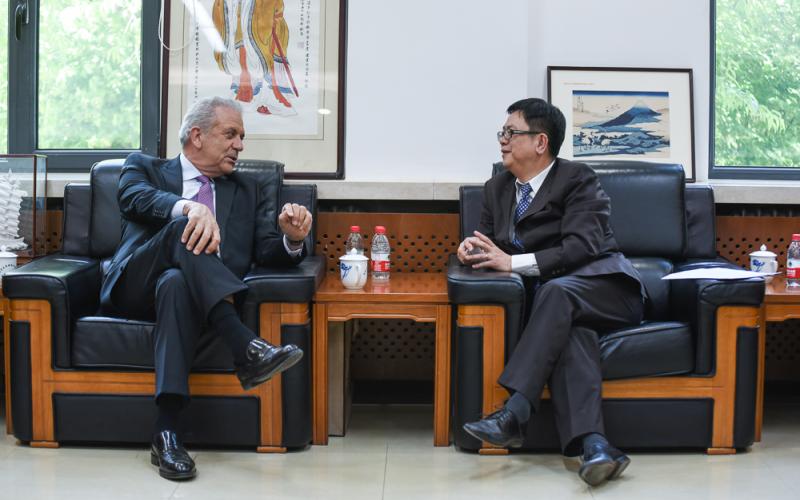
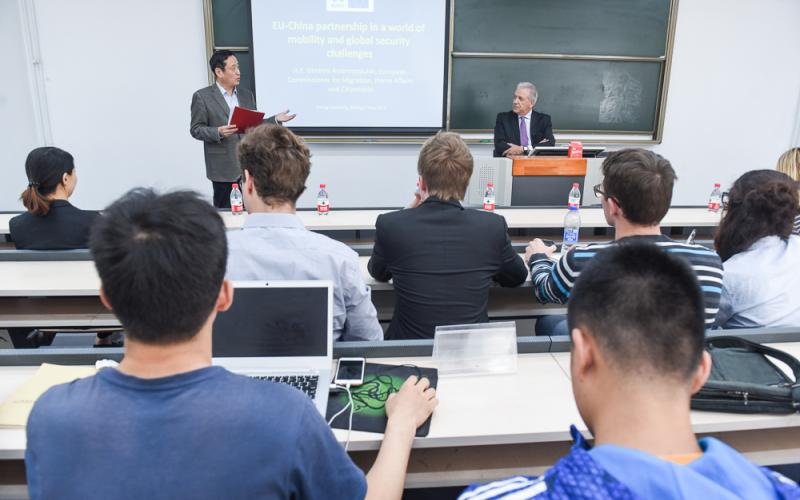
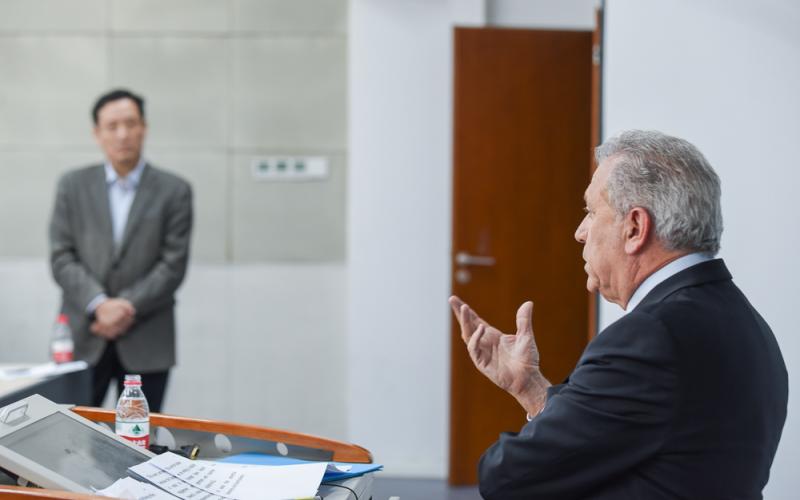
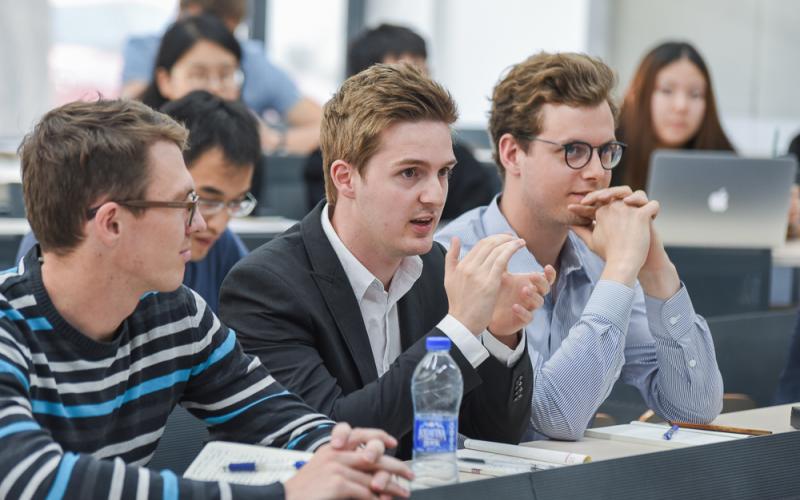
It is an honour for me to be back at the Peking University, after more than 10 years now, when it celebrates its 119th anniversary.
Not only is it one of the oldest and most respected academic institutions in China, but also across Asia – and I feel personally connected to this university as I am an Honorary Professor here.
In fact, Beijing is a city I hold very dear since I have signed the first friendship and collaboration agreement between Beijing and Athens in my then capacity as Mayor of Athens in the late 1990s, which also led to the establishment of the ‘Olympic bridge’ between these two historic cities, who succeeded each other in hosting the Olympic Games of 2004 and 2008 respectively.
In today’s rapidly changing world, Asia and Europe, East and West, China and the EU are becoming ever more connected – whether it’s on mobility, industry, climate, energy or security issues.
However, this connection should not surprise us because this connection was always there. And this dividing line between the so-called East and West is to some extent an artificial one.
To understand this, we have to go back in history, to see how our societies, the European and Chinese, have been built on the ethics, values and philosophies of two masters who – despite never having met each and not even lived in the same lifespans – have laid the fundaments of our societies: Confucius and Socrates.
Both envisioned an ideal society where everyone was treated equally before the law. Both were wanderers, self-taught, not limited by the institutional, physical or mental borders of the environments they lived in.
As the world is becoming increasingly globalised, this is also how we are invited to think and act today.
Despite many borders and frontiers in the world, including those supposedly between the East and West, these boundaries are being increasingly crossed and becoming ever more blurry in different ways.
Yes the world is becoming more globalised, but it is also becoming more connected. This connectedness brings opportunities, responsibilities but also challenges.
First of all, it brings opportunities for travel and mobility. For example, in 2015 and 2016 almost 2000 Chinese citizens were studying in the EU and more than 1000 EU citizens were studying in China. In fact, last year, more than 2 million Chinese citizens visited the EU – whether for business, study or tourism.
Promoting this kind of mobility is a central element of the EU-China Dialogue on Migration and Mobility, which was the main reason of my visit to Beijing.
As a matter of fact, I am happy to inform you that I came to Beijing to launch, the negotiations of an EU-China visa facilitation agreement. I hope that more visa application centres will be opened in Chinese cities, which will make it easier for Chinese citizens to obtain visas to come to the EU for study, for work or for pleasure. We do all this in view of promoting people to people contacts and exchanges between the citizens of the European Union and of China.
Secondly our global connectedness brings responsibilities. While mobility is rising globally, and more than 250 million people are on the move worldwide, mobility cannot be at the expense of public order and safety. This is why it is a global duty to manage migration and mobility better, together.
In Europe we have been directly affected by the instabilities in our neighbourhood, and in particular the large flows of refugees coming from Syria on the one hand via Turkey to Greece, and migrants coming through Libya to Italy. In two years, we have beefed up our rescue operations in the Mediterranean and strengthened our border management through the creation of the European Border and Coast Guard. Last year we granted protection to more than 700,000 people. But Europe cannot address the migratory flows on its own, particularly if we want to reduce irregular migration and fight the phenomenon of migrant smuggling. This is why we are strengthening our cooperation with origin and transit countries, such as Turkey, but also Northern and Sub-Saharan Africa. This is also why for example in parallel with the EU-China visa facilitation we have equally agreed on a way forward to combat irregular migration between the EU and China.
Migration is not just a regional phenomenon, but ultimately a global responsibility. This is precisely why all the international actors have been called by the United Nations General Assembly last September to contribute to the fair sharing of responsibilities for the world’s refugees.
Thirdly, as we face global threats and challenges, particularly security-related, there is a need for all of us, and especially for global powers like the European Union and China, to engage and cooperate.
The threat of terrorism, of cyber hacks, of organised crime but also fighting drugs and human trafficking or preventing money laundering and corruption – these are not European or Chinese challenges. They are shared.
Most recently, on 19 April, the European Union’s law enforcement agency, Europol, signed a Strategic Cooperation Agreement with China to fight organised crime and to step up security cooperation between both sides. This agreement will allow for the exchange of general intelligence as well as strategic and technical information.
This development provides a good framework for cooperation on all security matters, and it should help to establish multilateral cooperation that could complement cooperation already taking place bilaterally between China and EU Member States.
The European Union has taken many measures to better fight terrorism, radicalisation and increase security in the Europe and its neighbourhood.
For example, we have harmonised rules to criminalise everyone who helps potential terrorists, whether it’s financially, or helping them prepare or travel. We have also strengthened the rules for buying and possessing firearms – but most importantly to counter the trafficking of illegal firearms.
In an increasingly globalised and digitalised age, security is everything – and citizens are worried about their security. At home, online, when working or travelling.
Terrorism or cyber-attacks know no borders. This means that no country or region can deal with this alone. We need a global and joint approach. Ultimately, the safety and security of citizens is globally connected. What happens in North Korea for example, matters to China, and matters to the EU and the US too.
This is why for example we are working to establish Passenger Name Record agreements with countries outside the EU, to avoid that potential terrorists can board planes. We are also working with big internet companies like Google, Twitter, Facebook and Microsoft to remove terrorist content and propaganda online, through the EU Internet Forum.
Here too, we work across borders, whether physical or online, to increase the security and protect citizens not just in Europe but outside.
Ladies and gentlemen,
Dear students,
Born after the Cold War, you are the generation that has never known the iron curtain. In fact for you today, as for many young people around the world, the two most defining elements of opportunities of the 21st century are the possibilities of mobility and connectivity – the exact two things that were very limited (if not impossible in certain cases) 30 years ago.
Studying at this prestigious university, you are the future leaders, the future diplomats that will contribute to breaking down barriers and frontiers, and building partnerships – simply by thinking, living, exchanging and studying the way you do today.
Whether it’s Europe or China, we all want to preserve and strengthen stability and prosperity in our societies. But this cannot happen unilaterally – we can only do this together. This is why I am here today, because the European Union is ready to step up its engagement with China towards a more multilateral and cooperative global order, to build a more secure world, based on multilateralism and the respect of commonly agreed rules, where no regions is left behind with its own problems, and all interact together to build balanced and durable solutions. We look forward therefore for China to increasingly join forces with us in promoting peace, security, social institutional and economic development in all parts of the world –not only in Asia, but also in Africa and in the Middle East- where its great resources, investments and know-how can provide an added value.
The EU counts on China, and China can count on the EU.
But the real and long-lasting change will come from you: the youth and the future. Because if last year a few thousand students from China were studying in the EU and vice versa – in the future hopefully these can be tens of thousands. You are the multiplying effect of informal diplomacy that will build the foundations of the EU-China partnership of the future.
Thank you.