
Thank you Frans.
Ladies and gentlemen,
What we present today is the outcome of hard work, and it is a smart answer to a very complex situation that has been created following what has happened in Europe recently.
This proposal is the element that connects and completes a modern European border management.
This project is one of our Commission’s commitments.
And personally we are both committed to that from the very beginning.
Following our ambitious agendas on migration and security, we had to modernize our borders’ policy.
Today’s proposal is the element that connects and completes a modern European border management.
This project is one of my personal commitments. Following our ambitious agendas on migration and security we had to modernise our borders policy.
The nexus between migration and security is exactly our external border. ETIAS combines both.
Europe is and remains an open continent. Every year we welcome more than 30 million visa free travellers. We wish to maintain and increase this mobility.
Our relationship with our visa-free partners is essential – whether they are crossing the Atlantic or the Danube.
But in an age of increasing migration flows and of evolving security and terrorism threats, our openness cannot come at the cost of our security.
This is why today we propose a system that will be the missing link in a bigger information puzzle – starting from our external borders, and involving both migration and security.
With ETIAS, we will know much more about citizens coming from visa-free third countries, without hampering their travel to the Schengen area.
What we want to know are 2 key elements:
1. Are they a potential security threat? This means: are they flagged in Europol’s systems for terrorism?
2. Do they pose an irregular migration risk? Did they for example overstay their visa in the past?
The new automated system will cross-check this information against all our relevant data, as Frans explained, in a very streamlined and quick way.
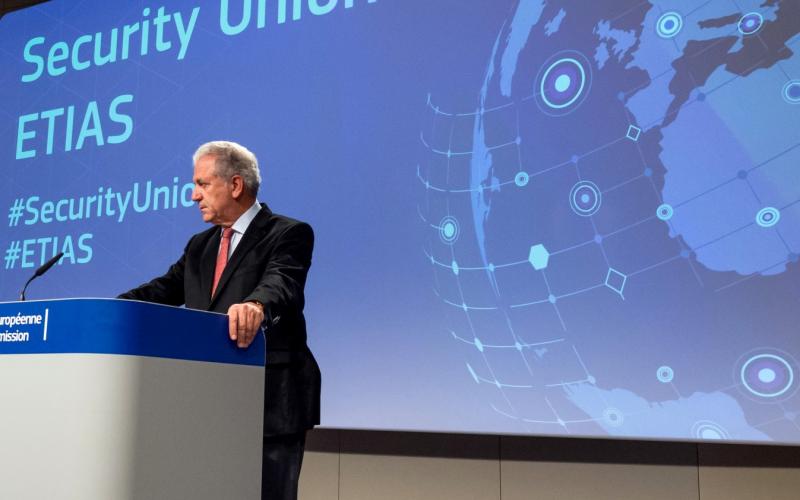
You can see behind me the different steps that need to be taken.
It is a system which is fully interconnected to all our other databases, and can cross-check data and give replies within minutes.
95-98% of these replies will be positive. 1-2% will go to the Member States, because we make sure that they keep their competence to decide who crosses their border.
National authorities will decide, when there are security alerts and threats.
And where necessary, they will involve law enforcement authorities and Europol.
Our full range of Home Affairs Agencies will be involved.
eu-LISA will design the system, and the European Border and Coast Guard will manage it centrally.
Europol will host the ETIAS watchlist, which will be critical for our security risk assessments.
Many of you will know the American ESTA system.
Unlike the US system, ETIAS is not for 1 country’s borders, but for all the Schengen Member States.
A system that covers land, sea and air borders and which is cheaper:
5 EUR for a validity period of 5 years.
That’s 1 EUR per year basically.
And it’s free for anyone under 18.
Let me conclude by saying that it’s important to see our ETIAS proposal as part of our wider efforts to better manage and control our external borders.
The European Border and Coast Guard, the Entry-Exit System, systematic checks at the external border – it is all part of the bigger picture.
This is also clear from our Second Security Union Report that we present today: progress has been made but our fight against terrorism and organised crime continues.
If we want Europe to remain open both on the inside and the outside, we have to make sure that our external borders are well managed in all aspects, without renouncing or sacrificing that openness.
Thank you.