
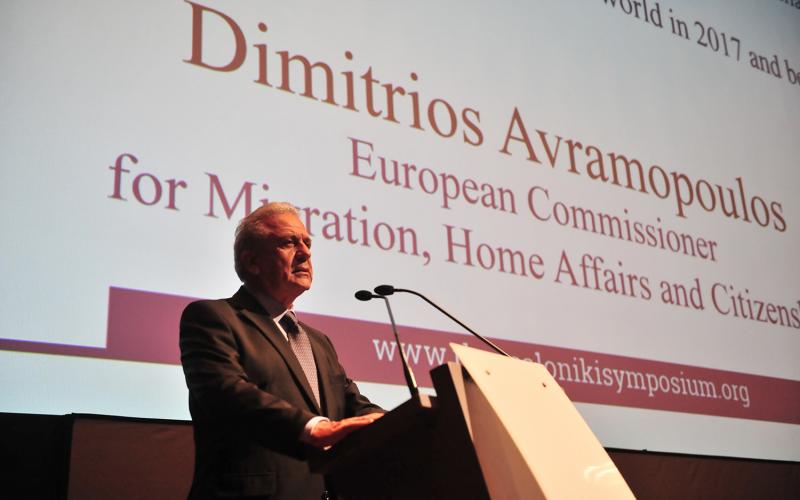
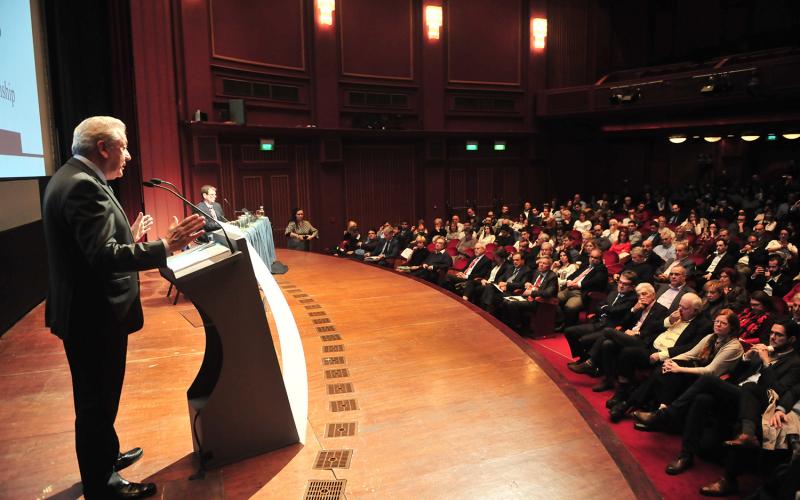
Ladies and Gentlemen,
I want to congratulatethe Northern Greece Entrepreneurs Cultural Society for this initiative. You give the possibility to the people of Thessaloniki, especially the younger generations, to reflect and discuss on their future and their major concerns.
Our world is changing, radically. Social and economic changes Inevitably influence our lives and our view of the world.
Therefore, the thoughts that I am going to share with you today are about How to turn the multiple crises that we are facing today – at international, European, national but also regionaland local level – into an opportunity.
And how to ensure the deepening and cohesion of the European project under the pressure of the refugee, security and economic challenges.
Dear friends,
The European citizens are very clear in their messages: they demand tangible solutions to the challenges of our time, which are increasingly transnational.
They demand results – and only this will restore their trust and support to the European Project but also to the political Institutions, both at European and national level.
This Commission, the Juncker Commission, has since the very first moment acted as true political body, leading the way for a common response to common challenges.
This was the vision of the President shared by the College of Commissioners.
And it is the only way ahead.
In times of growing populism and nationalism, failure is not an option.
But just as our challenges are shared across borders, so should be our responsibilities – whether we talk about the issues of the refugee crisis or the threat of terrorism.
This is what I repeat almost on a weekly basis, to press but also to Member States: “each of us has to take their own share of responsibility”.
It is as simple as that. We cannot criticize without offering solutions.
We cannot demand responsibility when we don’t deliver on the solidarity aspect or we want “solidarity à la carte”.
I see that referenda are becoming “fashionable” these days, but they cannot be an excuse for governments not to take up their responsibilities.
People sometimes present Europe or Brussels as being something far away, an invisible decision-maker.
But Europe is right here: what is decided by Member States is being implemented right here: through the relocation scheme and the hotspots for example, but also through the EU-Turkey Statement which has generated less flows.
Ladies and Gentlemen,
We often forget the tangible beneficial effect and impact that Europehas on our daily lives.
In fact, some even take certain European accomplishments for granted.
I would like to use the example of Schengen, which is the nexus of many of the challenges we face today, and yet our greatest achievement of European integration.
Schengen is the symbol of being and feeling European: for students, workers, businessmen, travelers that want to move freely, safely and quickly in an area without internal border controls.
We cannot imagine ourselves in the European Union without Schengen, without being able to move freely.
The financial cost of not having Schengen anymore has been estimated roughly at up to 20 billion EUR.
But the real cost of not having Schengen is immeasurable.
And yet we find ourselves in a situation where Schengen is at stake, because the migration crisis created an unprecedented situation for Europe. No country can deal with this alone.
In addition, the crisis proved that the European asylum framework was in need of radical and comprehensive reform and modernization.
But we had the moral and legal responsibility to offer help to all those people who, displaced by wars and conflicts, were asking for refuge.
The crisis made also evident the need to coordinate better and share the responsibility for a better managementand protection of our external borders.
On the 6th of October, we launched the European Border and Coast Guard, a historic achievement for Europe. The external borders of one Member State are now the external Borders of every Member State; they are borders of the European Union. And we did that in less than 9 months – allow me to be personally proud of it.
The European Border and Coast Guard is an example of how the Union can address the concerns of its citizens, immediately and effectively, in unity and shared responsibility.
And we are promoting a series of new measures and initiatives to better manage the migration crisis and better secure our borders.
Our door is open for those who are in need of international protection and travel to Europe in good faith, but those who are here irregularly will have to return.
Let me also be clear on one thing: We do not confuse migration with terrorism.
We know though that some dangerous people have taken advantage of our tolerance. But our tolerance will not come at the cost of our security.
The key element to knowing who is crossing our borders is the exchange of information.
And this cannot happen if we don’t trust each other. We have made significant progress in recent months to strengthen our collective capacity to identify terrorists and prevent their travels.
Much of our efforts will continue to focus on defending ourselves against terrorism – at home and abroad.
Because security is an essential pillar of stability. And I can tell yoy that in the aftermath of the terrorist attacks our citizens still feel insecure and we must address this.
Because insecurity makes us vulnerable. Finally, all of these challenges also have a global dimension.
And over the past year, we have stepped up our work with our external partners, both on migration and security.
In parallel, we have taken other importat steps forward. The EU-Turkey Statement is one such example, where we now have less than 100 people crossing the Aegean Sea instead of more than 6000 on a daily basis.
We have also established partnerships with African countries to better jointly manage the challenges of migration.
And we continue to work with our neighbours both close and far away, on both migration and security issues, whether this is the Western Balkan countries, Turkey, but also the United Stated and Canada.
Ladies and Gentlemen, dear friends,
Allow me to come back to the example of Schengen. We need Schengen and we have to better manage our external borders.
Not in order to build a Fortress Europe, but, instead to continue the development and progress of the most ambitious and successful democratic project in the history of our Union.
When people discuss what kind of Europe they want for the future, usually there are two answers: more or less Europe.
However, I believe the real answer is: a BETTER Europe.
We need to focus on what really matters for our citizens when it comes to common threats and problems.
We have to speak to our citizens’ heart, to make them feel that they are members of a family that is ready to prevent, act and react in order to protect their interests, promptly and effectively.
Without solidarity, shared responsibility and commitment there is no way forwardfor Europe, actually there is no way at all.
In order for Europe to stand strong and influential on the global scene, it has to be united, decisive and effective inside.
We have to work more intensively and promote more decisively to establish:
• Common Foreign Policy
• Common Defense Policy
• Common Security Policy
• Common Economic Policy
• Common Migration Policy
in order to safeguard the European Union, a Europe that is able to deliver united.
All in all, what we need is a better and more effective Europe.
Ladies and Gentlemen,
We have succeeded all these achievements building on our principles of solidarity, responsibility and mutual trust.
This is what some leaders in Europe must remember and understand before they speak about walls and fences.
That in order to find stability in a changing world, we have to stay together.
Particularly in times of crisis, we can only find stability through and with the Member States in a spirit of mutual respect and understanding and a collective commitment to our common causes.
Therefore, what I think is needed to face this unprecedented social and economic crises, questioning the very fundaments of our Union,is strong leadership.
Not only at European level but also at local, regional and national level within the Member States, with visionary initiatives and commitment to our common European future.
We have made significant progress as a Union. But we have more work ahead of us.
Let me therefore come back to the ultimate question of whether and to what extent Europe is in crisis.
The migration, security and economic challenges, the different referenda – yes they are all questioning our very Union.
Yes we could see this as an existential crisis. Or we could see this as an opportunity. For Europe to reinvent and strengthen itself.
Because Europe is resilient. Europe has a history of overcoming crises.
I can hardly think of a moment when someone was not making a speech about Europe being at yet another crossroads.
It is important to remember where we all come from. It is the moment for the leadership of all Member States and of course the European Union to show determination and commitment and uphold the values upon which Europe is built.
We belong to one of the most privileged generations of history. We are the only generation that hasn’t lived a war.
We must remember and uphold the dream of the founding fathers of Europe, who decided to create a stable and peaceful environment for all European nations.
But stable or peaceful does not have to mean immobile, it does not have to mean paralysis.
If we want to maintain our stability and our peace, we must dare to go forward, not backward.
And now is that moment:for political courage and for civic engagement.
As the world has become more global, it has become smaller, and more local. We cannot operate against each other. We can only go forward together.