
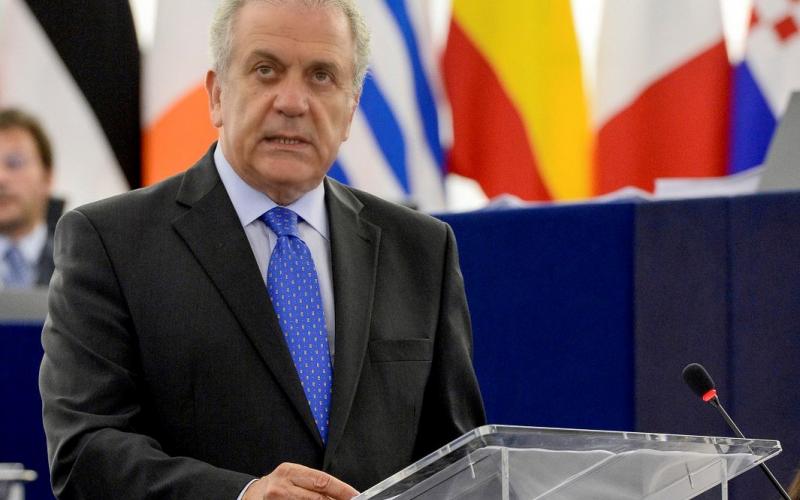
Strasbourg, 10 September 2015
Honourable Members,
First of all I would like to thank you all for your consistent and keen interest to address trafficking in human beings and keeping it high on the political agenda of the EU.
Let us be clear: trafficking in human beings is about the selling and buying of people and of their services.
Trafficking in human beings is expressively prohibited in the EU Charter of Fundamental Rights, and addressing trafficking means upholding fundamental rights.
At the same time, this is a serious form of organised crime, clearly stipulated in the EU Treaty.
This deplorable crime would not exist without the huge profits for traffickers and the demand that fosters all forms of exploitation.
If we want to prevent more victims from falling prey to traffickers, we must follow the money both in the legal and the illegal sectors and we must stop the flows.
Trafficking in human beings is now an integral part of the European Agenda on Migration and also of the European Agenda on Security.
Indeed, it is a phenomenon with clear links to many policy areas within and outside the EU.
Eurostat data indicates that for 2010-2012, the 28 Member States registered 30.146 victims.
80% of victims are female, and 70% of traffickers are male.
16% of registered victims are children, girls and boys.
Data proves that the most widespread form of exploitation is: sexual exploitation (69%), of which women and girls are the vast majority of the victims (95%).
Over 1000 child victims were trafficked for sexual exploitation.
This data clearly demonstrates a strong gender dimension of trafficking in human beings.
Let me be clear: The European Commission has recognised that trafficking in human beings is a structural form of violence against women.
It seriously inhibits women’s ability to enjoy rights and freedoms on an equal basis with men.
Gender plays a role at every stage of the trafficking process:
-by increasing vulnerability to trafficking,
-by fuelling exploitation and
-influencing the effectiveness of assistance and support.
I am proud to say that the European Commission has delivered a lot and my services continue to deliver, very ambitiously, work in this direction.
We have a comprehensive legal and policy framework, guided by the EU Anti-Trafficking Directive and the EU Strategy towards the Eradication of Trafficking in Human Beings 2012-2016.
The anti-trafficking Directive is human rights based and victims centred; it is gender specific and child sensitive.
The deadline for transposition of this Directive, expired on 6 April 2013.
Without delay the Commission, as the Guardian of the EU Treaties, initiated procedures and I am pleased to inform you that to date 25 Member States have officially informed the Commission that they have fully transposed the Directive at national level.
Only two Member States have not notified the Commission yet.
My services are currently analysing the information provided by all Member States and we will not hesitate in taking all the necessary steps to ensure full transposition and application of EU law.
The European Commission will be submitting the following reports to the European Parliament and the Council:
1. In early 2016, the first European Union Report on the progress made in addressing trafficking in human beings as per Article 20 of the Directive will be presented.
Member States and the civil society, as represented in the EU Civil Society Platform, have submitted information to the EU Anti Trafficking coordinator as per article 20, and the report is being prepared with my services.
This report will address the gender dimension and relevant considerations.
Secondly, the European Commission will submit a unified report under Article 23 of the Directive in 2016.
This report will assess the measures taken by Member States to comply with the anti-trafficking Directive.
It will also assess the impact of existing national law that criminalise those who use the services of victims of trafficking, on prevention of this crime, accompanied if necessary by adequate proposals.
This report will equally address the gender dimension of trafficking in human beings, including particularly the measures to reduce demand that fosters all forms of exploitation.
The EU anti-trafficking directive sets forth a legal obligation to reduce demand that fuels exploitation, including by considering criminalising those who knowingly use the services of victims.
The Employers Sanction Directive already criminalises those who knowingly employ victims of trafficking that are third country nationals.
My services have commissioned a Study on the Gender Dimensions of Trafficking in Human Beings to a renowned academic institution to examine the gender dimensions of trafficking for the purpose of sexual exploitation and measures to reduce demand that fuels this exploitation.
The Study took also under consideration the recommendations of this Parliament in the Resolution of 26 February 2014 “on sexual exploitation and prostitution and its impact on gender equality”.
The Study will be finalised by end of 2015.
The EU anti-trafficking Strategy comes to an end in 2016.
As stipulated in the European Agendas for Security and Migration, we will adopt a post-2016 Strategy.
We will ensure that we consult all stakeholders and ensure this Parliament will be kept abreast of the developments.
The gender dimension must be present in our post-2016 approach.
Ladies and gentlemen,
It is imperative to continue delivering.
We owe it to the victims and to our societies.