
Ladies and gentlemen, dear friends,
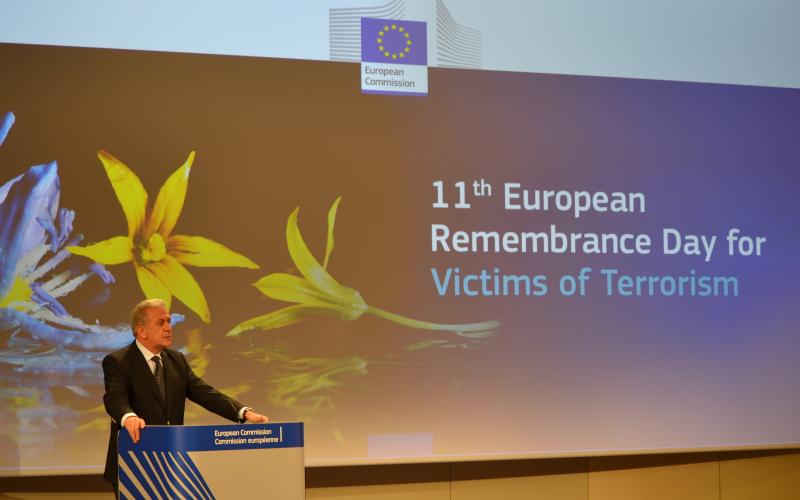
It is a privilege for me to be opening the 11th Commemoration for the Victims of Terrorism.
As many of you know, this event was initiated in the aftermath of the Madrid bombings in 2004, which killed 191 people and injured over 1,800. Unfortunately, since that horrific day 11 years ago, Europe has continued to suffer at the hands of terrorists.
So it is an honour to have with us so many representatives from organisations of victims of terrorism. I am deeply grateful to you all for taking the time to come here today, to show your support and to share your experiences. I know that many of you had to travel long distances and re-arrange your personal diaries in order to attend. For that I am most grateful.
In the last 11 years, Europe has experienced all too often the devastation inflicted by terrorism. In that time, Spain, Estonia, the UK, France, the Netherlands, Greece, Sweden, Germany, Italy, Norway, Bulgaria, Belgium and Denmark have all suffered at the hands of terrorists. At the start of this year two European capitals, Paris and Copenhagen, were targeted in the most ugly and barbaric acts of terrorism. Europeans have also been targeted by terrorists overseas, many of whom were risking their own lives to alleviate the suffering of others or to raise awareness back home. Only this weekend, one of our colleagues Ronny Piens, a Belgian, working as part of the EU delegation in Mali, was killed in an attack alongside three Malians and a French national in Bamako.
My participation in the peace rally in Paris, following the brutal attacks there, was a very moving experience. I walked alongside people from all nationalities, faiths and backgrounds. I was struck by the overwhelming sense of honour, dignity and compassion that compelled so many and from so far, to come together in a state of unity, standing up for democracy and freedom.
But the threat picture continues to be bleak. The Islamic State’s (IS) brazen proclamation of a caliphate has caught the imagination of some young Europeans. A large proportion of those who have travelled to the IS conflict zones are under the age of 25, some under 18. We are very concerned about the ease at which they can be radicalised and their ability to inflict violence both within the region and upon their return.
So, therefore, your stories, your suffering, are not, and must never be in vain. You have the ability to make powerful contributions in raising awareness about the devastation caused by terrorism. Your voices have an important role to play in making those individuals on the brink of violent extremism, think twice before they act.
Since becoming Commissioner, I have been quite impressed by the work of the ‘Voices of Victims of Terrorism’ from the Radicalization Awareness Network. In recent months, particular effort has been spent on working with the media to amplify and disseminate victims’ messages. The media is of course a powerful and influential tool and at a time of heightened interest in terrorism, we must take full advantage of it to promote your voices.
Tomorrow morning I will attend the Justice and Home Affairs Council with 28 Ministers of Interior and terrorism will once again be at the top of the agenda. Despite the menacing threat picture, I want to assure you that many efforts to counter terrorism are in progress. For example, exercises have been conducted and are ongoing at both national and EU levels to test our preparedness in potential attacks. We continue to enhance Europe’s security including at airports, critical infrastructure and public venues which attract mass gatherings. Member States are enhancing their legislation to prevent and disrupt terrorist travel and we are looking at how we can enhance the EU’s external borders to reduce the flow of terrorist travel and illegal weapons. We have revised our Radicalisation and Recruitment Strategy and guidelines have been produced to support the Member States. We are also in close contact with the internet industry to look at how we can address together online extremist propaganda.
Of course, much more can be done. And much more will be done in the framework of the new European Agenda on Security, which we are preparing to launch next month.
The safety and security of Europeans is a fundamental right – the European Union will always be on the front line to defend this right.
Thank you