
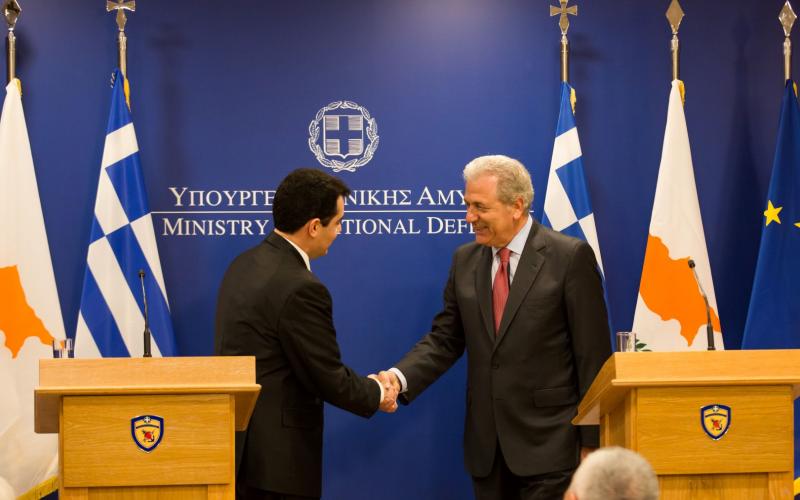
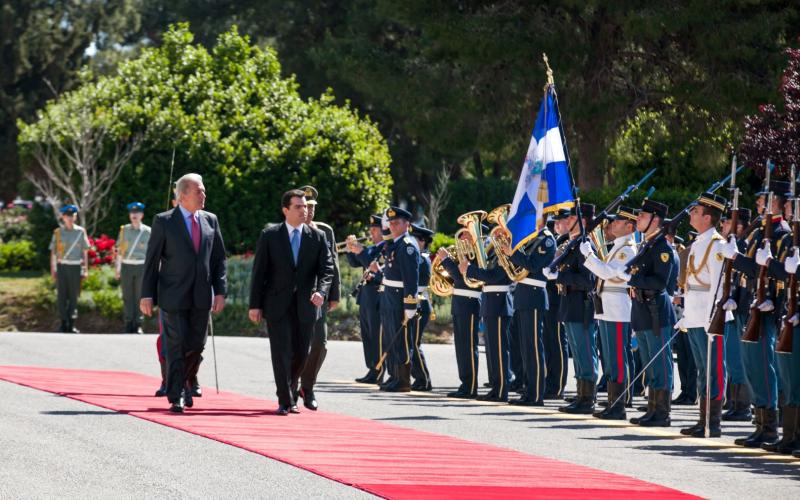
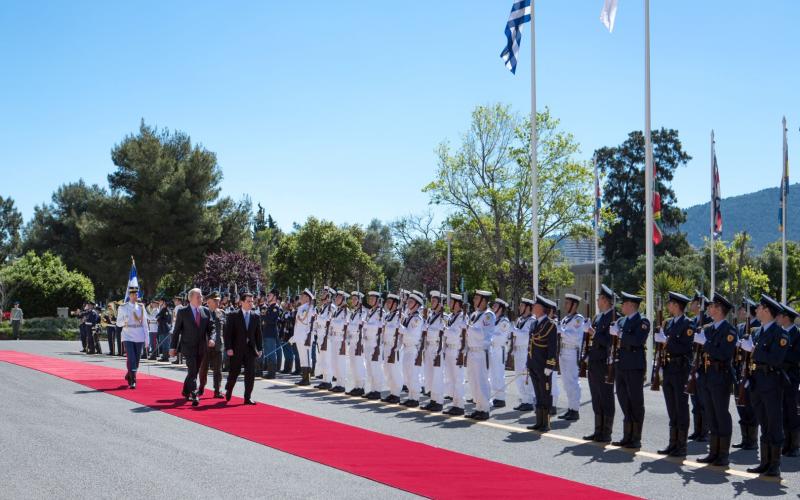
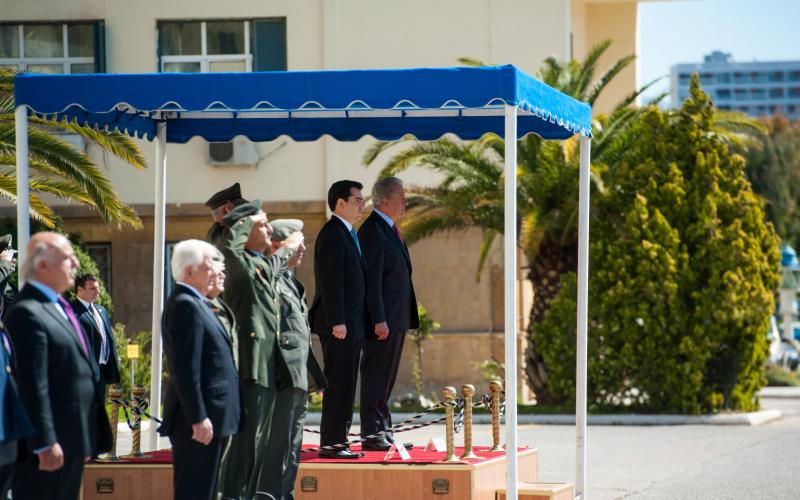
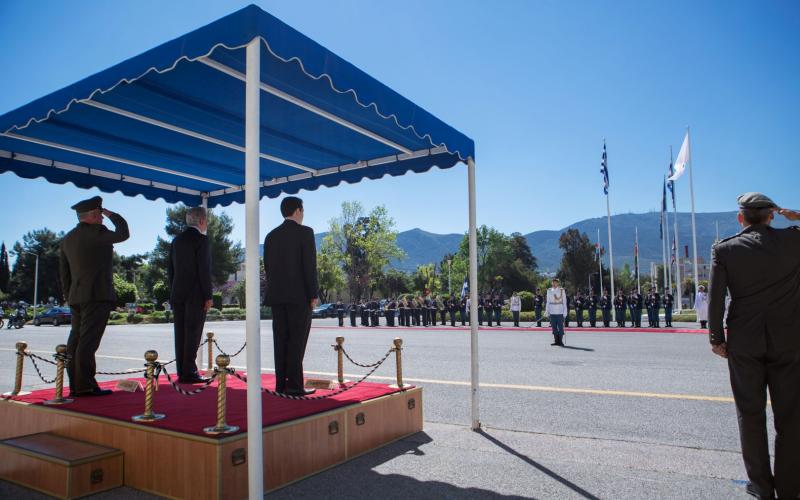
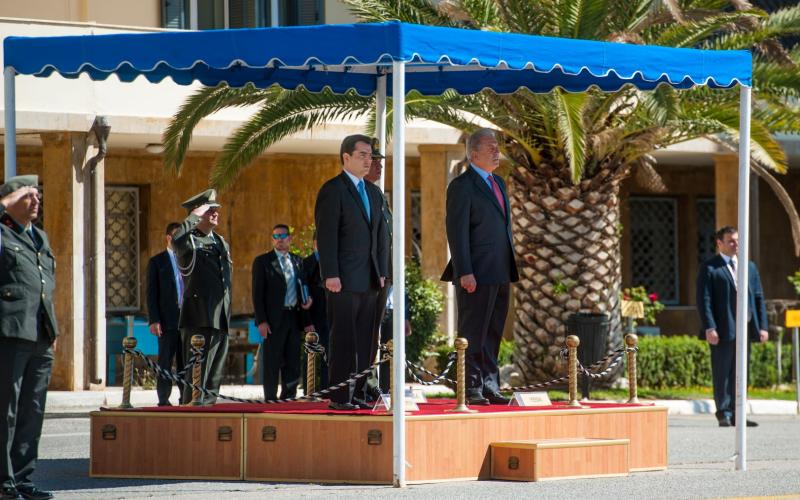
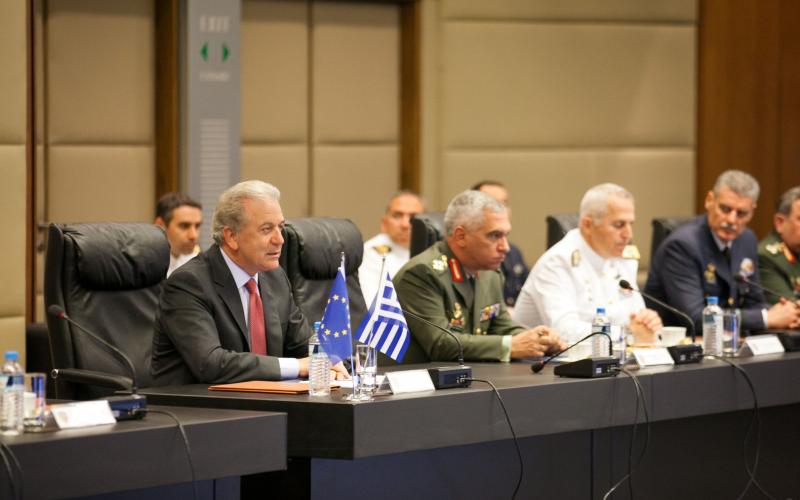
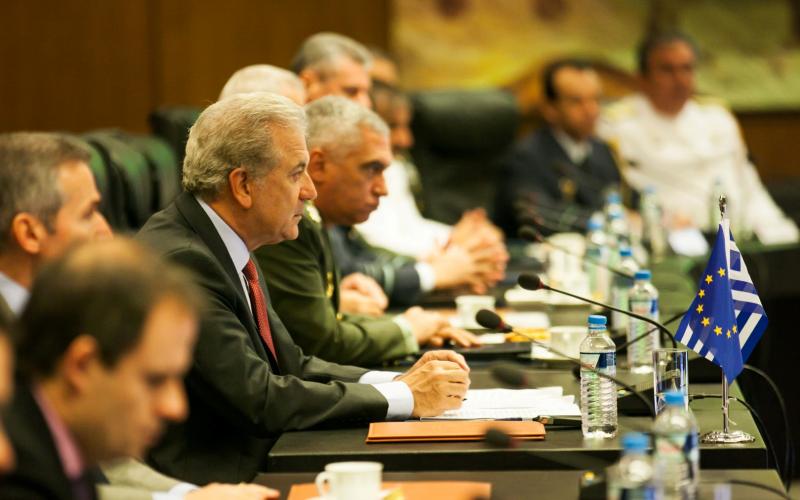
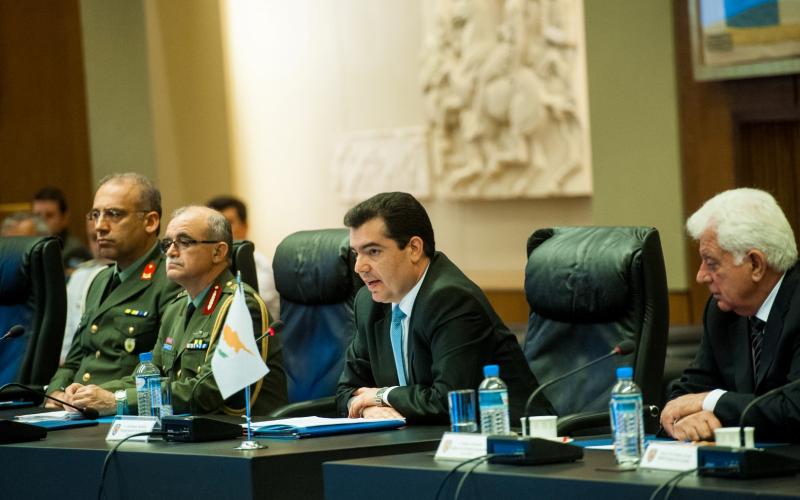
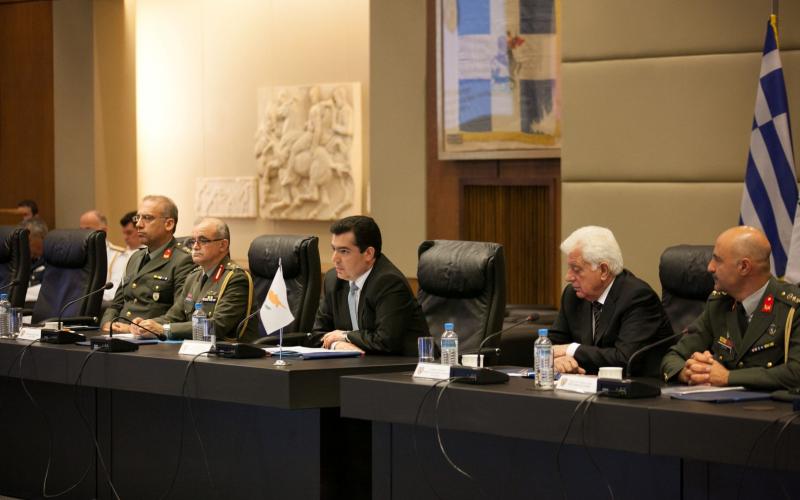
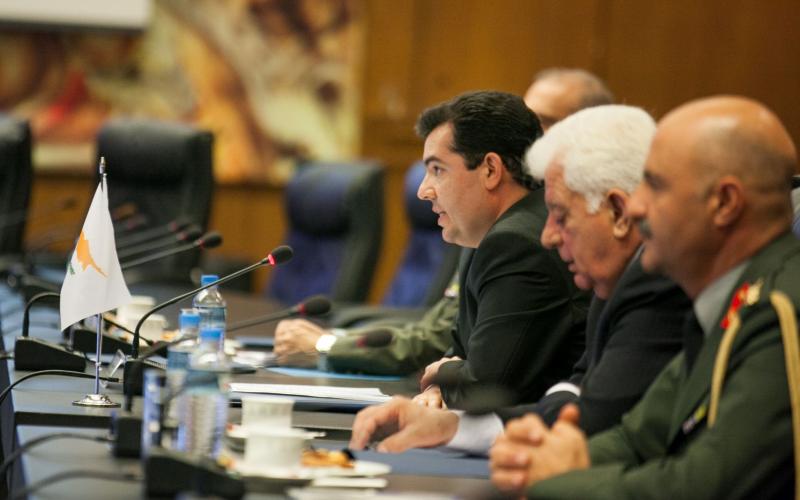
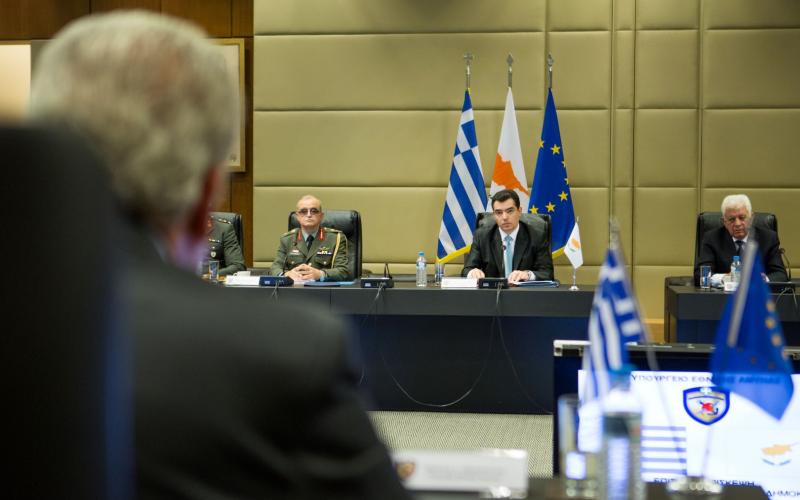
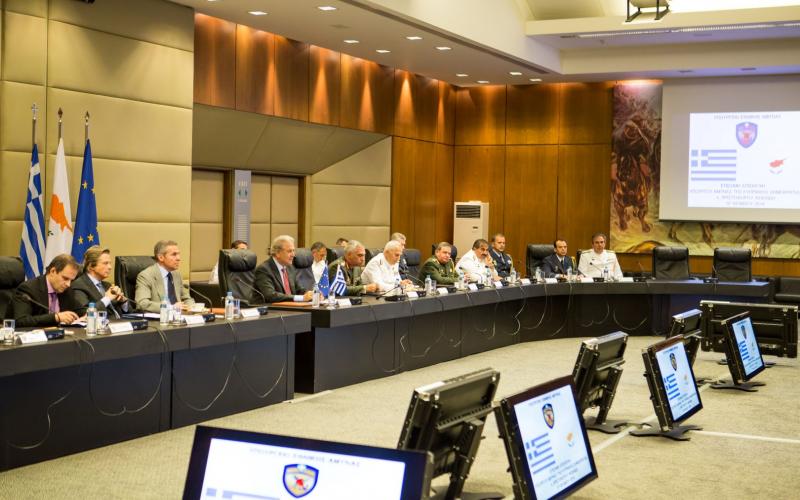
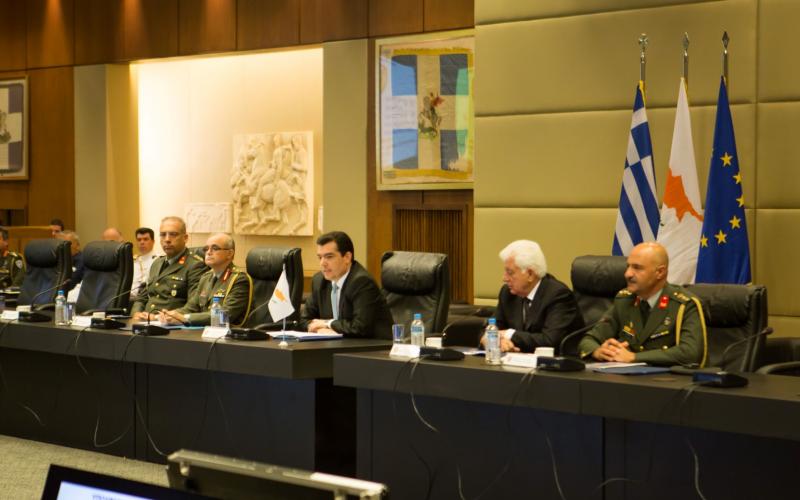
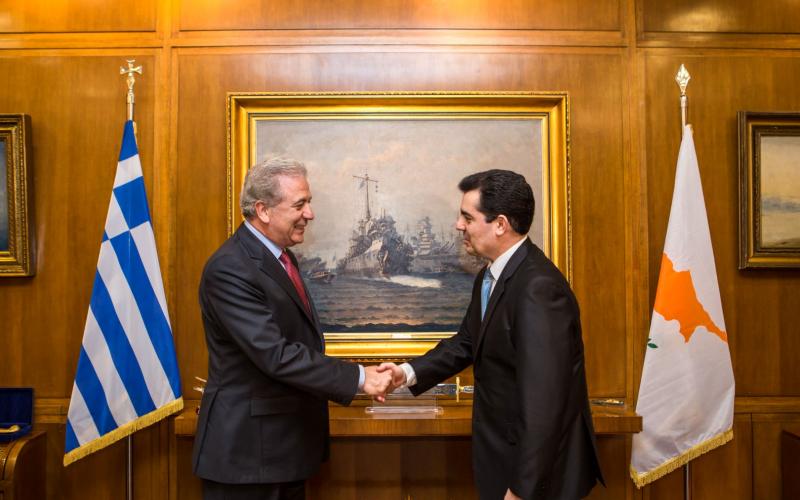
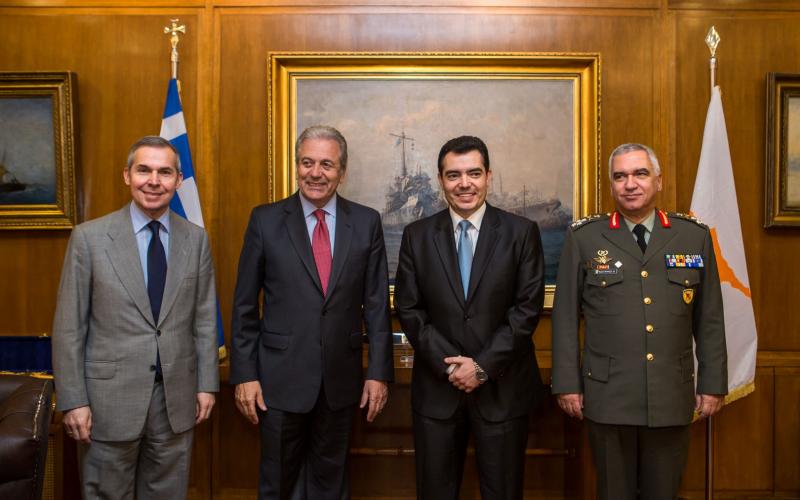
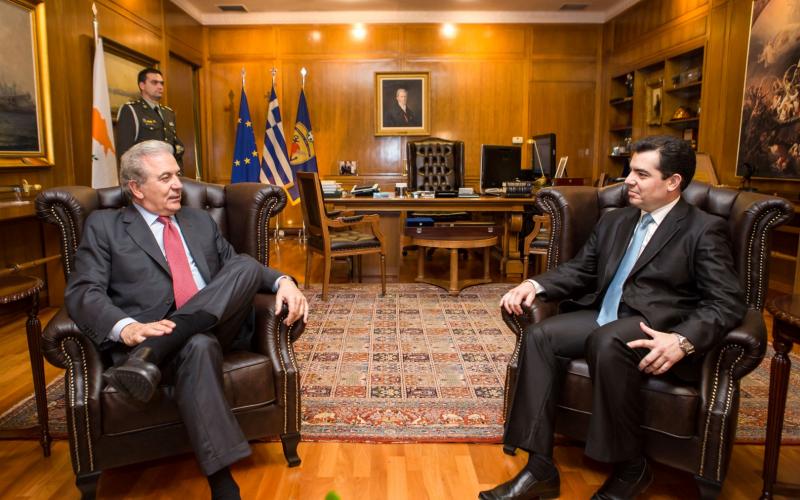
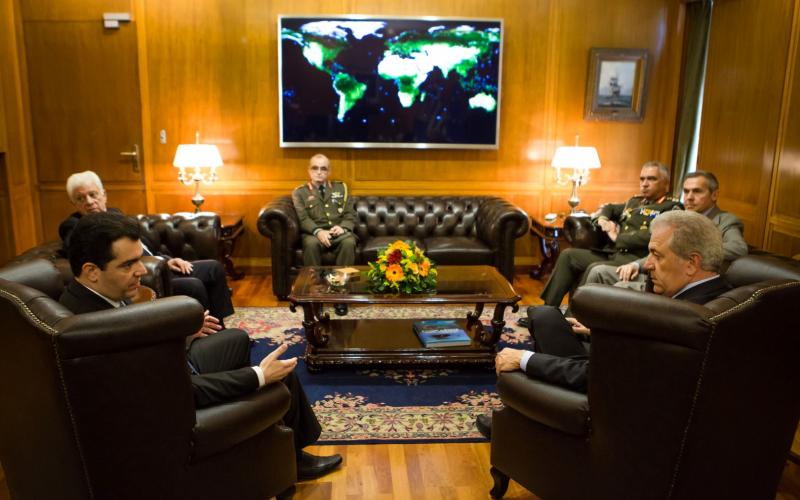
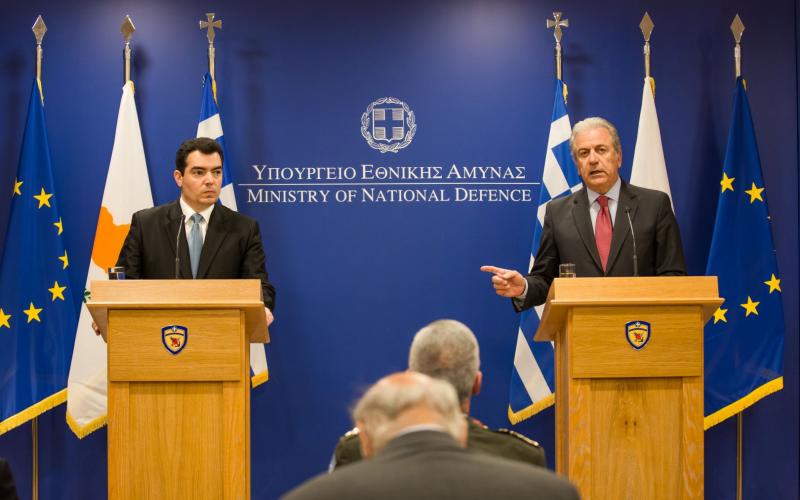
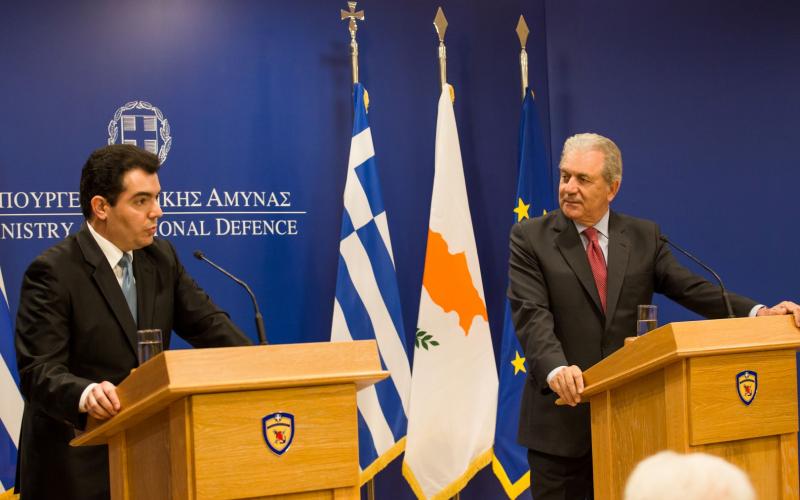
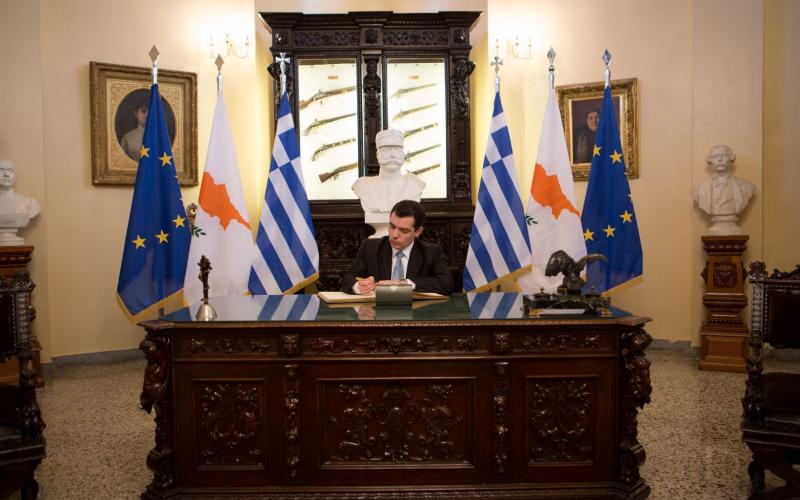
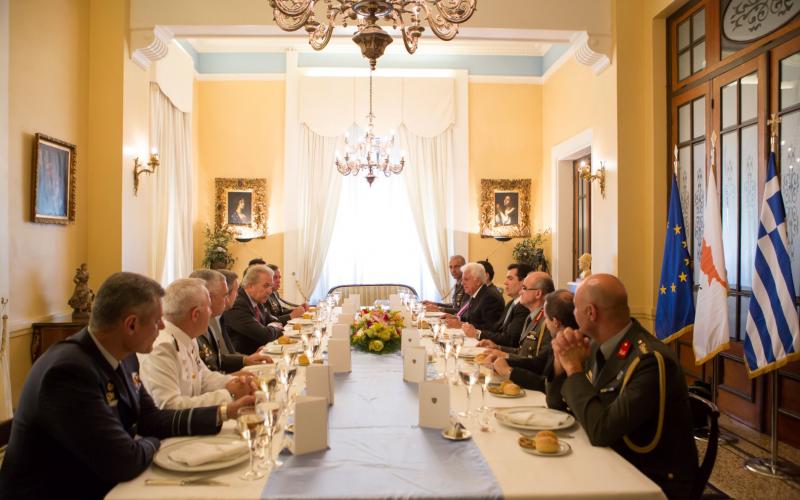
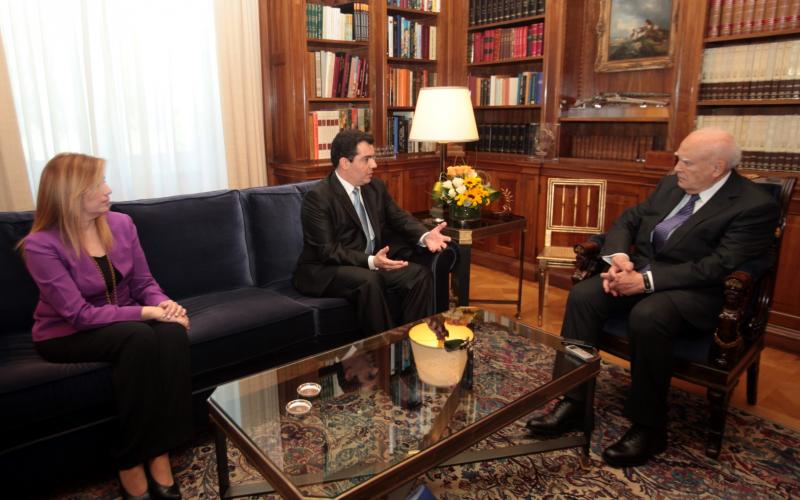
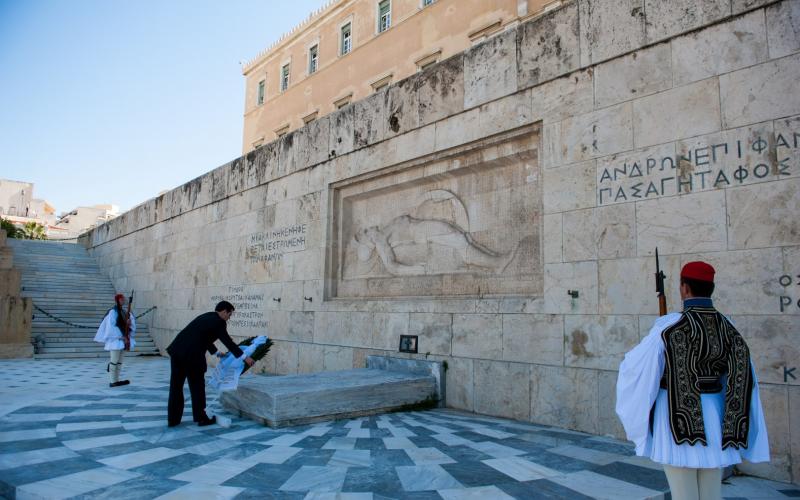
D. AVRAMOPOULOS: Today I had the special pleasure to welcome my counterpart and friend, Christoforos Fokaides, the new Defence Minister of the Republic of Cyprus who pays his first official visit abroad, here at the Ministry of National Defence.
With his presence here today, Mr. Fokaides confirms, above all, our common will that a constant consultation mechanism must exist between the two countries for the entire grid of issues, bilateral and international as well.
We discussed, at first, about our major national issue, as well as about the developments in the vulnerable region of the Eastern Mediterranean and also in the wider region around our countries, as well as about today’s challenges to security and defence on EU level, as well as in relation to the border of instability extending from Ukraine to Tunis. Greece and Cyprus are geographically located in the centre of the developments and due to their position, their strategy and their EU membership, they can play an important role.
Mr. Fokaides informed me on the latest developments of the Cypriot issue, on the course of the talks between the two communities, which as it is already known, are held on the basis of the joint declaration of 11 February.
The talks which the Cypriot government assumed to conduct under the guidance and instructions of President Anastasiades are – we must stress this – difficult and complicated.
It is clear that the solution, as it is therefore provided for by the joint declaration, must totally comply with the European acquis.
The political issue of Cyprus, as an issue of invasion and occupation, as an issue of an obvious and persistent violation of the International Law is an international issue and it is dealt with as such, under the auspices of UN Secretary General. It is an overt violation of the International Law.
The solution to the Cyprus issue is a top priority and a firm objective for Greece. Our country contributes with all its powers to the efforts taken by the Cypriot government to this direction.
Greek Cypriots and Turkish Cypriots have the responsibility to negotiate for the solution of the Cyprus issue, based upon the Resolutions of UN Security Council and on Cyprus’ status as a sovereign and full member-state of the United Nations and the European Union.
The Security Council resolutions call for a bi-communal, bi-zonal federation with political equality between the two communities, as set out in the resolutions, with a single sovereignty, a single international legal personality and a single citizenship.
It is a fair, sustainable and functional solution to the benefit of all Cypriot people, of all citizens of Cyprus, Greek Cypriots and Turkish Cypriots and it will decisively contribute to ensuring peace and stability in the wider region of Eastern Mediterranean.
We hope that Turkey will demonstrate the will to facilitate the negotiations for a total solution.
Moreover, Greece fully supports Cyprus in exercising its sovereign rights in its Exclusive Economic Zone.
This is what emanates from the International Law and the UN Convention on the Law of the Sea and it is recognised by the entire International Community, of course with the exception of Turkey. We are in full coordination and in close cooperation with the Republic of Cyprus on this issue.
In all my recent visits to important countries of the South-eastern Europe and Middle East I reiterated this firm position of our country, which is a player and leading actor in this issue.
As far as our bilateral defence agreement is concerned, this turns into a “Permanent, Stable and Upgraded Cooperation” as provided for by the Common Crisis Management Memorandum between Greece and Cyprus which will be signed soon, as we had the opportunity to decide with my colleague minister today. And things could not be different, if we think of the known strong and deep-rooted, national ties which connect us in the fields of security and defence.
Minister, Dear Christoforos,
I would like to thank you personally, as well as the Delegation that accompanies you for the very useful, substantial and constructive talks we had today.
I am convinced that continuing our regular meetings will contribute significantly to even better exchange of information and alignment of our efforts, so that our common goal will also bring the desired result.
My friend Minister,
I wish on this occasion, after thanking you again for your visit and wishing you the best of success in your new duties, to ask you to convey a message of love and solidarity to the Greek Cypriots and a confirmation that Greece remains the main supporter of Cyprus and a guarantor of its security, independence and its national sovereignty.
I ask you to have the floor.
C. FOKAIDES: First of all, Minister, I wish to thank you for your invitation and for today’s really cordial and warm hospitality.
I have to notice, as you already mentioned, that my presence here today as the first official visit after I took office as the new Minister of Defence has not only a substantial, but a symbolic significance as well, which demonstrates the unbreakable ties between Greece and Cyprus and confirms our countries’ common course.
In an era of significant geopolitical changes and new big challenges, Greece and Cyprus are key pillars for democratic stability, security and peace in South-eastern Europe.
Today, we had the opportunity to hold a sincere and very productive discussion during which we reviewed the whole spectrum of our bilateral relations.
In this context, as the Minister already mentioned, we will sign a memorandum of cooperation soon, a memorandum of crisis management between Greece and Cyprus. This is why I extended the Minister an invitation to visit Cyprus soon for its signature.
I must say that our cooperation remains close and permanent on EU level as well. Therefore, Minister, please allow me to congratulate again the Greek government for its very significant work of the Greek Presidency which led to very successful results so far.
I also had the opportunity to inform the Minister about the latest developments of the Cyprus issue after the recent resumption of the negotiations and, of course, to express again the determination of the Cypriot government, of the Greek Cypriot side, to work with sincerity and good will for a fair compromise which will end the biggest political, historical anachronism which still exists in Europe and in which part of the territory of an EU member-state is occupied by a country that wants to join the EU.
It is now upon the Turkish side, within the new round of negotiations which has begun, to take the opportunity and present constructive proposals on the negotiations. Proposals which comply with what it proclaims and declares.
We also discussed issues which regard the developments about the discovery and the potential utilisation of hydrocarbons within the Exclusive Economic Zone of Cyprus and in the wider region of the Eastern Mediterranean.
The strategic cooperations that we develop and implement with powerful countries of our region and with countries which have interests in the region do not only defend our exercising the sovereign rights according to the International Law and international conventions. They also serve our need for energy security, they promote Europe’s energy independence and they finally act as an accelerator to promote peace, regional cooperation and growth.
The prospect of hydrocarbons can and must be used as an opportunity and as a lever to solve the problems to everyone’s benefit. At least, this is the aim of our policy.
I would like, of course, at the same time to stress that we are as much determined to work for a solution, as we are determined to defend our sovereign rights in the context provided for by the International Law. Exercising these rights is recognised, as the Minister already mentioned, as much by our EU partners as by the international community in general.
At last, I wish once more, my dear friend, Minister, to express my grateful thanks to the Greek government, to our brothers, the Greek people and of course to you personally for the permanent and unselfish support to Cyprus.
Once more, I thank you for the hospitality, you and your officers.