
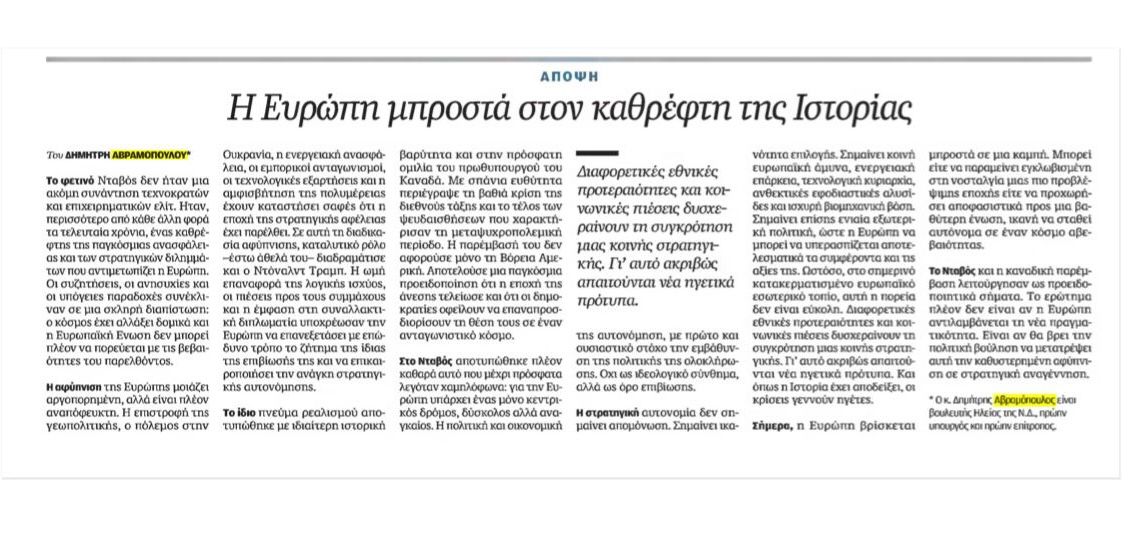
This year’s Davos was not just another gathering of technocrats and business elites. More than at any time in recent years, it served as a mirror of global insecurity and of the strategic dilemmas Europe faces. The debates, concerns, and unspoken assumptions converged on a hard conclusion: the world has changed structurally, and the European Union can no longer move forward with the certainties of the past.
Europe’s awakening may seem overdue, but it is now unavoidable. The return of geopolitics, the war in Ukraine, energy insecurity, trade rivalries, technological dependencies, and the erosion of multilateralism have made it clear that the era of strategic naivety is over. In this process of awakening, Donald Trump also played a catalytic role—albeit unintentionally. The blunt reassertion of power politics, the pressure on allies, and the emphasis on transactional diplomacy forced Europe to revisit—painfully—the question of its very survival and to renew the case for strategic autonomy.
The same spirit of realism was captured, with particular historical weight, in the Canadian Prime Minister’s recent speech. With rare candor, he described the deep crisis of the international order and the end of the illusions that defined the post–Cold War period. His intervention was not directed only at North America. It was a global warning that the era of comfort is over, and that democracies must redefine their place in a competitive world.
In Davos, what until recently was said in a low voice became unmistakably clear: for Europe there is only one central path—difficult, yet necessary. Political and economic autonomy, with the first and essential goal being deeper political integration. Not as an ideological slogan, but as a condition for survival.
Strategic autonomy does not mean isolation. It means the ability to choose. It means a common European defense, energy sufficiency, technological sovereignty, resilient supply chains, and a strong industrial base. It also means a unified foreign policy, so that Europe can effectively defend its interests and its values.
Yet in today’s fragmented European domestic landscape, this course is not easy. Divergent national priorities and social pressures hinder the formation of a common strategy. That is precisely why new models of leadership are required. And as history has shown, crises give birth to leaders.
Today, Europe stands at a turning point. It can either remain trapped in nostalgia for a more predictable era or move decisively toward a deeper union—one capable of standing on its own in a world of uncertainty.
Davos and the Canadian intervention served as warning signals. The question is no longer whether Europe understands the new reality. It is whether it will find the political will to turn this delayed awakening into a strategic renewal.