
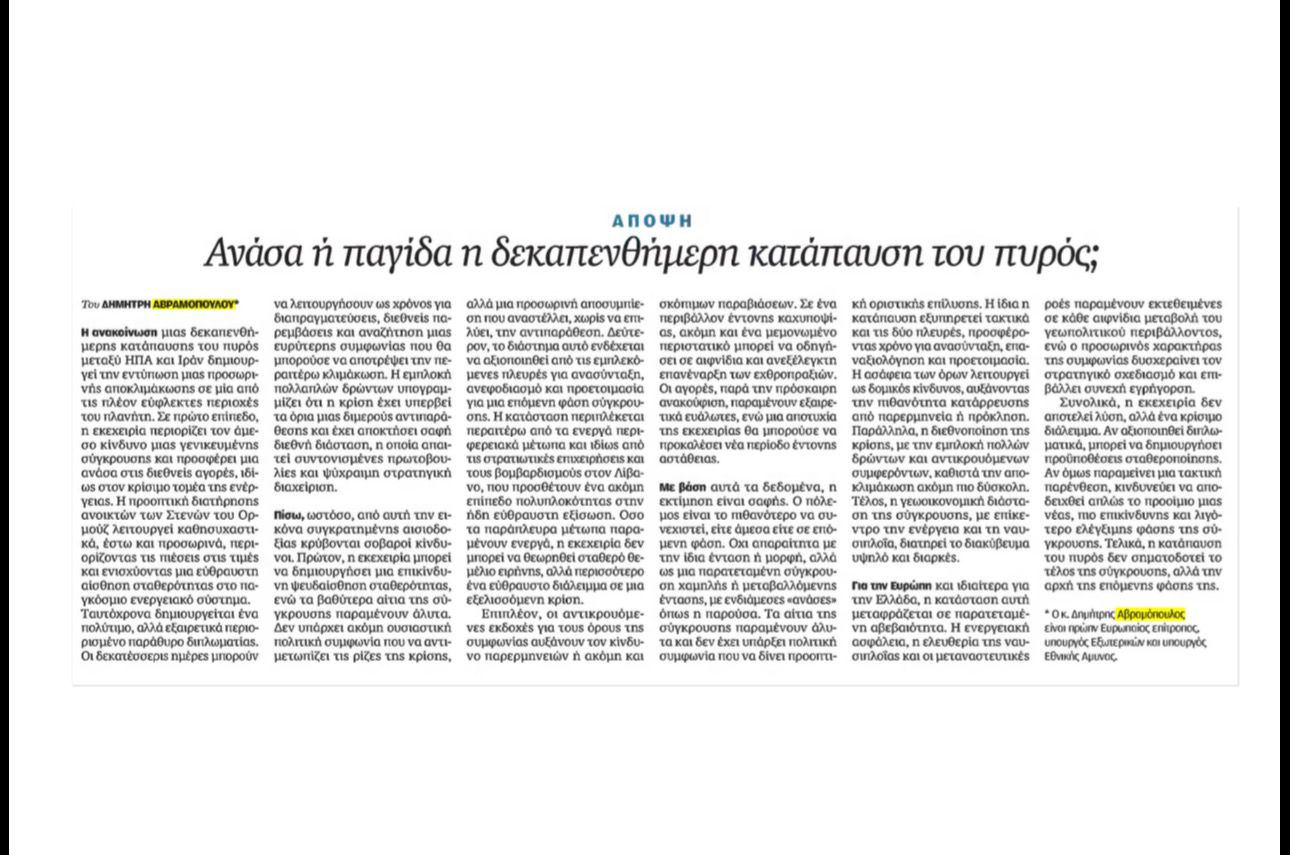
The announcement of a two-week ceasefire between the United States and Iran creates the impression of a temporary de-escalation in one of the most volatile regions of the planet. At first glance, the truce reduces the immediate risk of a full-scale conflict and offers some relief to international markets, especially in the critical energy sector. The prospect of keeping the Strait of Hormuz open has a reassuring effect, albeit temporarily, easing price pressures and reinforcing a fragile sense of stability in the global energy system.
At the same time, it creates a valuable, though extremely limited, diplomatic window. These two weeks may serve as time for negotiations, international intervention, and the pursuit of a broader agreement that could prevent further escalation. The involvement of multiple actors underscores the fact that the crisis has gone beyond the bounds of a bilateral confrontation and has acquired a clear international dimension, one that requires coordinated initiatives and calm, strategic management.
However, behind this image of restrained optimism lie serious risks. First, the ceasefire may create a dangerous illusion of stability while the deeper causes of the conflict remain unresolved. There is still no substantive political agreement addressing the roots of the crisis, only a temporary easing of tensions that suspends the confrontation without resolving it. Second, this interval may be used by the parties involved to regroup, resupply, and prepare for a new phase of conflict.
The situation is further complicated by active regional fronts, especially the military operations and bombardments in Lebanon, which add yet another layer of complexity to an already fragile equation. As long as these parallel fronts remain active, the ceasefire cannot be regarded as a stable foundation for peace, but rather as a fragile pause in an unfolding crisis.
Moreover, conflicting interpretations of the terms of the agreement increase the risk of misunderstandings or even deliberate violations. In an environment of deep mistrust, even a single incident could lead to a sudden and uncontrollable resumption of hostilities. Markets, despite their temporary relief, remain extremely vulnerable, while the failure of the ceasefire could trigger a new period of intense instability.
Based on these facts, the assessment is clear. The war is more likely than not to continue, either immediately or in a subsequent phase. Not necessarily with the same intensity or in the same form, but as a prolonged conflict of low or fluctuating intensity, punctuated by intermittent “breathing spaces” such as the present one. The causes of the conflict remain unresolved, and no political agreement has emerged that offers the prospect of a definitive settlement. The ceasefire itself serves the tactical interests of both sides, buying time for regrouping, reassessment, and preparation. The ambiguity of its terms functions as a structural risk, increasing the likelihood of collapse through misinterpretation or provocation. At the same time, the internationalization of the crisis, with the involvement of multiple actors and conflicting interests, makes de-escalation even more difficult. Finally, the geoeconomic dimension of the conflict, centered on energy and maritime navigation, keeps the stakes both high and enduring.
For Europe, and especially for Greece, this situation translates into prolonged uncertainty. Energy security, freedom of navigation, and migration flows remain exposed to every sudden shift in the geopolitical environment, while the temporary nature of the agreement makes strategic planning more difficult and imposes the need for constant vigilance.
Overall, the ceasefire is not a solution but a critical pause. If used diplomatically, it may create conditions for stabilization. But if it remains merely a tactical interlude, it risks proving to be nothing more than the prelude to a new, more dangerous, and less controllable phase of the conflict. Ultimately, the ceasefire does not mark the end of the conflict, but the beginning of its next phase.