
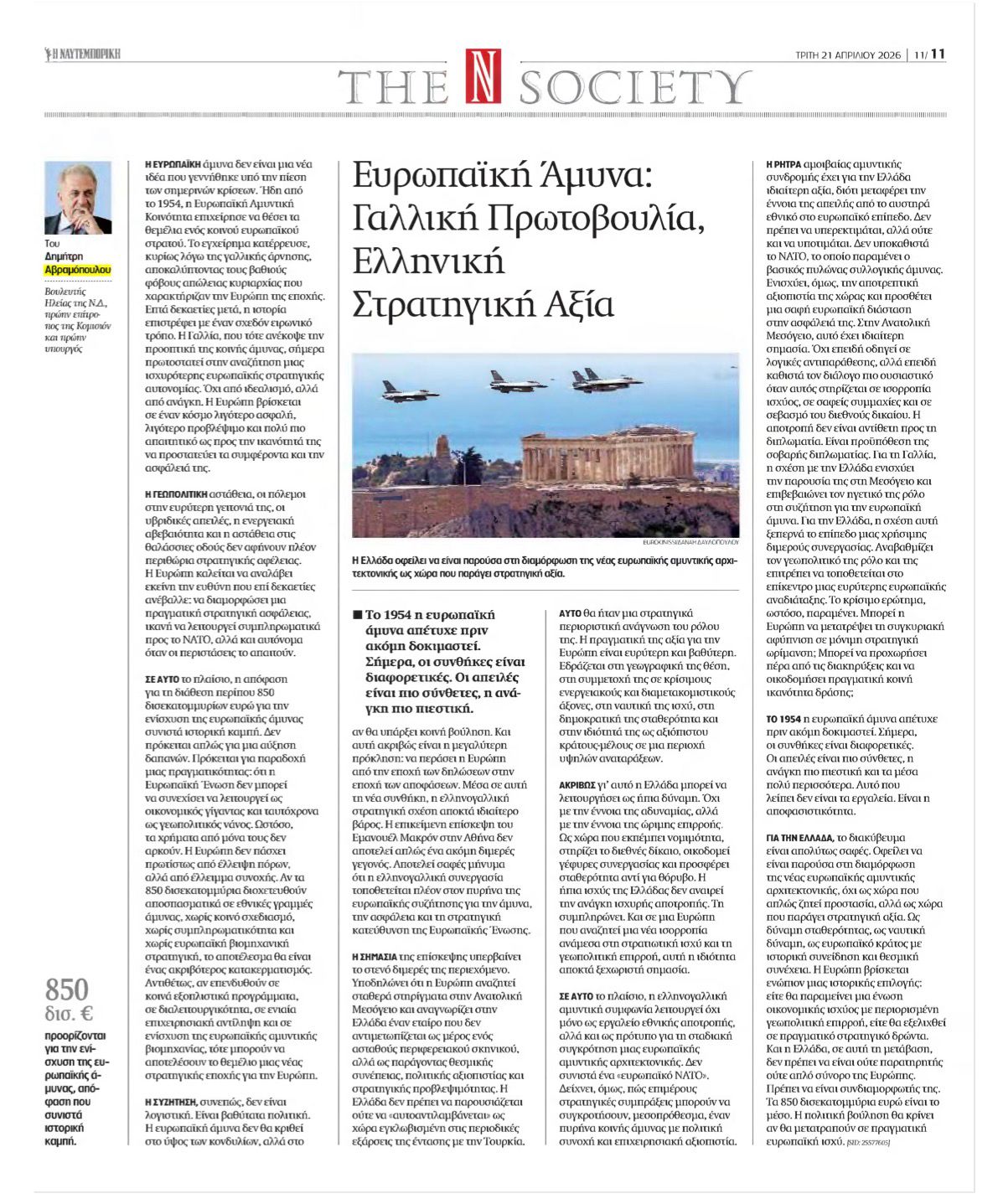
European defence is not a new idea born under the pressure of today’s crises. On the contrary, it has been a longstanding objective of European integration, one that resurfaces with varying intensity at every historical turning point.
As early as 1954, the European Defence Community attempted to lay the foundations for a common European army. The project collapsed, mainly because of French opposition, revealing the deep fears of sovereignty loss that characterised Europe at the time.
Seven decades later, history returns in an almost ironic way. France, which then halted the prospect of common defence, is now at the forefront of the search for a stronger European strategic autonomy. This shift is no coincidence. It reflects a deeper transformation in the international system, in which Europe is being called upon to redefine its role—not as a spectator to events, but as an actor endowed with strategic will and operational capability.
Today, Europe faces a complex security environment. The war in Ukraine, the conflicts in the Middle East, instability in North Africa, the intensification of great-power rivalry, and the re-emergence of power as a decisive factor in international politics all create a framework of heightened uncertainty. At the same time, hybrid threats, cybersecurity, the weaponisation of energy and migration flows are reshaping the very concept of security, which now extends beyond traditional military boundaries.
In this environment, the European Union can no longer continue to function exclusively as an economic union. Reality demands a transition towards a union with strategic substance as well. The concept of strategic autonomy does not imply a distancing from transatlantic relations; rather, it concerns strengthening Europe’s capacity to act. NATO remains the principal pillar of collective defence, but Europe must acquire the ability to act when circumstances require it.
The decision to allocate approximately €850 billion to strengthening European defence constitutes one of the most significant developments of recent decades. This is not merely an increase in defence spending. It is a tangible recognition that security comes at a cost and that Europe must be prepared to bear it. Yet the size of the funds alone does not guarantee success.
The crucial issue is how these resources are to be used. Europe has long been characterised by fragmentation in the field of defence. Multiple national programmes, different weapons systems, limited interoperability, and the absence of a common industrial strategy have created a system that is less efficient and more costly. If this new investment is not accompanied by meaningful integration, there is a risk that the same problems will simply be reproduced on a larger scale.
This is where the importance of the European defence industry becomes evident. Europe cannot remain dependent on external suppliers in critical areas of security. The development of domestic expertise, the strengthening of the production base, and investment in innovation are prerequisites for building genuine strategic autonomy. Defence is directly linked to the economy, technology, and competitiveness. This dimension becomes even more important in the context of international competition.
Europe cannot remain merely a consumer of security in a world where technological superiority determines power. Defence innovation—from unmanned systems to space applications and cyber defence—has now become a key field of strategic advantage.
The creation of economies of scale, the integration of the defence equipment market, and the strengthening of European value chains can turn defence into a driver of overall European power. In this way, investment in defence ceases to be merely an expense and becomes a strategic investment in Europe’s future.
The debate, therefore, is not technical. It is deeply political. The question is not how much Europe will spend, but whether it is willing to function as a unified strategic entity. And here lies the central challenge: overcoming national reservations in favour of a common European perspective.
Within this context, the Greek-French strategic relationship takes on particular importance. Emmanuel Macron’s forthcoming visit to Athens is not simply another bilateral event. It is an indication that this relationship is now embedded in a broader European framework, in which bilateral partnerships serve as catalysts for the shaping of common policies.
The significance of the visit goes beyond the bilateral level. It suggests that Europe is seeking reliable partners in critical geographical regions. The Eastern Mediterranean is one of them. In a region where energy interests, geopolitical tensions, and strategically important maritime routes intersect, Greece is emerging as a factor of stability.
Greece should neither present itself nor perceive itself as a country trapped in the periodic flare-ups of tension with Turkey. Such an interpretation would strategically diminish its role and confine it to a defensive narrative.
The emphasis, therefore, should not be on confrontation, but on a shift in perspective: from managing a problem to highlighting Greece’s strategic role as a factor of stability, consistency, and institutional reliability in the Eastern Mediterranean.
Greece’s true value to Europe is broader and deeper. It lies in its geographical position, its participation in critical energy and transit corridors, its naval strength, its democratic stability, and its status as a reliable member state in a highly volatile region.
Precisely for this reason, Greece can act as a soft power. Not in the sense of weakness, but in the sense of mature influence: as a country that projects legitimacy, upholds international law, builds bridges of cooperation, and offers stability instead of noise. Soft power does not negate the need for deterrence. It complements it and gives it greater depth and credibility.
Within this framework, the Greek-French defence agreement functions not only as a tool of national deterrence, but also as a model for the gradual construction of a European defence architecture. It does not amount to a European NATO. It does, however, show how individual strategic partnerships can form the nucleus of a common defence with political coherence and operational credibility.
In the same spirit, this agreement should not be interpreted as being directed against Turkey. Such an approach would be politically simplistic and strategically flawed. It was not established to fuel confrontational thinking, but to strengthen deterrent credibility, consolidate a framework of security, and highlight a model of cooperation based on stability, respect for international law, and the balance of power.
The mutual defence assistance clause strengthens Greece’s deterrent power while at the same time giving the concept of security a European dimension. It does not replace NATO, but functions complementarily, reinforcing Europe’s multilayered security architecture.
In the Eastern Mediterranean, this is of particular importance. The balance of power is a prerequisite for meaningful dialogue. Deterrence does not run counter to diplomacy. It makes diplomacy more effective and more credible. In an environment where challenges are complex, the existence of clear alliances and stable rules acts as a factor in preventing instability.
For France, cooperation with Greece strengthens its presence in the Mediterranean and confirms its role as a key player in the debate on European defence. For Greece, this relationship serves as a lever for enhancing its geopolitical role and strengthening its international presence.
The critical question, however, remains: can Europe turn this moment of mobilisation into a permanent strategic choice? History shows that crises often act as catalysts for change, but maintaining momentum requires political will and consistency.
Today, conditions are different from those of 1954. The threats are more complex, the need for cooperation more urgent, and the available means far greater. What remains a challenge is political integration in the field of defence.
For Greece, this moment represents both an opportunity and a responsibility. It must be an active participant in shaping European defence policy—not as a country seeking protection, but as a country that helps shape policy and generates strategic value.
Europe stands before a historic choice: either it will remain a union of economic power with limited geopolitical influence, or it will evolve into a genuine strategic actor. This evolution is not predetermined. It will depend on the decisions taken today.
The €850 billion constitute an important instrument. They are not, however, the objective. The objective is to create a Europe that can protect its interests, safeguard its security, and play an active role in the international system.
Political will shall determine whether this opportunity is transformed into genuine European power.