
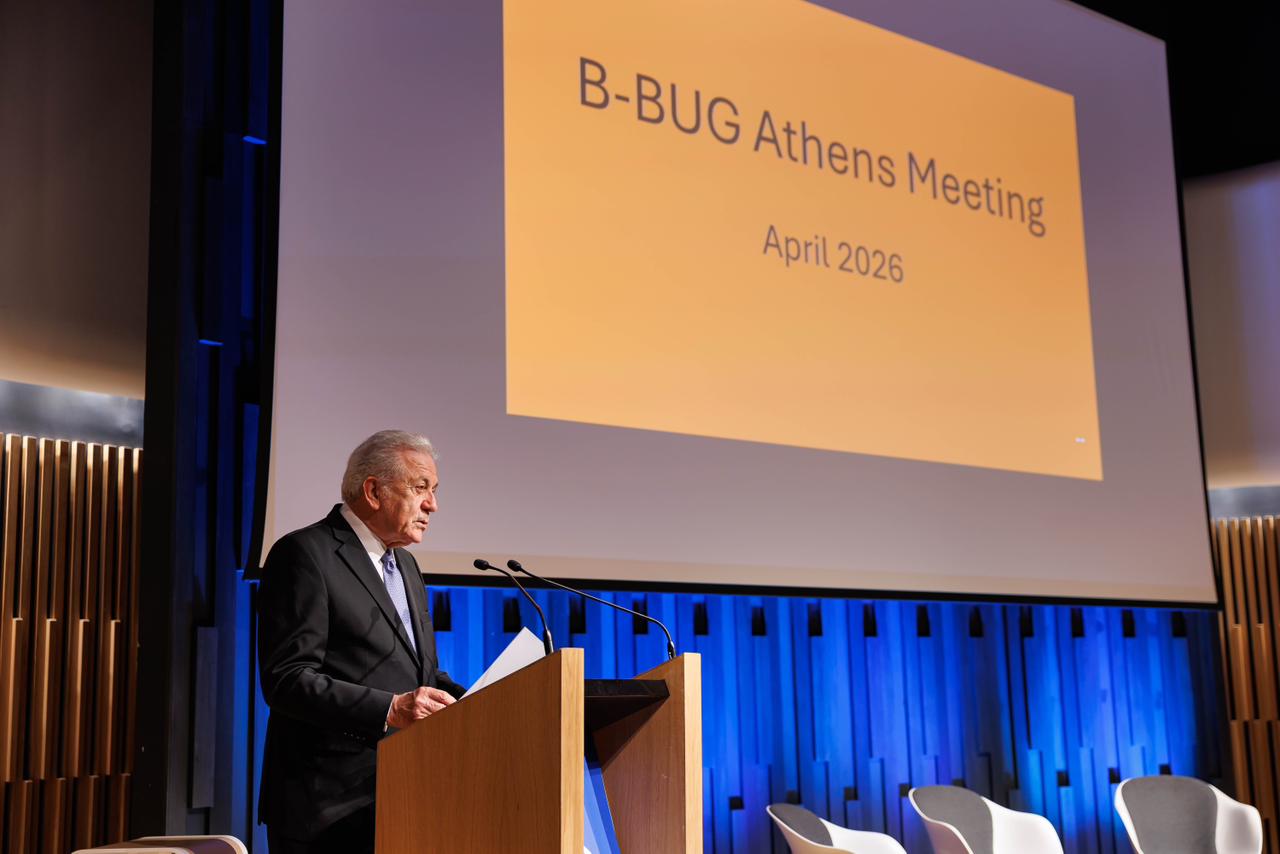
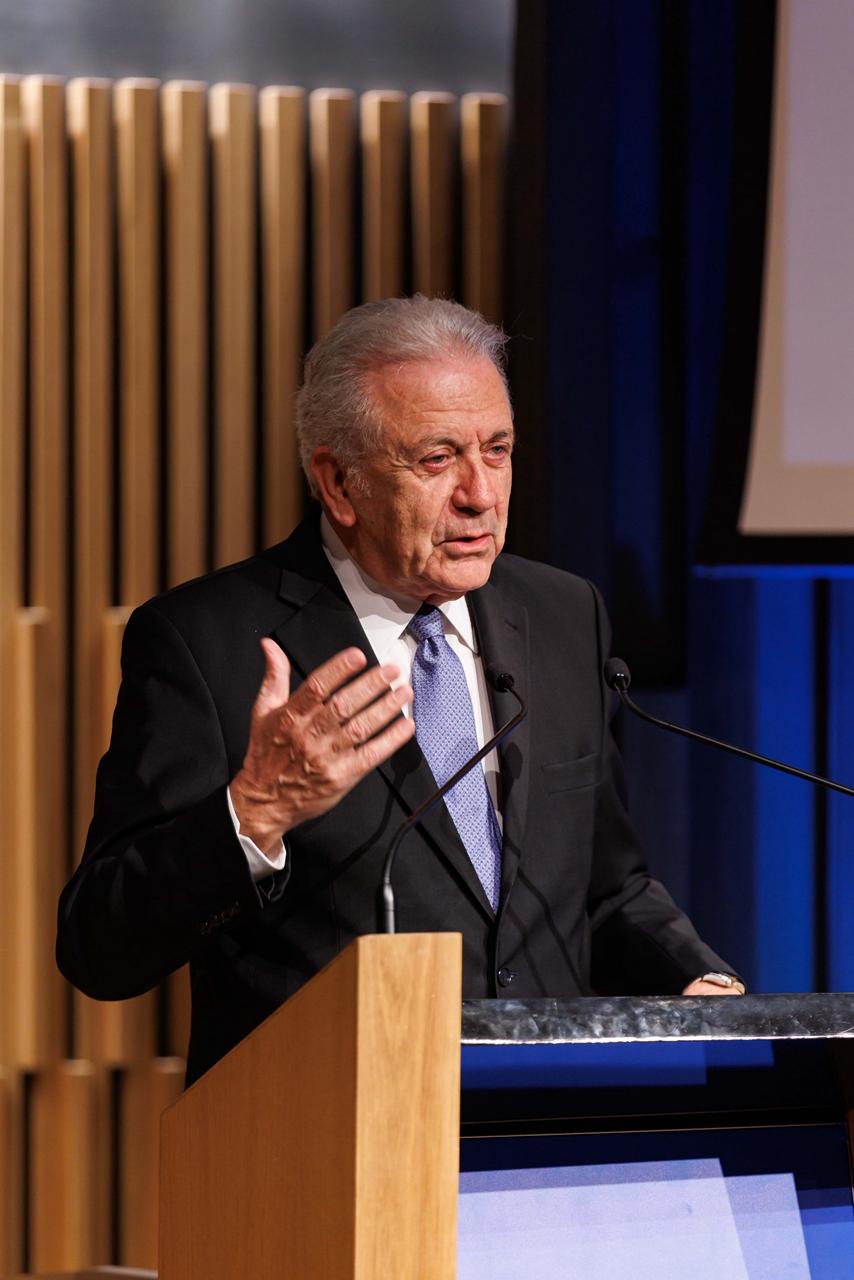
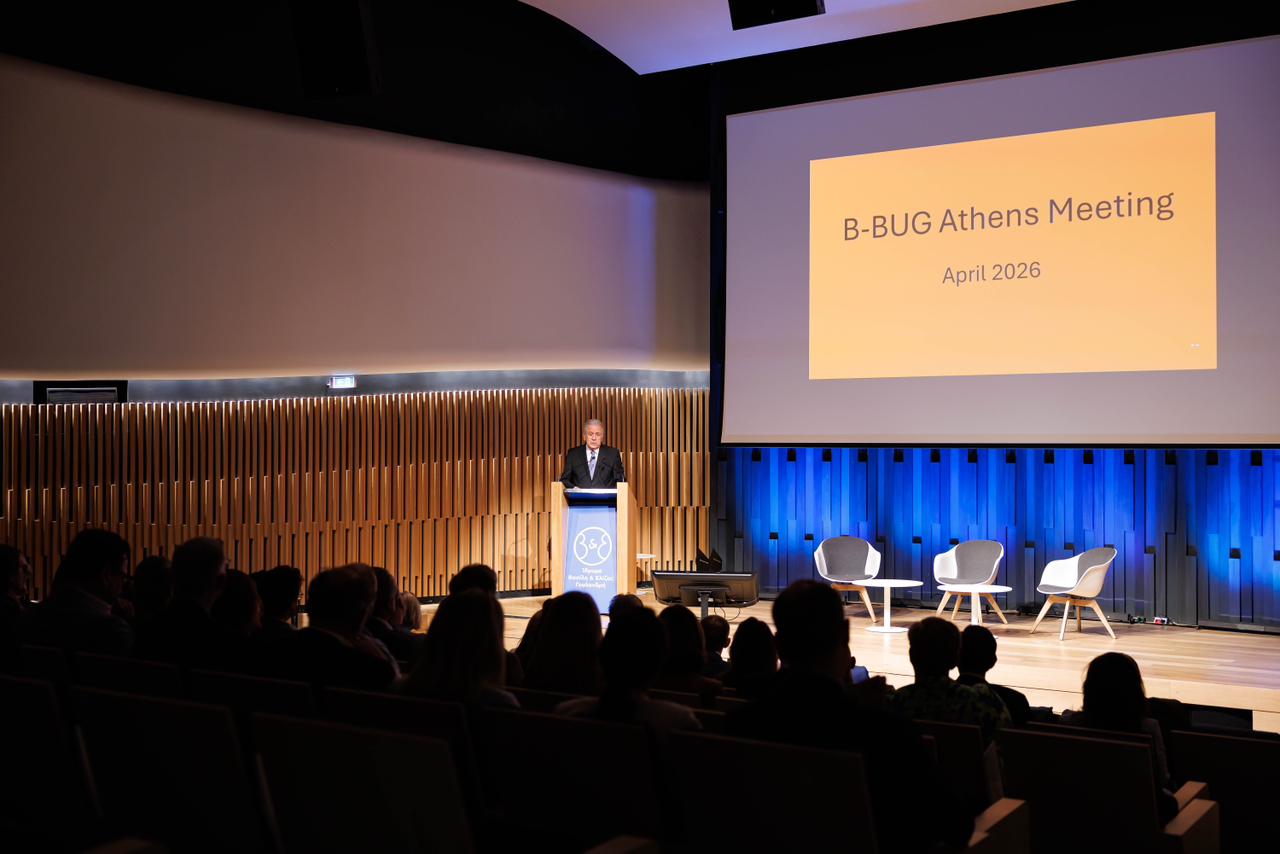
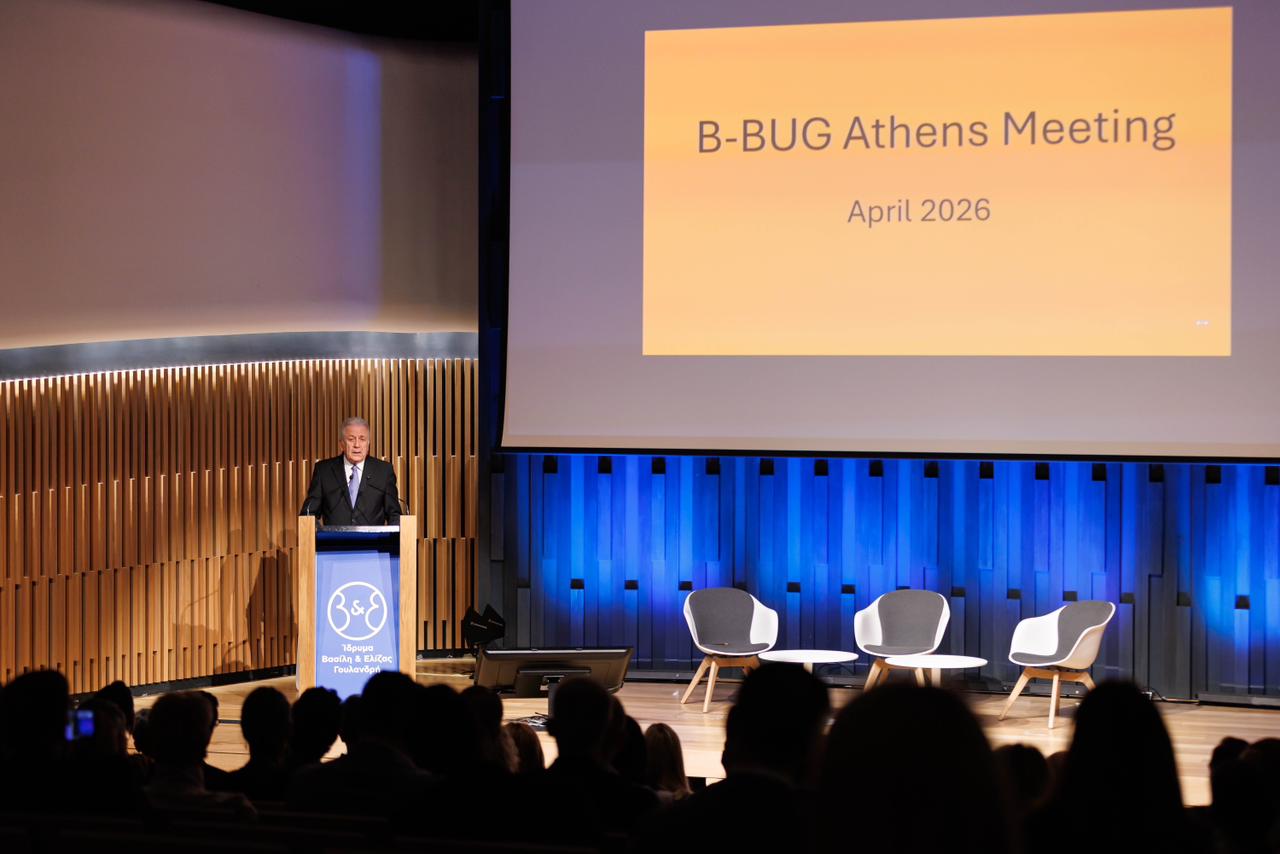
Ladies and Gentlemen,
I understand you want to learn more about this part of the world, which is part also of your life since now we all belong to the European Union.
Let’s hope that the European Union will continue to exist, although we can also talk about it, given my experience later on.
It is crossing existential moments.
The topic that we have chosen has to do with our neighborhood, with Mediterranean sea.
You know, six, seven years ago, the interest of the world was turned towards Asia.
Now it comes back to our neighborhood because of what is happening in the Mediterranean.
And as I said before, to share with you some of my thoughts, given my experience over the Mediterranean, brings me to the core of my presentation, which is the role of our country, Greece, in the Mediterranean.
It is not a new role.
Greece was always connected to the Mediterranean.
Wherever you travel around the Mediterranean, you see the remains of the Greek presence, because Greece was not what you know today.
It was something larger.
Since it is a closed meeting, I can share with you what I believe.
Greece became small from the moment it became a state.
And you know what I mean.
Wherever you travel in the Mediterranean, you see their cities bearing Greek names.
The same in the Black Sea, everywhere, and, of course, in Southeastern Europe.
It’s a pride for us to be part of the history of the Mediterranean.
But the Mediterranean is not merely a geographical space.
It is a living crossroads of civilizations, a strategy artery of global trade, and a region where history and geopolitics constantly interact.
Today, however, it is also a region under huge pressure, from the instability in the Middle East and North Africa to energy insecurity, migration flows, and renewed great power antagonism, competition.
Our region, the Mediterranean, is once again at the center of global attention.
In such a content, Greece is not a passive observer.
It cannot be.
It is a stabilizing force, besides its size, because Greece’s role is defined by what we call soft power.
Our geography places us at the intersection of three continents, and our history, as I said before, gives us depth and perspective.
And our membership in the European Union and NATO provides us with both responsibility and leverage.
Greece today acts as a bridge between Europe and the Middle East, between North and South, between tradition and modernity.
But let me be clear.
A bridge is not a neutral ground, as some believe.
It is an active connector, a facilitator of dialogue, and a garant of continuity.
This is precisely the role Greece seeks to play, first in the field of security.
Security in the Mediterranean cannot longer be defined solely in military terms.
It includes energy security—and you, in Germany, you know what do I mean when I talk about energy—maritime safety, cyber resilience, and the protection of critical infrastructure.
Greece contributes actively to all these dimensions.
From safeguarding safe sea lines, key sea lines, to participating in international missions, to strengthening regional defense cooperation.
Our country is a pillar of stability.
At the same time, we remain firmly committed to international law, especially the United Nations Convention on the Law of the Sea, as the only solid foundation for peaceful coexistence in our region.
Second, in the field of energy, the Eastern Mediterranean is emerging as a critical energy hub.
At a time when Europe seeks diversification and resilience, Greece plays a central role as a gateway and a connector through infrastructure projects, interconnectors, and LNG capacity.
We are helping to reshape the regional energy map.
But beyond infrastructure, Greece advocates for a broader vision:
Energy cooperation as a tool for peace, because shared interests can build shared stability.
Third, I referred to that in the beginning, in the area in the field of migration.
Migration is not only a humanitarian issue.
It is also a geopolitical one.
Greece stands at the front line of migratory progressions from the very beginning, since 2015, as I said before.
Yet it approaches this challenge with responsibility and realism.
We protect our borders while upholding our international obligations.
We call for a truly European response based on solidarity, fair burden sharing, and cooperation with countries of origin and transit.
Fourth, in the field of diplomacy, Greece maintains open channels for communication with all actors in the region.
We invest in trilateral and multilateral partnerships.
We support dialogue, even when it is difficult.
And we believe that diplomacy is not a sign of weakness, but a strategic maturity.
In a divided and fragmented world, the ability to speak with all sides is a strategic asset.
My dear friends, the Mediterranean has always been a mirror of the international system from the very beginning of history.
When cooperation prevails, it flourishes.
When tensions rise, it becomes a fault line.
Today, we are at such a crossroads.
Greece’s answer is clear:
More cooperation, better understanding, mutual respect, more dialogue, more respect for international law, not because it is easy, but because it is a necessity.
Our role is not to dominate, but to connect.
Not to escalate, but to stabilize.
Not to divide, but to bring closer.
And this is our priority right now in the area where countries and interests are in conflict.
This is not only a national strategy.
It is a European responsibility, because in this way, Europe is connected with the basic principles upon which it was built especially after the Second World War.
Because the future of Europe is inseparable from the future of all of us and of the Mediterranean.
And in that future, Greece will continue to stand as a reliable partner, a credible interlocutor, and a force of stability.
With these thoughts, I try to portray the role of Greece in the region:
A country that was always at the crossroads of cultural civilizations and in the middle of big conflicts.
As I said in the beginning, the Mediterranean is coming back on the international scene.
It has to be transformed to an area, a wider area of cooperation and stability.
But under the pressure of the current developments in the region, it’s becoming, again, one of the most complicated parts and neighborhoods of the world.
So we are here, as part of stability, believing that finally we shall get out of this stalemate.
You see what’s happening in the Middle East, in Northern Africa.
There’s a whole region.
We are all neighbors of Europe and part of the Mediterranean, parts of our larger neighborhood.
So I welcome you again to Athens, in my capacity as mayor of Athens, although it’s the approximate 25 years here have elapsed since then.
Thank you for your attention.