
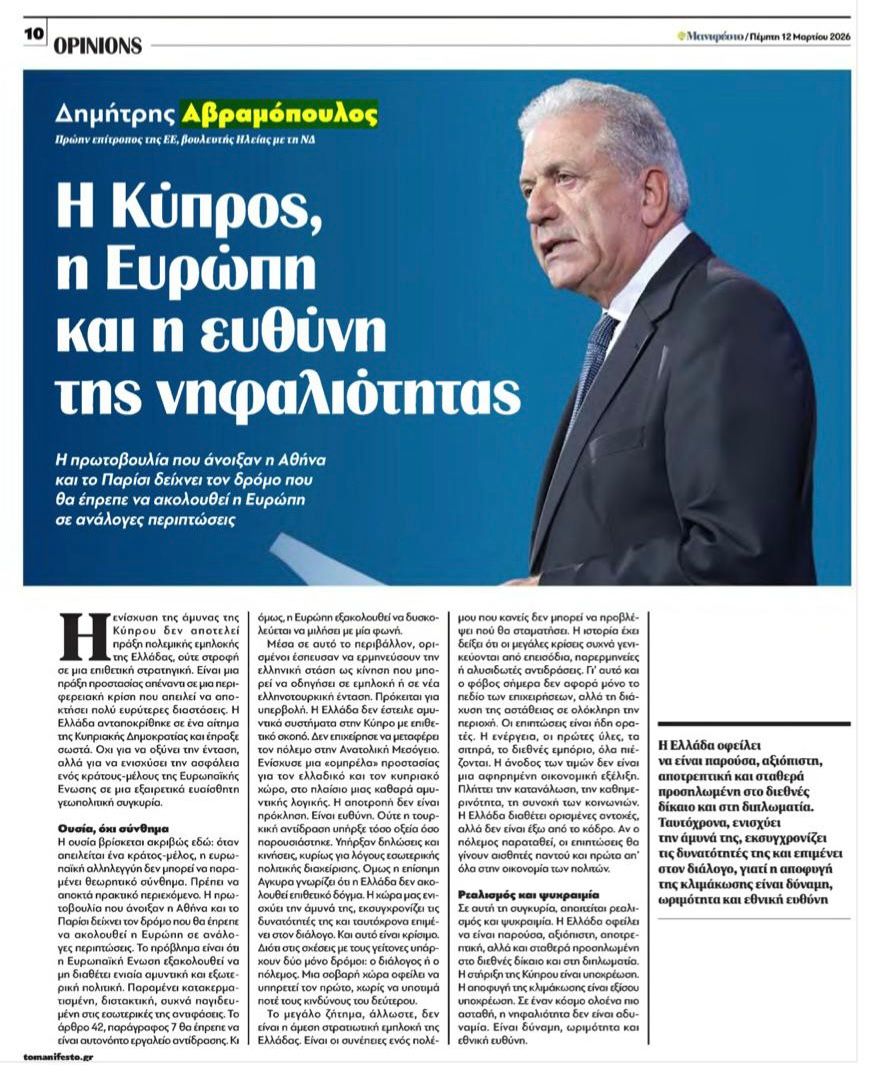
The strengthening of Cyprus’s defense does not constitute an act of Greece’s military involvement, nor a shift toward an aggressive strategy. It is an act of protection in response to a regional crisis that threatens to acquire much broader dimensions.
Greece responded to a request from the Republic of Cyprus and acted correctly. Not in order to intensify tensions, but to reinforce the security of a member state of the European Union at an exceptionally sensitive geopolitical moment.
The essence lies precisely here: when a member state is threatened, European solidarity cannot remain a theoretical slogan. It must acquire practical substance. The initiative undertaken by Athens and Paris points to the path that Europe should follow in similar circumstances.
The problem is that the European Union still lacks a unified defense and foreign policy. It remains fragmented, hesitant, and often trapped in its internal contradictions. Article 42, paragraph 7 should be a self-evident instrument of response. Yet Europe continues to struggle to speak with a single voice.
A “Protective Umbrella”
Within this environment, some were quick to interpret Greece’s stance as a move that could lead to involvement or to a new escalation in Greek–Turkish tensions. This is an exaggeration. Greece did not send defensive systems to Cyprus with an offensive purpose. Nor did it attempt to transfer the war to the Eastern Mediterranean. It reinforced a “protective umbrella” for both the Greek and Cypriot spaces, within the framework of a purely defensive logic. Deterrence is not provocation. It is responsibility.
Nor was the Turkish reaction as sharp as it was presented. There were statements and moves, mainly for reasons of domestic political management. However, the official authorities in Ankara know that Greece does not follow an offensive doctrine. Our country strengthens its defense, modernizes its capabilities, and at the same time insists on dialogue. And this is crucial. Because in relations with neighbors there are only two paths: dialogue or war. A serious country must serve the first, without ever underestimating the risks of the second.
The major issue, moreover, is not Greece’s immediate military involvement. It is the consequences of a war that no one can predict where it will stop. History has shown that major crises often escalate from incidents, misinterpretations, or chain reactions. That is why the fear today does not concern only the battlefield, but the spread of instability across the entire region.
The consequences are already visible. Energy, raw materials, grain, and international trade are all under pressure. Rising prices are not an abstract economic development. They affect consumption, everyday life, and the cohesion of societies. Greece has certain levels of resilience, but it is not outside the frame. If the war is prolonged, the effects will be felt everywhere, and above all in the citizens’ economy.
Realism and Composure
In this context, realism and composure are required. Greece must remain present, credible, and capable of deterrence, while also remaining firmly committed to international law and diplomacy. Supporting Cyprus is an obligation. Avoiding escalation is equally an obligation. In a world that is becoming increasingly unstable, sobriety is not weakness. It is strength, maturity, and national responsibility.