
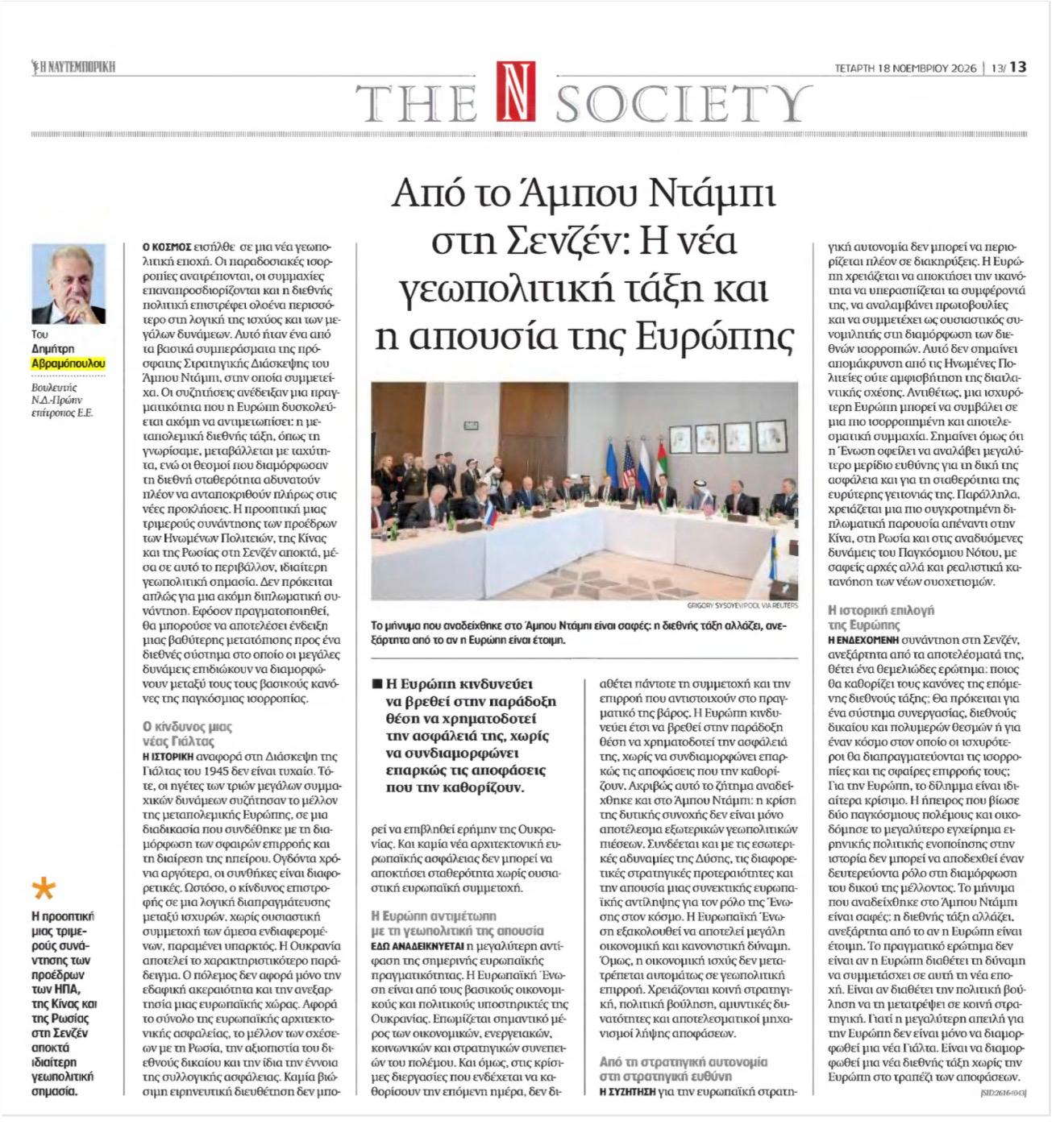
The world has entered a new geopolitical era. Traditional balances are being overturned, alliances are being redefined, and international politics is increasingly reverting to a logic shaped by power and great-power competition. This was one of the key conclusions of the recent Abu Dhabi Strategic Conference, which I had the opportunity to attend.
The discussions highlighted a reality that Europe is still struggling to confront: the post-war international order, as we have known it, is changing rapidly, while the institutions that once underpinned international stability are no longer fully equipped to respond to the challenges of the new era.
Against this backdrop, the prospect of a trilateral meeting between the Presidents of the United States, China and Russia in Shenzhen takes on particular geopolitical significance.
This would be more than just another diplomatic meeting. Should it take place, it could signal a deeper shift towards an international system in which the major powers seek to establish among themselves the fundamental rules governing the global balance of power.
The Risk of a New Yalta
The historical reference to the 1945 Yalta Conference is no coincidence. At the time, the leaders of the three major Allied powers discussed the future of post-war Europe, in a process that became closely associated with the establishment of spheres of influence and the division of the continent.
Eighty years later, circumstances are different. Nevertheless, the risk of a return to a system in which powerful states negotiate among themselves, without the meaningful participation of those directly concerned, remains real.
Ukraine is the clearest example. The war is not merely a matter of the territorial integrity and independence of a European country. It concerns the entire European security architecture, the future of relations with Russia, the credibility of international law and the very concept of collective security.
No sustainable peace settlement can be imposed without Ukraine’s participation. Nor can any new European security architecture achieve lasting stability without meaningful European involvement.
Europe Confronts Its Geopolitical Absence
This is where the greatest contradiction in Europe’s current predicament becomes apparent. The European Union is among Ukraine’s principal economic and political supporters. It bears a substantial share of the economic, energy-related, social and strategic consequences of the war.
And yet, in the critical processes that may determine what comes next, it does not always have the seat at the table or the influence commensurate with its actual weight.
Europe therefore risks finding itself in the paradoxical position of financing its own security without having a sufficient role in shaping the decisions that determine it.
This was precisely one of the issues highlighted in Abu Dhabi: the crisis of Western cohesion is not simply the result of external geopolitical pressures.
It is also rooted in the West’s internal weaknesses, diverging strategic priorities and the absence of a coherent European vision of the Union’s role in the world.
The European Union remains a major economic and regulatory power. Yet economic strength does not automatically translate into geopolitical influence. This requires a common strategy, political will, defence capabilities and effective decision-making mechanisms.
From Strategic Autonomy to Strategic Responsibility
The debate on European strategic autonomy can no longer be confined to declarations of intent. Europe needs to develop the capacity to defend its interests, take initiatives and engage as a meaningful interlocutor in shaping the international balance of power.
This does not mean distancing itself from the United States, nor does it entail questioning the transatlantic relationship. On the contrary, a stronger Europe can contribute to a more balanced and effective alliance.
It does mean, however, that the Union must assume a greater share of responsibility for its own security and for the stability of its wider neighbourhood.
At the same time, Europe needs a more coherent diplomatic presence in its relations with China, Russia and the emerging powers of the Global South, guided by clear principles but also informed by a realistic understanding of the new balance of power.
Europe’s Historic Choice
The prospect of a meeting in Shenzhen, regardless of its outcome, raises a fundamental question: who will shape the rules of the next international order?
Will it be a system based on cooperation, international law and multilateral institutions, or a world in which the most powerful states negotiate the balance of power and the spheres of influence among themselves?
For Europe, this is a particularly consequential dilemma. The continent that experienced two world wars and went on to build the greatest project of peaceful political integration in history cannot accept a secondary role in shaping its own future.
The message that emerged in Abu Dhabi is clear: the international order is changing, regardless of whether Europe is ready.
The real question is not whether Europe has the power to participate in this new era. It is whether it has the political will to translate that potential into a common strategy.
For Europe’s greatest threat is not merely the emergence of a new Yalta. It is the emergence of a new international order in which Europe has no seat at the decision-making table.