
Greek-Turkish relations are once again entering a period of heightened tension. Following the “calm waters” of recent years, old disputes, new claims, and rhetoric are returning, reminding us that nothing in the Aegean and the Eastern Mediterranean should be regarded as definitively settled.
The critical question is not whether tensions will continue. Most likely, they will. The real question is whether they could lead to a Greek-Turkish conflict.
The safest assessment is that Turkey does not currently have Greece as a strategic objective and is not seeking a war with it.
Ankara has broader geopolitical ambitions. It is seeking to establish itself as an autonomous regional power, extending from the Black Sea and the Caucasus to the Middle East and North Africa, while simultaneously developing relations with different and often competing centers of power.
Behind the public statements and periodic tensions, a broader diplomatic “maneuvering” is underway.
The region’s longstanding geopolitical alignments are changing. Turkey is restoring relations with Egypt and expanding its outreach to the Arab world. Arab countries are reassessing their relations with one another as well as their relationship with the United States. The confrontation between Turkey and Israel is creating new dynamics, while energy, maritime connectivity, and trade corridors are giving the Eastern Mediterranean growing geopolitical importance.
The rapprochement between Egypt and Turkey is characteristic of this new reality. It should not be interpreted as a move against Greece. It does, however, confirm something that Athens must always bear in mind: in international politics, there are no eternal rivalries, and alliances cannot be built on the expectation that third countries will remain permanent adversaries.
This diplomatic mobility also acts as a constraint on Ankara. A military conflict with Greece would disrupt balances that Turkey itself is seeking to build, test NATO cohesion, strain its relations with Europe and the United States, and carry serious economic and political costs. This, however, does not mean genuine normalization.
Turkey continues to approach the Aegean and the Eastern Mediterranean through a framework of longstanding claims. The “Blue Homeland” doctrine, the concept of “gray zones,” the questioning of the impact of the islands on maritime zones, and the casus belli are not merely occasional expressions of a particular government. They have become deeply embedded within the Turkish state and among a significant part of the political and military establishment.
This is where the real difficulty in forecasting developments lies: strategic intent is one thing; the dynamics of a crisis are another.
Turkey’s political leadership may not desire a military confrontation. An uncontrolled incident, however, in the Aegean—an air or naval encounter, or an incident involving exploration, energy activities, or maritime zones—could, within a very short period of time, create a fundamentally different reality.
In a crisis, the issue will not be only what Turkey’s political leadership wants, but also which mechanisms are activated and how quickly the logic of deterrence can give way to a logic of escalation. After all, some of Turkey’s longstanding positions toward Greece have roots that predate the current leadership by many years.
This is why Greece must avoid two equally misguided interpretations. The first is that Turkey is preparing for an inevitable conflict. The second is that, because Turkey does not seek war, a serious crisis can therefore be ruled out. The history of Greek-Turkish relations shows that the most dangerous moments have not always arisen because one side had decided from the outset to pursue confrontation.
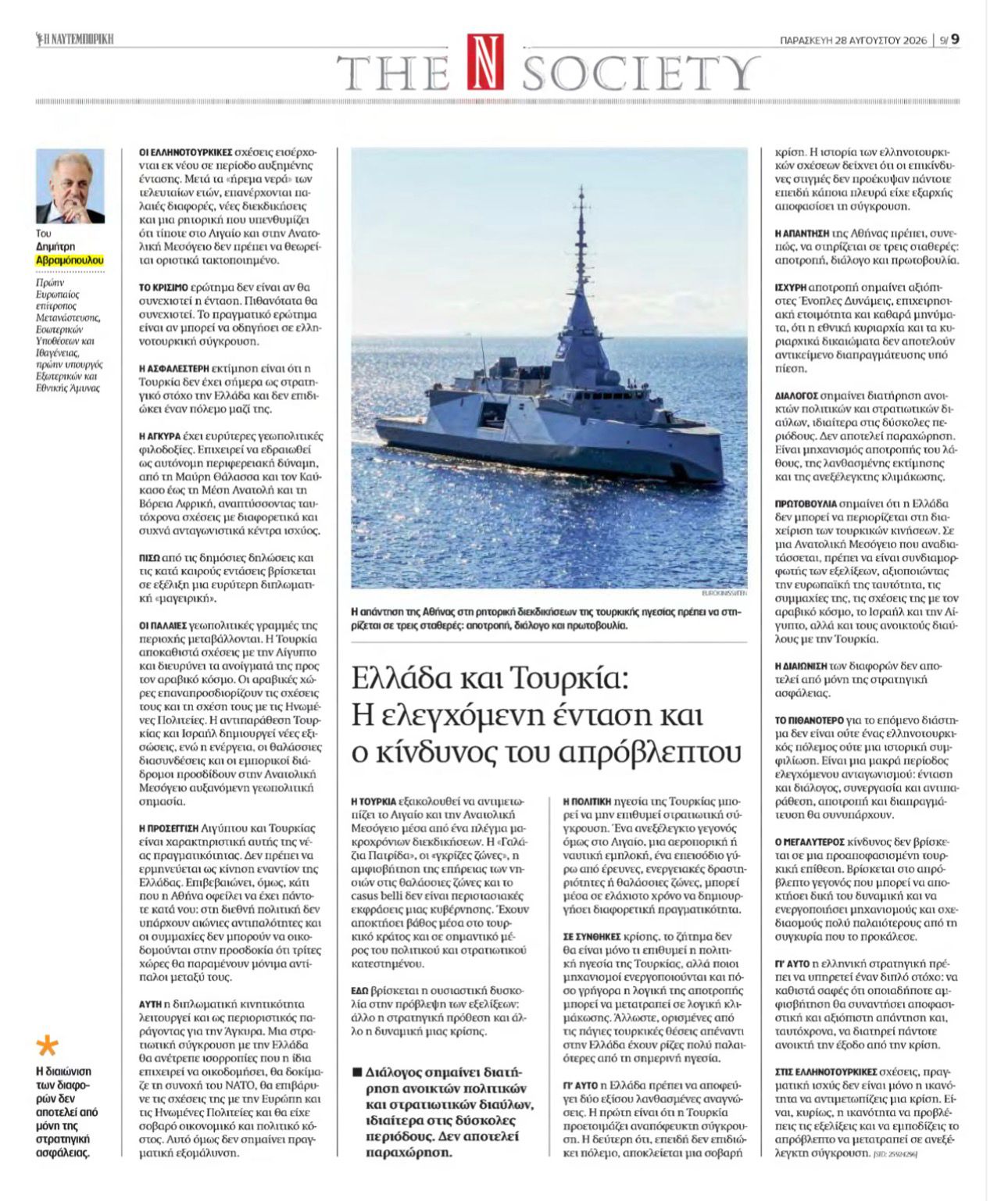
Athens’s response should therefore rest on three constants: deterrence, dialogue, and initiative.
Strong deterrence means credible Armed Forces, operational readiness, and clear messages that national sovereignty and sovereign rights are not matters for negotiation under pressure.
Dialogue means maintaining open political and military channels, particularly during difficult periods. It is not a concession. It is a mechanism for preventing mistakes, miscalculation, and uncontrolled escalation.
Initiative means that Greece cannot limit itself to managing Turkish moves. In an Eastern Mediterranean that is being reshaped, Greece must be a co-shaper of developments, leveraging its European identity, its alliances, and its relations with the Arab world, Israel, and Egypt, while also maintaining open channels with Turkey.
The perpetuation of disputes does not, in itself, constitute a security strategy.
The most likely scenario in the period ahead is neither a Greek-Turkish war nor a historic reconciliation. It is a prolonged period of managed rivalry: tension and dialogue, cooperation and confrontation, deterrence and negotiation will coexist.
The greatest risk does not lie in a premeditated Turkish attack. It lies in an unpredictable event that may acquire a dynamic of its own and activate mechanisms and plans that are far older than the circumstances that triggered it.
For this reason, Greek strategy must pursue a dual objective: to make it clear that any challenge will be met with a determined and credible response while, at the same time, always keeping an avenue out of the crisis open.
In Greek-Turkish relations, real power is not merely the ability to deal with a crisis. Above all, it is the ability to anticipate developments and prevent the unpredictable from turning into uncontrolled conflict.