
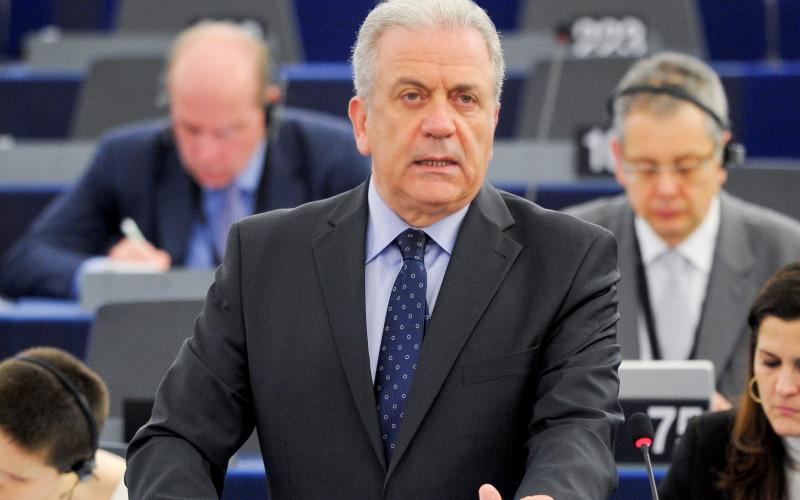
I would like to thank the Rapporteurs, Ms Metsola and Ms Kyenge, for this comprehensive report.
They and the LIBE Committee have invested a great deal of serious work to achieve this result.
We share a common objective.
Indeed, we all agree that time has come to replace chaotic, irregular and dangerous migratory flows by organised, safe and legal pathways to Europe.
Like the European Agenda on Migration, your report rightly stresses the need to work on all aspects of migration to:
– reduce incentive for irregular migration
– assist migrants in need of protection
– secure our external borders
– and attract skills to support our economic growth.
We cannot work on one of the aspects and ignore the other.
We cannot choose what to focus on.
We need in parallel to enhance all aspects of our policy, to coordinate with all key players and be both realistic and ambitious, looking ahead.
The agreement reached between the EU and Turkey shall also be seen in this broad context.
Implementing this agreement is a challenge.
We are working tirelessly to put in place all the legal, practical, logistical and financial arrangements to implement it.
We are doing so with the Greek and the Turkish governments as well as with international organisations and NGOs to ensure that EU and international law is respected.
People who apply for asylum in Greece will have their applications treated on a case by case basis, in line with EU law.
I was in Ankara last week to discuss how the EU-Turkey agreement is being put into practice.
Discussions are still on going on the protection guarantees for both Syrian and non-Syrian asylum seekers.
As a result, first promising steps have been taken.
In the short time since its implementation started on 4th April, 74 Syrians were resettled to Europe and more than 300 migrants returned to Turkey.
We have started to finance projects to support Turkey to hosting millions of refugees.
More generally, the current crisis has shown that the present system is not working and many elements are reflected in your report.
We need in particular to overhaul the asylum system.
Currently, the first arrival place of a person in the EU decides which Member State should handle an asylum claim.
This is neither fair nor sustainable as we have seen in the last months.
The Communication presented last week 2 options to put in place a sustainable and fair system for determining the Member State responsible for examining asylum claims.
The first alternative is to add a corrective fairness mechanism to Dublin – what I would call “Dublin plus”.
We would keep the current criteria and supplement them with adjustments through redistribution to other Member States in specific circumstances.
The objective would be to have a threshold that would not be too high.
Redistribution should start before the asylum system of a Member State is overstretched.
The second, alternative line of thought we are proposing is changing the basic criteria.
In this scenario, responsibility for an asylum claim would be decided from the very start and for every case on the basis of a distribution key between Member States.
Both options would provide the much needed solidarity and fair share of responsibilities between Member States.
Indeed under both options, the distribution mechanism should be activated automatically.
But a reformed Dublin mechanism will not alone make our asylum policy more fair and efficient.
This why the Commission will present complementary initiatives, in order to achieve greater convergence in the EU asylum system and to limit secondary movements across the EU.
The Eurodac system will be reinforced.
The Asylum Procedures and Qualification Directives will be replaced with fully harmonised Regulations.
Targeted modifications will be proposed to the Reception Conditions Directive and a new, reinforced, mandate will be given to EASO.
To avoid that migrants embark in dangerous journey, we also need to enhance safe and legal pathways to Europe.
This is why we will put forward a horizontal mechanism for resettlement.
Right now there are many differences between Member States’ approaches to resettlement.
It would be more efficient if EU Member States pool their offers and use the same methodology.
We agree as well that in the future we will also need migration to fill skills gaps and to address the demographic challenge that all our nations in Europe face.
We will propose a reform of the Blue Card scheme for highly-skilled migrants, as well as measures to attract and support innovative entrepreneurs.
I also want to emphasise that we are working on an Action Plan on Integration, for all third country nationals.
This will be a crucial element to increase the acceptance in our society.
All these actions are complementary to the actions initiated to protect our border and reduce incentive for irregular migration.
Last week, we proposed to make our borders smarter and stronger.
We created an EU entry-exit system to improve our external borders management, by better monitoring over-stayers.
The Commission is pursuing its efforts to -together with Member States- improve the return of irregular migrants not in need of protection, especially Sub-Saharan countries.
Let me assure you once more that the Commission is working very hard with all actors to ensure that the current deficit in the migration system is being addressed.
Honourable Members,
This refugee crisis has been a catalyst for these changes to be accelerated.
The picture sometimes looks very dark.
I don’t hide from you that my first thought every morning is whether we will, as Europeans, overcome this crisis and turn it into an opportunity, instead of a disaster.
But I still want to believe that we are all now realising the need to adapt to a new era which is characterised by human mobility.
Most importantly, we start realising that we can only face this new reality united and based in our common values of respect of human rights.
And it’s true to say that this Parliament was the first to show the way ahead and this Commission’s mission was from the beginning to tackle the issue in a comprehensive way.
In this framework, I welcome that many constructive proposals can be found in your report, which show our common understanding of the challenges and potential solutions.
I am looking forward to a constructive debate.