
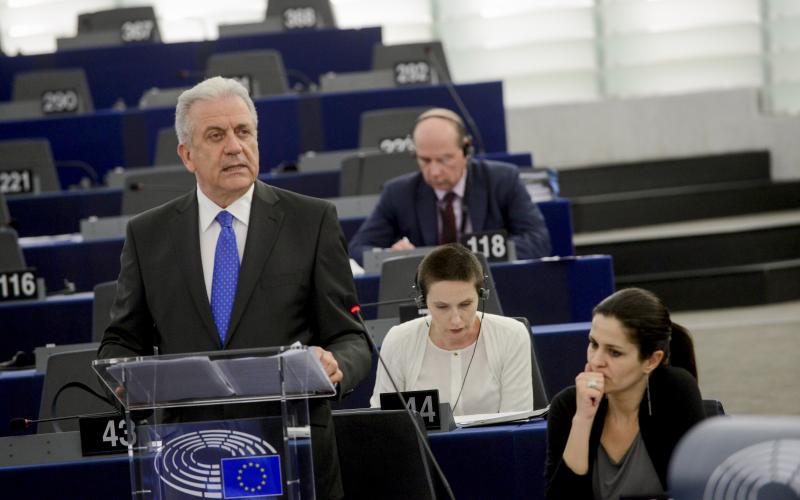
Video: https://youtu.be/zDqDSHPETyg
The adoption of the EU PNR Directive is finally within sight. I really count on wide support by this House.
This will send a strong message about the contribution of this Parliament to our common efforts to strengthen the European Framework in an area that used to be dealt at national level only.
Let me start by thanking the Rapporteur, Mr Timothy Kirkhope, and the LIBE committee for their valuable efforts in securing a solid compromise on PNR.
All political groups have worked to shape a balanced text addressing our common goal: to have an instrument, a tool, that is effective in preventing and combating terrorism and serious crime.
The Commission will be putting pressure on Member States to implement it as soon as possible: we cannot wait for two years. We have no time to lose.
We are having this discussion in the aftermath of the terrorist attacks in Brussels, but we also had it after the two Paris attacks. I truly hope we don’t have to have this discussion in similar circumstances anymore.
The Directive will now put in place a coherent framework for the necessary PNR data exchanges between Member States. This is an essential aspect.
The EU-PNR will allow to our security services -to connect dots, -to do more complete searches -and to identify possible foreign terrorist fighters when they board planes to, in and out of Europe.
We will continue supporting the Member States to ensure the national Passenger Information Units are inter-connected.
The protection of personal data is of course fundamental in this framework. We do not want to exchange information at the expense of fundamental rights.
The final compromise includes:
– A well-defined purpose limitation: the Directive explicitly lists the offences which justify the use of PNR data,
– Strict data access
– limitations on onward transfers of data: the conditions for sharing PNR data with other national and foreign authorities are strict and clearly defined,
– Limited retention period: data is masked-out after six months,
– Prohibition of sensitive data: such data must be deleted immediately upon if received, and…
– Oversight: the processing of data is supervised internally by a data protection officer, and externally, by an independent supervisory authority.
With these elements, the EU PNR Directive strikes the right balance between security and privacy.
Let me now turn to the external dimension of PNR policy.
The Parliament decided to seek the opinion of the Court of Justice on the draft PNR agreement with Canada.
This opinion will be critical in setting the legal parameters for any future PNR agreement between the EU and third countries.
Based on the EU PNR Directive, our Member States will collect PNR data from flights coming from third countries.
As a result, it is expected that an increasing number of third countries will request PNR data from EU air carriers.
We therefore need to have a coherent approach to PNR requests from third countries.
The Commission plans to present its ideas on this subject after the Court of Justice has delivered its opinion on the draft PNR Agreement with Canada.
In any event, the EU PNR Directive will set a standard which will have to be followed by any future legal instruments regulating the transfer of PNR data to third countries.
And it will help us a lot in the fight against terrorism. Of course – by itself it will not solve all our problems with terrorism.
Much more needs to happen – such as:
-better information exchange,
-better implementation of the tools we have in place,
-tackling the roots of radicalisation.
It is however an important instrument which together with other tools will strengthen our position in preventing terrorist attacks and dismantling criminal networks.
That is why coming to an agreement on this proposal today is so important.
In the wake of the tragedies in Brussels, this is a good example of joint European action to ensure the security of our citizens.
PNR is one critical tool, and we will need all the tools we have at our disposal.
Let us continue in the same way for all other pending proposals on the table.