
Dear President Lambertz,
Dear Ladies and Gentlemen,
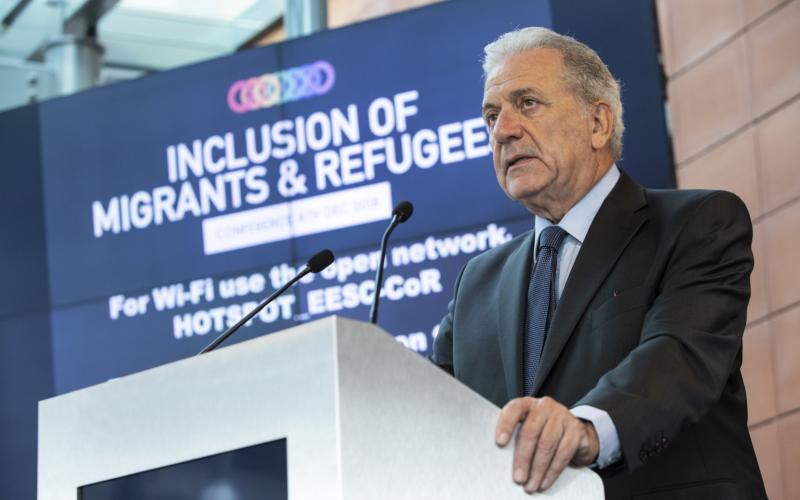
I am very glad to open this conference today, which brings together key players working on integration on the local, national and European level.
I cannot stress enough how important the issue of integration is, and will be even more so in the years to come. Our citizens also feel very strongly about this.
According to a recent survey conducted in all EU countries, seven in ten Europeans think that integrating immigrants is a necessary investment in the long-run for their country.
Despite the challenging context in recent years, we know that many cities implemented successful mechanisms to integrate migrant children in schools or to help migrants enter the labour market,also in cooperation with local employers.
While discussions and debates about migration and integration are sometimes heated at national, European or even international level,local actors simply do their job.
I speak from experience as a former mayor myself. Many actors at the local and regional level – many of you here – have played an immensely important role in the lives of hundreds and thousands of people settling in our societies.
But we also know that you cannot do or solve this alone.
The Partnership on Inclusion under the Urban Agenda for the EU was precisely conceived with this in mind.
This two-way dialogue with cities and local authorities is a platform to learn from one another, but also to multiply successes.
I am glad to see today so many representatives of local, and national authorities and of the civil society, gathered here to learn more about what the Partnership has achieved in the last three years.
There are thousands of examples across Europe of local communities where integration is a reality, and where diversity is an asset and not a source of concern.
At the EU level, we want to support your efforts better and in a meaningful way.
On the one hand, this means that we need to know what the real needs on the ground are.
At the same time, we want to understand what the models and interventions are that work best and that can be disseminated across the EU.
Offering the space to exchange is one way of supporting you.
But another one is of course funding. The Asylum, Migration and Integration Fund alone has for instance supported almost 3.4 million migrants in their integration efforts between 2015 and 2017.
In that period, this Fund has co-financed 4800 measures to help the integration of third country nationals.
One good example here in Belgium is the project called “Interactive in Ghent”. It targets low-skilled, vulnerable migrants and aims to socially activate and integrate them in the society through language training, screening of individual competencies, and work insertion.
Another example is the Cities Grow project, which supports mutual learning and mentoring between sixteen European cities for a more effective labour market integration of migrants.
We know that access to EU funding can prove challenging for local and regional authorities, in particular small ones.
This is why we made funding for integration more accessible for local authorities in our proposal for the next financing period that will cover the years 2021-2028.
Furthermore, we proposed a substantial increase of EU Funds for migration more generally.
The amount proposed for the future Asylum and Migration Fund is three times higher than the initial amount of the current Asylum, Migration and Integration Fund.
Integration is a central priority of us, and therefore receives both the attention and funding across different policy areas.
This is why for example the European Social Fund and the European Regional Development Fund will have a specific thematic priority on integration, which will focus on supporting long-term integration measures.
It is important that local authorities coordinate closely with national authorities in charge of managing these funds to make sure integration is one of the priorities of their national programmes.
We also plan to discuss with many of you in the near future how EU Funds for integration can be used in the best possible way to create synergies and to reach the right addressees on the local level.
It is crucial to ensure that we use the Funds available in the most effective way and for this we need a well-functioning coordination between all players involved at national as well as the regional and local level.
We count on the Committee of the Regions, as the voice of Local and Regional authorities in the EU to support us in better understanding the needs at the local level and further strengthening the dialogue with local and regional authorities.
We are working closely with Member States in this respect and we will continue to do so through the European Integration Network.
The key to make integration successful in the long term is to approach it not as an emergency, or a quick fix but as a mainstreamed and long-term priority, across all areas but also education, not just migration, employment, social inclusion and regional policy.
I also strongly believe that local authorities can also play an important role in building a more positive narrative around migration and integration.
I have said before that we cannot take the question of integration lightly – I know I don’t need to convince anyone in this room today of this.
Integration is not an urgency, but a social and economic necessity.
In the last years, we achieved concrete results and established the basis for important structural changes in the future.
This Commission and me personally are committed to continue the dialogue and excellent cooperation with all of you.
Thank you.