
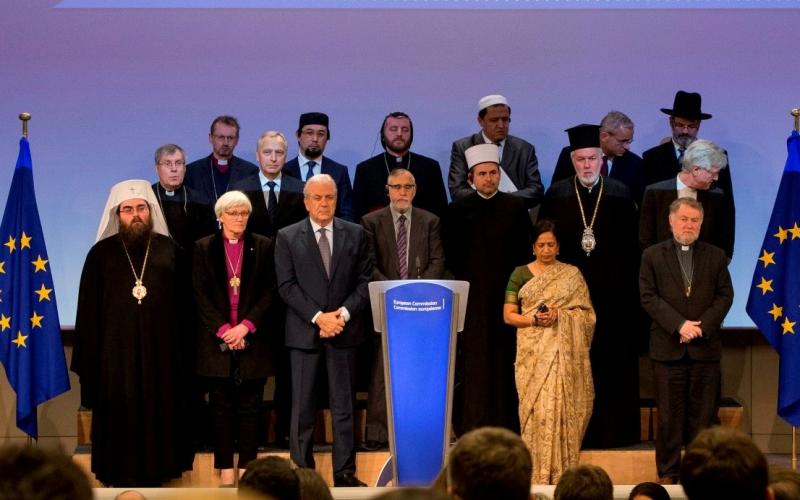
Opening Remarks at the lunch:
Your Excellencies,
It is an honour to be with you here today, and to discuss a topic which occupies me on a daily basis: migration, the refugee crisis and the question of social cohesion and integration.
I wish I could have joined you earlier but I had obligations in the European Parliament on the financial implications of this very phenomenon.
Allow me to highlight the importance of this dialogue, especially in times of major social changes and challenges.
Human mobility and migration is increasingly shaping the 21st century at a global scale.
Our main challenge is not how to stop it, but how to better deal with it, how to turn it into an opportunity.
The foundations of our common European endeavour are our common values, our shared principles of democracy, respect of human rights and solidarity.
Europe is and will remain an open and tolerant continent. But citizens are also increasingly concerned.
With the rise of mobility, there is the rise of diversity – but unfortunately there is also the rise of populism, nationalism, xenophobia and racism.
The question that we therefore struggle with is: how to better live together, how to be more united across our linguistic, religious, and ethnic differences?
How do we create more culturally, socially and economically cohesive societies?
There are elements of integration that we can quantify in numbers, such as how many migrant children are enrolled in school, or how many migrants are employed.
Especially in the context of the refugee crisis, it is not just government, but also civil society and religious organisations and charities which can play an important role in supporting and receiving the newly arrived, in helping with accommodation, but also with broader participation in society.
But the most difficult thing about integration and social cohesion we cannot quantify: trust and mutual respect.
This is where governments are much more limited to intervene – and precisely where religious communities have a key role to play.
In our comprehensive approach to address the challenges of migration, I have travelled a lot both within the EU as well as outside.
The biggest challenge that I see for Europe but also in our neighbourhood, is how to build bridges across different communities.
Now is the moment to foster mutual respect between different communities and different faiths.
Some are seeing parallels with history – or perhaps even repetitions. But it is the duty of leaders – whether they are political or religious – to understand and learn from history in order not to repeat it.
This year we have not only witnessed unprecedented migration flows.
Our continent has also lived terrible terrorist attacks, claiming the lives of innocent citizens – but most importantly: scarring the social tissue of our societies.
It is a wake-up call: the majority of these perpetrators are EU citizens.
They are OUR youth, OUR boys who turned their back to our values, to our way of living.
And I don’t want to make a direct link between migration and integration, but we do have to be aware of the lesson that history is teaching us today.
Let me be very firm: religion should never become an element of division. Religion is also not the cause of violence.
Religion is unfortunately abused for violent and political purposes.
This is why it is also religion that can act as the cure. From the inside.
Not from Brussels or national capitals: but from the most micro level possible – communities.
Our worst common enemy is not “hate” or “mistrust” – it is “disengagement”.
As a government, whether at local or national level, and in particular at EU level, it is extremely difficult to reach those who risk becoming disengaged.
But you, through your different communities: you can.
We should act more decisively against the increasing trend of detached groups and communities.
You are not only religious pastors – you are also educators.
In civic culture, democratic norms, tolerance, participation, belonging in society.
Tell us how we can support you more, how we can join our forces towards the common goal of fostering more cohesive, connected and inclusive societies – irrespective of status, ethnicity, religion, language or nationality.
Your Excellencies, thank you.
Doorstep:
Video https://youtu.be/ZOLqi76VjmQ
The dialogue between religions is more important than ever today. It is the moment where we need more and deeper mutual, cultural and religious respect.
In the past, the world has been divided by ethnic conflicts, religious conflicts and civil wars. One of the most barbaric confrontations in the past was among religions. Now, given the new reality we are confronted with – especially in the field of migration, the refugee crisis, the question of social cohesion and integration – we all understand that it will help a lot to further and more efficiently address this issue, if religious leaders can really contribute through joint and common efforts in order to establish not only a dialogue but a better understanding among religions—as I said, mutual respect.
The world has to become more united, more cohesive. Solidarity should prevail everywhere. Solidarity is a term that is enshrined in all religions. By getting together, exchanging views and being committed to moving forward in order to establish a dialogue and a broader cooperation in the future, this will lead to a more cohesive and united world.
The initiative undertaken by the European Commission brought today in Brussels representatives of all religions around the same table. It is a very important step forward. Religion can really unite people, because around the world all religions are fighting in order to spread a message of peace, solidarity and friendship.