
Dear all,
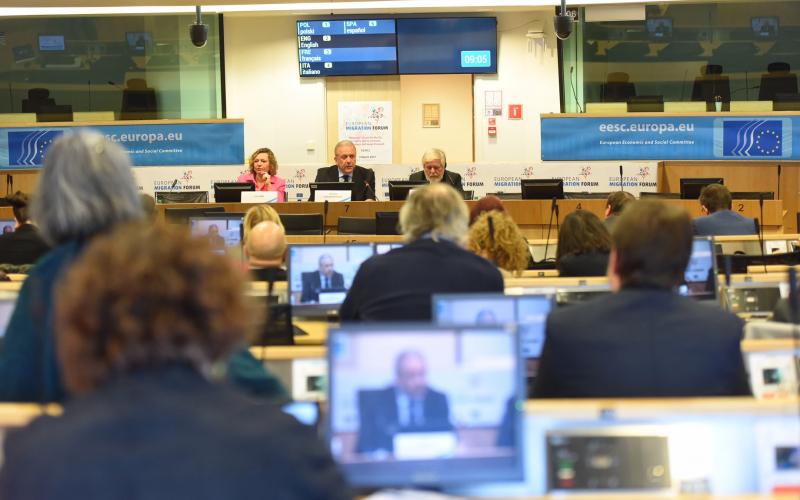
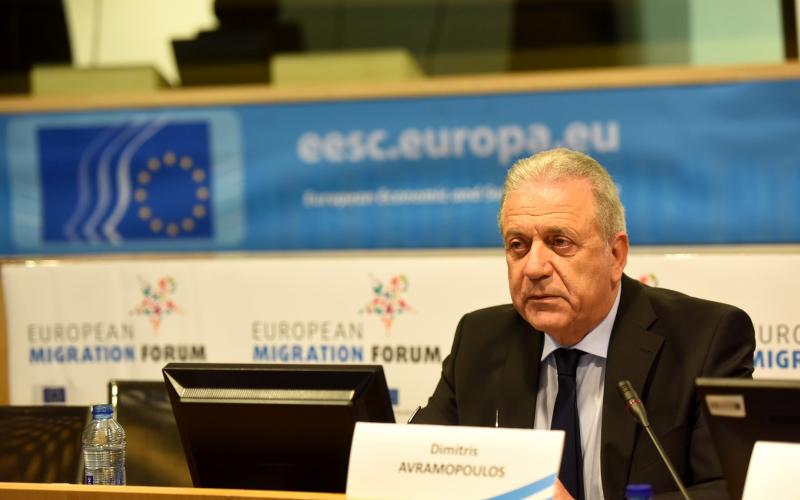
It is my great pleasure to welcome all of you to the third meeting of the European Migration Forum, our annual dialogue with civil society that we organise together with our friends from the European Economic and Social Committee.
In the context of the refugee and migration crisis, this annual dialogue and exchange has become all the more important.
With so many people on the move today, for a variety of reasons, in different contexts and posing different challenges, it is clear that:
1. migration continues to be an important political priority
2. but also that it is a phenomenon where different stakeholders are involved in.
Dear colleagues,
– and I wish to call you colleagues very deliberately, because we are on the same side, we are all striving for the same goal: a better and fairer management of migration on the ground, for the people involved and for our societies.
In times like these, we need to unify our forces to fight discrimination, to counter xenophobic and populist narratives.
The fact that we are so numerous today, with all EU countries represented and a great variety of expertise in this room, proves that we all share the same ambition to work together to address today’s migratory challenges.
Yes, the phenomenon of migration continues to be one of the most challenging and also divisive issues that our societies, in Europe and globally, are confronted with.
But migration is also an opportunity – and this is precisely where you as civil society have a key role to play.
The EU needs to step up to the ambition of being an example of unity, strength, peace and solidarity; a continent where bridges, not walls, are built.
This is a process that cannot just happen top-down, but must also come bottom-up.
Over the past two years, the European Union has made enormous efforts to build shared solutions, to work together, to promote solidarity.
We have evolved from a scattered approach on migration to a European and comprehensive response.
No country, no city, no organisation can deal with this challenge on its own.
This is why today’s exchange is not just to “tick the box” – it is part of our ongoing collaboration with you all.
Your work on the ground and your advice is invaluable to us.
As you know, we are now working to reform our common asylum system, to make it more humane, fair and efficient.
A system which is generous to those in need and strict towards potential abuses. A system which needs to have solidarity at its very heart.
You know that I have been very vocal about this: there is no fair sharing of responsibility without solidarity.
Later this morning I will present the results achieved so far.
With just over 13,500 relocations from Italy and Greece so far, only 14% of the total has been relocated.
We also have resettled over 14,000 people in need of protection from countries like Turkey, Lebanon and Jordan since June 2015.
In the short term, Member States should pick up the pace of relocations from Italy and Greece urgently.
In the middle and long run, we have to find an agreement on a truly European common asylum system, to be able to respond more quickly when future crises occur.
While it will not be an official part of our discussions today, I do want to also mention one aspect which I know is always a very difficult issue, but it is an integrated part of any comprehensive migration policy: return.
Later this morning, I will present a revised Action Plan on Return and a Recommendation to Member States, to make their return systems more efficient.
I want to be crystal clear however: everything is fully in line with EU legislation and with fundamental rights.
We are very much aware of the concerns that exist, and have taken those into account when we exchanged with some of you while preparing this package.
We have to be honest, pragmatic and humane about this issue.
If we want to make our asylum system fairer, we need to make sure that only those who really need protection make use of it.
This means that we need to deal with the abuses more swiftly, but also make sure that such abuses happen less to start with.
Enhancing our legal channels is an essential component, and I already mentioned resettlement.
But we also need to equip our migration policy to better deal with those who don’t come for humanitarian reasons, so they too can come in a legal and regular way
– whether it’s for work, family or study.
We recently improved the EU rules for foreign students and researchers to come here, and we have proposed a more European and attractive Blue Card system for highly skilled migrants.
I invite you to think with us today how we can further improve our legal migration rules and procedures.
Whichever way people arrive in the EU, we have a joint responsibility to deal appropriately and humanely with all of them.
Many of you and your organisations have been involved from the very outset of the refugee crisis.
We want to get your feedback also from the operational side:
– how we can improve the reception process on the ground?
– how we can improve access to basic services?
But we also need to work towards the future.
When people obtain protection and the right to remain, when people are resettled to the EU: how do we help them integrate?
But also: how do we build more inclusive and cohesive societies?
This is precisely where civil society has a key role to play, and where me and my services look forward to exchanging and collaborating with you, not just today but continuously.
Ladies and gentlemen,
At the brink of the 60th anniversary of the Treaty of Rome, we find ourselves at a crucial moment for the future of Europe and of the European Union.
President Juncker also highlighted this yesterday when he presented the White Paper on the Future of the EU.
Today one of the biggest threats to the unity and future of the European Union is the rise of populism, nationalism and xenophobia.
And migration is being exploited by these voices.
Governments and civil society need each other more than ever today, and this Forum is an opportunity for all of us to work together.
I am certain that this year’s discussion will also significantly contribute to the important work we have to deliver both in terms of new policy initiatives and better implementation of existing rules.
I welcome you all and wish you fruitful discussions in the coming two days.
Thank you.