
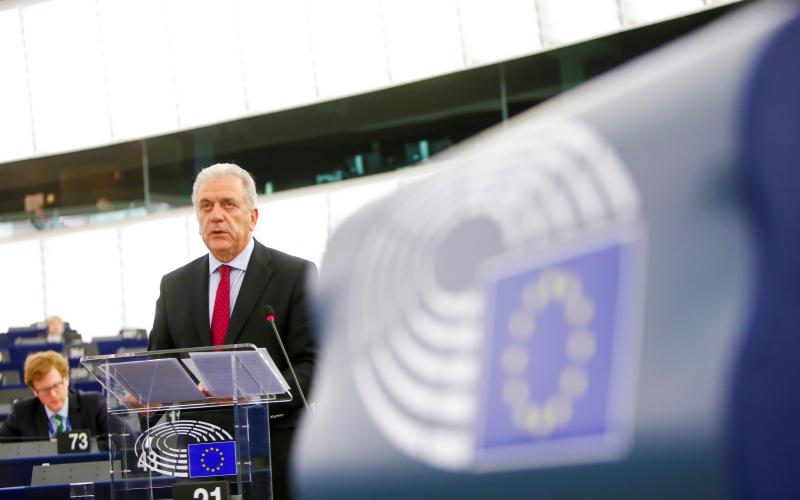
Opening Remarks:
Video: https://youtu.be/tUA3kL7quf0
Honourable Members,
Thank you for this very timely debate on relocation today,a few hours before we will adopt the 12th Report on Relocation and Resettlement.
I think we all agree that relocation is vital to the success of our migration and asylum policies based on solidarity and responsibility.
This is why it is so essential that relocation works in all its aspects, and is implemented by everyone.
For this, one element remains critical for the success of the scheme: the political will and the mutual cooperation and trust between the Member States of relocation and the beneficiary Member States.
This is not to the benefit of just Greece, or just Italy. This is to the benefit of the entire European Union and our European asylum system.
Because a well-functioning relocation scheme is also essential to prevent secondary movements and preserve the integrity of the free border Schengen area.
Member States have so far relocated in total more than 18,000 persons and we have to acknowledge the tangible, important progress made on relocation.
Further efforts are however needed and Member States should therefore deploy the additional efforts and flexibility to make relocation of all eligible applicants currently present in Italy and Greece happen.
But this cannot be the responsibility of just a few Member States. This has to be shared by ALL Member States.
Our common goal is for all Member States to contribute fairly and proportionally to relocation.
Right now, around 12,500 eligible applicants in Greece and around 4,000 in Italy are registered and ready to be relocated.
If all Member States step-up the number of relocations, it is absolutely possible to achieve this goal by September.
It is time to show political will and determination. Member States should also fully implement the recommendations that we put forward in our regular reports.
Most importantly, Member States should increase their monthly pledges in proportion to their allocations and increase the capacity to process application requests.
While many Member States have increased their contributions, there are – regrettably – still a few Member States that have not relocated a single person. This is in breach of their obligations.
More generally, Member States should also: avoid overly restrictive or arbitrary preferences, limit requirements causing delays in the transfer procedure and give priority to applications concerning vulnerable applicants, in particular unaccompanied minors.
In addition, the Commission urges Italy to speed up the procedures to identify and register for relocation all eligible applicants and to find mutually acceptable solutions on security interviews with relocating Member States.
All those eligible for relocation arriving in Italy need to be orderly channelled to specifically designated relocation hubs.
All Member States should relocate more unaccompanied minors, and in particular from Italy.I am glad to see that your draft resolution includes many of these recommendations.
I count on your support to convince Member States to implement them fully and swiftly.
Relocation is a joint effort that requires all Member States to contribute. Relocation is both an obligation and a moral duty.
Thank you for your attention and I thank the Parliament for its continued support.
Closing Remarks:
Video: https://youtu.be/EbE0oFFaphA
Thank you Madame President,
Honourable Members,
Thank you for this interesting debate. I would like to repeat what Ms Kinga said ”There is no solidarity a la carte” and as Ska Keller said “Relocation is one of the tools and ways to show solidarity in practice”
Madame Griesbeck you rightly stressed the moral aspect of the relocation issue, I share many of your views Let me say that I share many of your views and I count on your continuous support.
Relocation is often reduced to numbers but we are talking about people who are in need of our protection.
Our shared duty is to make sure they get that protection, as soon as possible, and in a manageable way for the EU.
This is the essence of the emergency relocation schemes. This is why our focus right now is to make sure that everyone eligible is relocated, to all Member States, before September. Member States that have not yet relocated anyone, or have not relocated for more than a year should make progress immediately.
If no action is taken within a month, we will specify our position on making use of our powers under the Treaties and in particular on the opening of infringement procedures. I am very clear on that. Let me also say that I understand your concerns and remarks on the deadline and the future.
But these relocation schemes have not been set-up as an intermediary step in view of the reform of Dublin.
They are an emergency measure. Of course, as we very clearly said, Member States’ legal obligations do not stop after September 2017. If you have an outstanding bill, you have to pay it.
I also took note of your views on the opportunity to revise the scope of the relocation decisions.
But as I said, at the moment, our priority is to relocate all migrants in need of protection that are currently eligible.
We need to focus on this objective. If all Member States actively contribute, this is perfectly possible and feasible.
And I count on you to help us make this happen. Let me now shift to Greek because my compatriots asked me some questions.
Το θέμα αυτό είναι πολύ σημαντικό για την Ελλάδα, καθώς βρίσκεται στην πρώτη γραμμή μαζί με την Ιταλία. Οι δύο αυτές χώρες δέχονται την μεγαλύτερη πίεση.
Για την κατάσταση στην Ελλάδα, θα ήθελα να τονίσω ότι, εάν τα Κράτη Μέλη ανταποκριθούν στις υποχρεώσεις τους, είναι απολύτως εφικτό μέχρι τον Σεπτέμβριο να μετεγκατασταθούν όλοι οι υποψήφιοι που βρίσκονται στην Ελλάδα, και είναι περίπου 12.500 άτομα.
Να τονίσω, εδώ, ότι η Ελλάδα έχει ολοκληρώσει όλες τις διαδικασίες και εφόσον η καλή αυτή συνεργασία συνεχιστεί θα πετύχουμε τους στόχους μας. Όπως είπα, κάποια Κράτη Μέλη δεν συνεργάζονται. Θα ήθελα στο σημείο αυτό να πω ότι η ανοχή και η υπομονή αρχίζουν πλέον να εξαντλούνται.
Θα ήθελα να τονίσω ότι πιστεύω στην αξία της συνεννόησης, του διαλόγου και της πειθούς. Έτσι έπρεπε να ξεκινήσουμε και αυτό κάναμε. Τώρα όμως έχουμε φτάσει σε ένα οριακό σημείο. Και η απόδειξη ότι αυτή η στρατηγική τελικά αποφέρει αποτελέσματα είναι ότι οι ρυθμοί μετεγκατάστασης έχουν σημαντικά αυξηθεί τους τελευταίους μήνες.
Αν δεν υπάρξει συμμόρφωση, και μην έχετε καμία αμφιβολία γι’αυτό, η Επιτροπή θα υποστηρίξει πολιτικά αλλά και νομικά την πολιτική της.
Όσον αφορά στη Δήλωση ΕΕ-Τουρκίας, θα ήθελα να σας πω ότι λειτουργεί, και έχει λειτουργήσει κάτω από πιεστικές και δύσκολες συνθήκες με σημαντικά αποτελέσματα. Πριν από ένα χρόνο και δύο μήνες, είχαμε περίπου 12.000 διελεύσεις την ημέρα, ενώ σήμερα αυτός ο αριθμός έχει πέσει κατά μέσον όρο σε 50-60 άτομα την ημέρα. Πρέπει να την κρατήσουμε τη Συμφωνία, την συνεννόηση αυτή, ζωντανή.
Οι δε επιστροφές προς την Τουρκία συνεχίζονται. Χτες βρέθηκα στην Αθήνα και είχα συνάντηση με τους αρμόδιους υπουργούς της Ελληνικής Κυβέρνησης και δεν σας κρύβω ότι με ικανοποίηση ενημερώθηκα για την επιτάχυνση και αυτών των διαδικασιών.
Οι ασυνόδευτοι ανήλικοι είναι προτεραιότητα μας. Αυτό το μήνυμα πρέπει να περάσει σε όλα τα Κράτη Μέλη. Ειδικά από την Ιταλία δεν γίνονται αρκετές μετεγκαταστάσεις ασυνόδευτων ανηλίκων. Ωστόσο, θέλω να τονίσω ότι υπάρχει πρόοδος και στον τομέα αυτό.
Και σε κάθε περίπτωση η σημερινή συζήτηση κατέδειξε ότι το Ευρωπαϊκό Κοινοβούλιο στηρίζει τις μετεγκαταστάσεις και τις προσπάθειες της Επιτροπής. Θα ήθελα να εκφράσω τις ευχάριστες μου προς το Ευρωπαϊκό Κοινοβούλιο για την στήριξη της πολιτικής μας.
Από την πρώτη κιόλας στιγμή υπήρξατε βασικοί υποστηρικτές και τελικά θα κριθεί και από την δική σας συμβολή η επιτυχία της πολιτικής μας, η οποία ανταποκρίνεται πλήρως και στο πνεύμα των Συνθηκών και στο βαθύτερο ηθικό και πολιτικό περιεχόμενο των αποφάσεων και της πολιτικής που από κοινού έχουμε υιοθετήσει.