
Dear all,
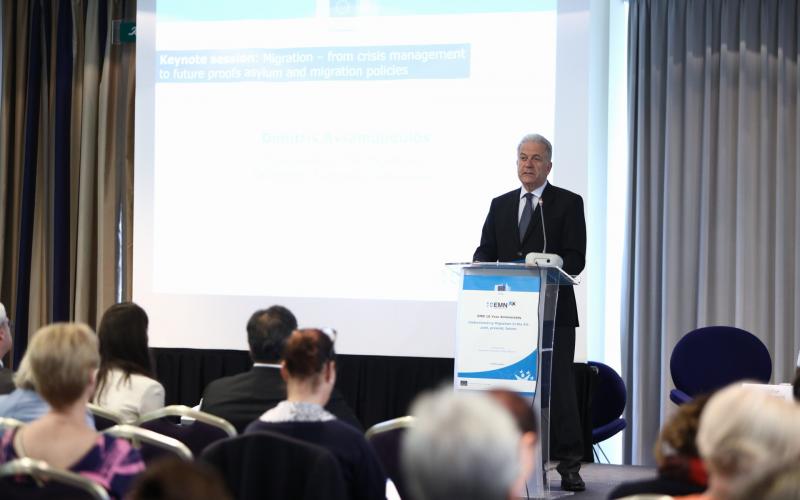
I am pleased to be here with you today to celebrate the tenth anniversary of the European Migration Network (EMN).
The European Migration Network was created a decade ago when only those working in the field of migration knew how important it was to have a better understanding of the migration policies,
to have the facts and figures and to exchange information and best practices.
Today migration is a top priority for everyone, not least our citizens. In ten years a lot has changed.
We have experienced large migration inflows.
We have gone from a scattered approach to migration to a comprehensive European policy on migration.
All along the way, the work of the EMN was there.
Sometimes it has not always been publicly visible but your work has been of great value to develop, improve and implement a fair, ambitious and effective migration policy that works at all levels, not just now but also in the long run.
I would therefore like to thank all of you present here today, who contribute every day to the existence and output of this network.
This anniversary is for all of us a good moment to draw lessons from our past experiences, and especially of the past 3 years, and to set the direction to address the challenges ahead of us.
The recent times have confirmed and proven what I said from the very beginning: that no Member State can effectively address the challenge of migration alone.
It is clear that we need a common approach that brings together European and national efforts with solidarity and shared responsibility.
This approach needs to combine both the internal and external policies because they go hand in hand.
And it has to be operational, make a difference on the ground.
Based on these principles, I am proud of what we have achieved as a Union so far.
As a result of our joint actions, the total number of arrivals along all the main migratory routes in 2017 has gone down by 63% compared to the previous year.
Since the end of 2015, around 35 000 persons were relocated from Greece and Italy and 36 500 were resettled from Turkey, the Middle East and Africa.
Since 1 February 2016, EU operations in support to the Italian coast guard have rescued almost 290 000 migrants.
In 2017, the European migrant smuggling centre in Europol has supported 1700 new investigations.
However, it is not the time for complacency.
Even if the number of arrivals remains relatively low, arrivals from Turkey have seen a significant increase since March 2018
and arrivals on the Western Mediterranean route continue to show an upward trend.
The EU therefore needs to show the necessary vigilance and preparedness to respond to any seasonal peaks or shifts in pressure.
We need to continue cooperating closely with key third countries such as Turkey, Libya and Niger.
But you all know as well as I do that it’s not just about arrivals or flows.
What matters equally for our citizens is that we also manage the millions of migrants that arrived in the European Union over the past years by dealing with their asylum applications, and either facilitating their rapid integration if they have a right to stay or organise their speedy return if they don’t.
For this, we need a sustainable and long-term European migration policy.
We need to carry out structural reforms on all aspects of our migration policy.
To uphold our values and fulfil our obligations, we need a resilient European asylum system that works in normal circumstances but also in times of crisis. This is not the case now.
That is why we have proposed a complete reform of the Common European Asylum system.
With this reform, we will ensure that asylum seekers and recognised refugees are granted the same rights across Europe for the time needed, to prevent abuses and secondary movements.
The reform of the Dublin System will streamline the procedure to determine which member state is responsible for an asylum application in normal circumstances.
In times of pressure, it should equip the European Union with a mechanism that allows us to respond in a systematic, joint and timely manner to disproportionate arrivals.
In my view, all Member States should participate to alleviate the pressure on the most affected Member States, in order to avoid the collapse of their asylum and migration system.
While the European parliament already adopted its position on the reform of Dublin, it is time for the Council and therefore the Member states to hurry up.
In October 2017, the leaders committed to reaching a consensus during the first half of 2018. The clock is ticking now.
Finding a solution to the reform of the Common European Asylum System will of course not solve everything but it is an important part of the solution.
This goes hand in hand with stronger external borders, which has been a priority for this Commission from the start.
The European Border and Coast Guard is one of the fastest and greatest achievements of this Commission.
We are ready to go further. This is reflected in our recent proposal for the next EU budget.
As part of the next multiannual financial framework, we propose to create a new integrated border management fund which will help guarantee a high level of security in the EU, with a standing corps of around 10,000 border guards, while safeguarding the free movement of persons.
I look forward to exchanging with the Member States on these proposals.
In parallel, more work is also needed to increase the return of those migrants who have no right to stay in the European Union as only 36.6% of return orders in 2017 were actually carried out.
The role of the European Border and Coast Guard is paramount here.
In 2018, the agency already helped organise 111 return operations but Member States should make much greater use of the agency’s newly boosted mandate on returns.
They must also improve their national systems. Here too the work of the European Migration Network has demonstrated both the discrepancies on the ground but also best practices.
During the last three years, significant political and operational engagement with main third-countries of origin or transit has also brought progress in our negotiations on readmission agreements and on practical arrangements.
Practical cooperation is improving, and good practices are being agreed and implemented with the third-countries’ authorities.
In order to improve still further the cooperation on returns, all the incentives and leverages of our internal and external policies have to be used.
As part of a holistic approach, it is equally important to further enhance legal migration channels to the EU.
This is something that is not always easy or popular to talk about nowadays but here too the EMN can help in providing evidence and best practices from across the EU.
Legal migration and integration are essential components of any well-functioning migration policy.
Not only to support the effective management of migration flows and to curb irregular migration, but also to contribute to the EU’s economic development in the medium and long term, both by attracting new skills from abroad as well as making sure that no skills are wasted of those who are here to stay.
Our recent Eurobarometer on integration has shown that 69% of Europeans believe that integration measures are a necessary investment in the long-run.
This is why as part of the next multi annual framework, we have proposed to mainstream the priority of medium and long term integration in our structural funds.
When I look ten years into the future, I am confident that we will have an effective, holistic, comprehensive and sustainable asylum and migration system in Europe based on democratic and human rights values.
Throughout these on-going and possible future efforts, I count on the continued support of the European Migration Network to help us shape our policies even better, as well as to better measure and assess their impact and results.
In a time when populism and nationalism are gaining ground, the European Migration Network has a key role to play to ensure our migration policy is based on facts and not emotions.
Thank you all for your kind attention and for your tremendous work in the past decade.
We know that migration will be with us not just in the next decade but in the decades to come – so “bonne continuation” and happy anniversary!