


Dear all,
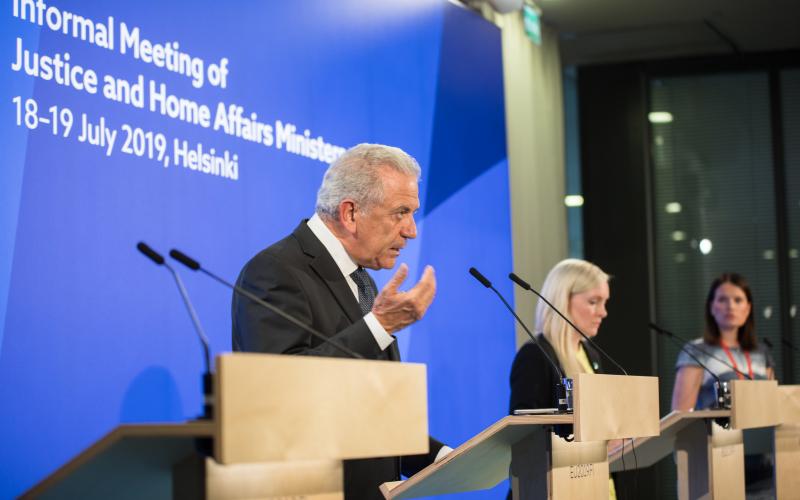
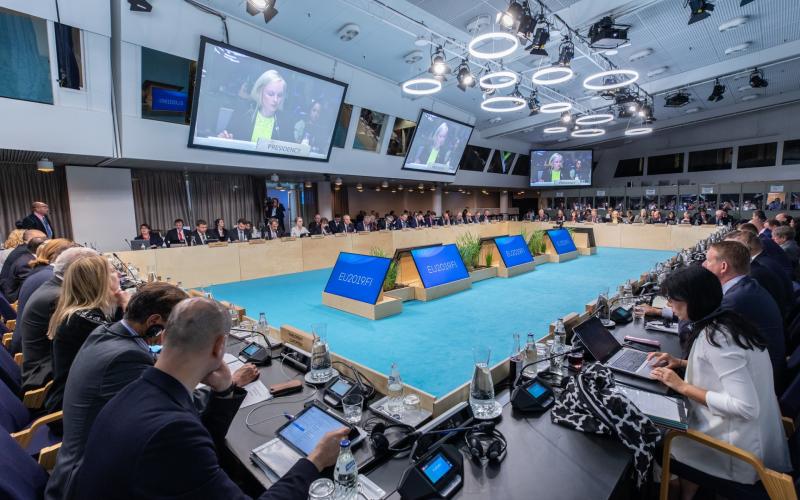
I would like to warmly thank Minister Maria Ohisalo for hosting us in beautiful Helsinki today and for giving us a very timely opportunity to discuss the future of our security and migration policies.
I am really glad to see the Finnish Presidency taking up our shared priorities to better protect our citizens and to better manage migration.
When it comes to ensuring the security of citizens, we have put in place important building blocks for our Security Union.
It is time to finish the job that we started, and put the measures and rules in place: on interoperability, PNR, firearms, terrorism crimes, cybersecurity and money laundering.
We urgently also need to reinforce our fight against terrorist content online – particularly in the aftermath of Christchurch.
I hope that our proposal will soon be turned into law.
I wish to thank the Finnish Presidency for their innovative and creative efforts to improve cooperation on countering hybrid threats and the exercise they organised today.
Finally, we had an interesting discussion about harnessing the power of Artificial Intelligence for the needs of law enforcement.
I very much welcome that this is a key priority of the Finnish Presidency.
Let me turn to migration now. In the last weeks and months, we have done our utmost to support and coordinate practical solidarity solutions between Member States following disembarkations in the central Mediterranean.
But it’s becoming increasingly clear that we cannot continue like this. The current situation of uncertainty does not benefit anyone; it only creates tensions.
While fighting smuggling and preventing irregular arrivals to replace them by legal pathways remains our priority, we cannot leave migrants at sea while we look for solutions.
The challenges of sea arrivals are not and cannot be the sole responsibility of just a handful of Member States – whether it is because of their geographic location, or because of their willingness.
This is a responsibility for all of us and we need to address it collectively. It is only through a joint, European approach that we will be able to find real, practical, and workable solutions.
Until the reformed asylum rules are in place, we need a temporary and predictable solution following disembarkation, based on shared responsibility and solidarity.
Discussions on temporary arrangements have intensified lately – and I welcome this development. I call on all Member States to join this initiative.
This solution would offer concrete solidarity in a structured, effective and flexible way.
The experience gained in previous disembarkations has shown very clearly that this can work.
In fact, since last summer, more than 800 voluntary relocations have taken place.
I expect discussions on this to continue in the coming days and weeks.
From my side, I have assured Member States that we are ready to fully support this operationally and financially, with the help of EU agencies.
At the same time, we also have to continue our work in avoiding that people pay smugglers and embark on dangerous journeys in the first place.
This is why we have increased our support to migrants in third countries and we been working to provide legal pathways to Europe for those needing protection, with almost 60,000 of the most vulnerable persons having found shelter in the EU since 2015 thanks to EU-sponsored resettlement schemes.
I have called on ministers today once again to step up these efforts.
As you can see, the European Union remains fully mobilised to address migratory challenges and we count on all Member States to work together in order to achieve tangible results.
Thank you for your attention.