
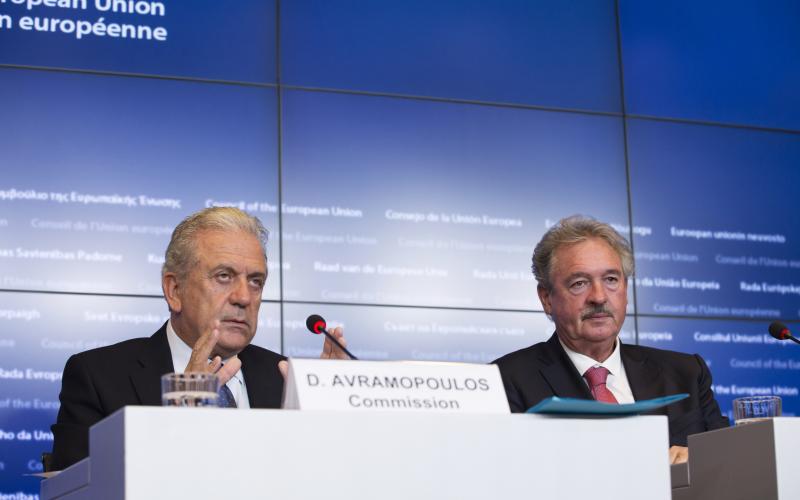
Luxembourg, 8 October 2015
First of all, let me thank Jean Asselborn and the Luxembourgish Presidency for the consistently excellent work and cooperation in dealing with the ongoing refugee crisis.
Today is another day of European joint progress.
First, I have informed Member States on the progress made on the implementation of the relocation mechanism and the roll out of the hotspot support teams in Italy and Greece.
The first relocation plane of Eritreans is taking off tomorrow from Italy to Sweden. This means that they have been registered, fingerprinted, identified and screened for relocation.
This also means that the first hotspot system in Italy is operational already in Lampedusa.
We will continue to work closely with the Italian authorities to deploy Support Teams in other hotspot areas in South Italy.
Tonight I will leave with Jean Asselborn to Italy for the first relocation that will take place tomorrow.
This relocation has a symbolic and a substantial character. Symbolic as it’s the beginning, a new start for what we are doing in this field, and substantial because it is a real tangible result of what we have started doing.
Later tomorrow afternoon, we will go to Greece to ensure that we can see a similar development from Greece soon, and my team is working day and night on the spot to make this happen.
This progress marks only the beginning – these efforts need to be pursued to provide more tangible results.
We have encouraged Member States to deploy their national experts and appoint liaison officers as quickly as possible, and to indicate as soon as possible the number of applicants that they can swiftly relocate already this month.
As you know, relocation is only one part of a more comprehensive approach.
Effective return of those who have no right to stay is the other side of the coin – and we have to become better at it.
Around 10 joint return flights are being organised in October. This is good but not enough.
We also want to make better use of existing information exchange systems such as the Schengen Information System and Eurodac to truly develop an integrated system of return management at EU level.
Working with third countries and establishing and implementing readmission agreements is also an essential element.
We have to step up our efforts with third countries from which irregular migrants come, such as Pakistan for example.
I will go to Pakistan at the end of October to discuss readmission with the Pakistani Government.
Of course, border management is equally important for the effective management of migration.
We all know that we are at a crossroad.
Shall border management remain a national responsibility or shall we move to a shared responsibility?
We had a very interesting debate today. This will feed into the upcoming proposal of the Commission which we will present before the end of this year.
In the end we can only address the ongoing refugee and migration crisis if we make progress in all areas.
As I have said before, the magnitude of the crisis makes it impossible to handle in a fragmented and isolated manner.
I welcome the fact that the Council has expressed today its support for the proposal adopted by the Commission on 30 September 2015 to increase the financial support to respond to the migratory crisis by more than €400m.
I hope that the Parliament, who has been very supportive form the very beginning in order to address this issue, will also approve swiftly our proposal.
This shows that the European Union can react quickly.
Together, we are building a common approach that will help everyone both in the short term and long term.
This also implies cooperating with our neighbourhood.
Later today we have the Western Balkans migratory routes conferences and next week I will go to Turkey.
Let’s continue the work. Let’s prove to the world that Europe is up to the challenge.