


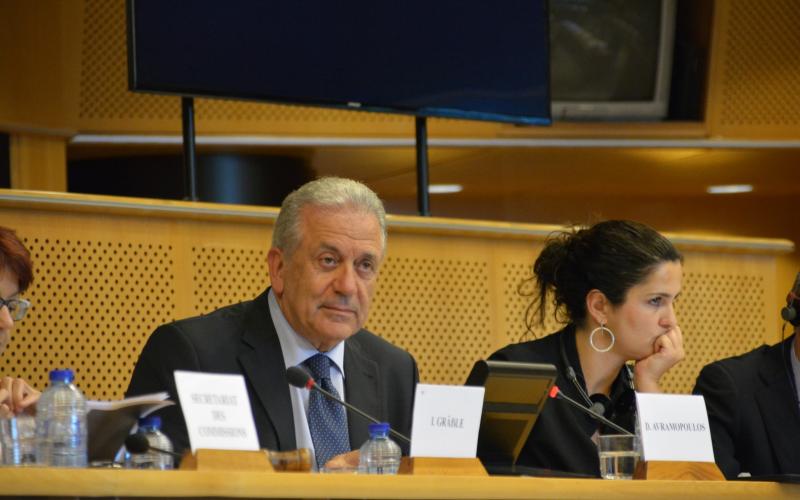
Honourable Members,
Dear colleagues,
As you might know it’s a pleasure for me to exchange views with your colleagues of the LIBE committee and I am happy to be finally able to exchange views with you.
Our previous try was cancelled because of dramatic events.
Europe is facing an unprecedented migratory crisis.
We witness this in Greece, where more than 57,000 people are currently stranded.
We also witness this in Italy with nearly 1000 arrivals per day last week.
250.000 persons were saved by the Joint Operations Triton and Poseidon in 2015 in their effort to cross the sea.
Today the focus is in Greece and Italy but it can be any country with external borders tomorrow.
And the pressure is not limited to frontline Member States, as this refugee crisis has shown to us.
Since the beginning, we have been doing the outmost to help the Member States under pressure.
Emergency financial support was granted
• to the front-line Member States,
• to transit countries such as Hungary, Croatia and Slovenia
• and to destination countries such as to France for Calais, or to Germany, or Austria and others,
with the objective of increasing their reception capacities and strengthening their asylum systems.
The funding served to finance, for example:
• asylum case workers,
• IT equipment,
• finger printing devices
• as well to reinforce the external border controls with equipment for border controls and border surveillance
Our support to the most affected Member States is not limited in financial means:
For example,
we have sent people on the ground who are working with the Authorities on a daily basis in order to find solutions to different challenges of this phenomenon.
Our response to the refugee crisis is comprehensive, outlined in the EU Agenda on Migration and its implementing packages.
It prioritizes:
• the protection of those in need,
• the return of those who have no right to stay,
• the fight against the smuggler’s networks,
• the joint protection of our external common borders
• the creation of legal ways for asylum seekers to reach Europe.
In this framework, last March, the EU and Turkey have adopted an important Statement of agreed actions to better manage the migration crisis.
This Statement is not a magic solution.
There are no magic solutions that will automatically solve the problem.
The implementation of the overall strategy is the key.
And to implement solutions, we need money.
At this point, let me thank the European Parliament for its support to our request for a EUR 1.6 billion budget reinforcement for 2016.
I plead for equal support on our migration and security needs for 2017 amounting to EUR 3 billion.
It is not a secret that the funding available is very limited compared to the needs we shall cater for as a matter of urgency.
To address the most burning challenges, we have significantly increased the budget for emergency actions.
A total of more than EUR 460 million has been made available as Emergency Assistance to Member States and to implementing partners working on the ground.
Our agencies, such as Frontex, EASO and Europol, are deploying hundreds of experts on the ground to support the implementation of the hotspots’ approach and the relocation process in Greece and in Italy.
Their resources have been scaled-up. But more needs to be done.
As you know:
– The mandate of Frontex is now going to be expanded into a European Border and Coast Guard;
– A proposal to expand EASO’s mandate into a genuine European Agency for Asylum is currently being discussed by the co-legislators.
This morning the Commission presented the second of two packages of legislative proposals to complete the reform of the Common European Asylum System, in line with our comprehensive strategy.
I count on the support of the European Parliament to advance rapidly in the negotiations on all key migration files currently on the table.
This morning, we have also presented the 5th report on relocation. There is an increase in the pace of relocations. Now is not the time to slow down!
On the contrary, it is the moment to pick up the pace even more.
Member States’ efforts need our continuous support to maintain and step up this positive trend.
And then there is the commitment to resettle more people from Turkey.
Because for every door that is closed to irregular migration, a window should be opened to offer a safe pathway.
The numbers are in fact promising with more than 8000 people having been resettled.
As regards the external aspects of our migration policy, we have recently adopted a Partnership Framework which will take the form of “compacts” with priority Third Countries.
This Partnership Framework is results oriented.
One of the core issues is the return of those who have no right to stay:
Return to be followed by sustainable reintegration is a costly process.
In the long term, this Framework will also address the root causes of irregular migration from these third countries.
Our policy is a challenging one, changing the landscape of the EU migration and Asylum policy,which has been totally fragmented until know and was not fit to respond to today’s challenges.
You can then agree with me that the resources available are limited.
And I will agree with you that this is one more reason why these limited resources shall be used effectively.
They shall be used for actions targeted at tackling the crisis. We cannot fail.
We have to deliver based on our limited resources.
At the same time, we have the obligation to make sure that these resources are used in line with sound financial management.
And I can assure you, Honourable Members, that I attach considerable importance to the sound financial management of the EU Budget in the Home Affairs Area.
Our funds are mainly implemented by the Member States under shared management.
The Member States have considerable autonomy in defining actions to be implemented.
The continuous and close coordination is helpful in ensuring the regularity of expenditure and also that the funds are spent in line with agreed objectives.
Control is assured through the assessment of annually submitted reports and audit opinions.
The Commission also monitors the programmes’ implementation.
The Commission also cooperates with the European Court of Auditors during its yearly audit and various performance audits.
In fact, one such performance audit on the Hotspots is underway.
The Commission will review the Court’s preliminary findings, once received, with great interest.
Because, I repeat, we need to deliver concrete results with the very limited resources available.
It is our obligation to inform on our work in full transparency. And these are not empty words: Apart from publishing factsheets on our financial support to Member States, we also publish every 15 days all commitments and payments made for each Member State under AMIF and ISF.
The Commission will report to the European Parliament and the Council next year on the implementation of the 2007-2013 Home Affairs Funds.
Regarding the Asylum, Migration and Integration Fund (AMIF) and Internal Security Fund (ISF), which as you know run from 2014 to 2020, an interim evaluation will be carried out between September 2017 and May 2018.
We will submit an interim Evaluation Report to the Parliament and the other Institutions by the end of June 2018.
All this will come on top of the annual reporting exercises on the implementation of the EU Budget.
Last week, Vice President Georgieva has presented to you the 2015 Annual Management and Performance Report for the EU Budget.
The immense challenges of 2015 required a combination of political initiatives and strategic use of the EU budget.
The EU response to the refugee crisis is a clear example of such a strategic approach to funding thanks to:
• rigorous monitoring of implementation
• and substantial redeployment efforts.
Focus, speed and results are our guiding principles.
I wish to thank you for your attention and I look forward hear your views and answer your questions.