
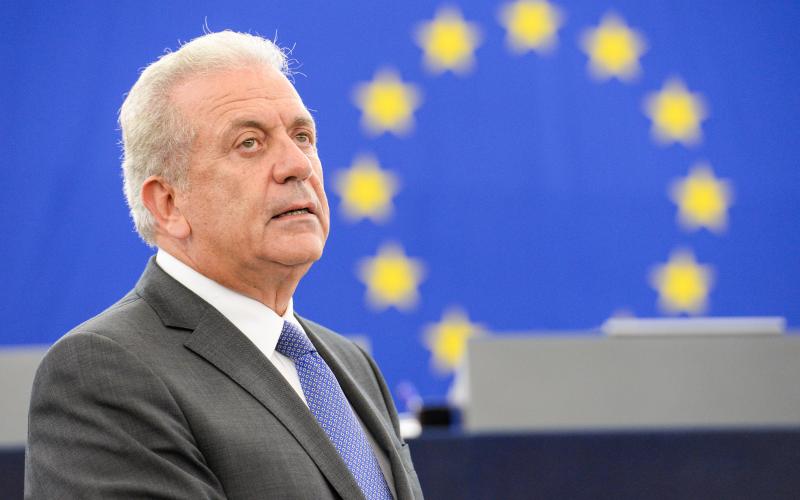
Video:
I would like to thank the rapporteur Ms Ska Keller for the draft report on this proposed amendment to the 2nd Council Decision on relocation.
Even when we disagree, it’s always a pleasure to be here and debate with you.
And what matters is that we agree on the political goal and on the importance of the success of the relocation scheme.
Because, relocation is the most tangible proof of European solidarity towards both the people in need of protection and overcharged Member States.
Better sharing of responsibility among Member States is not a pull factor;
Ιt is an indispensable tool at our disposal to better manage the refugee crisis and the migration challenge in general.
This is the essence of our comprehensive migration policy, as also President Juncker said this morning.
We have to be realistic: while Greece and Italy are making great efforts, they cannot shoulder the responsibility alone and entirely to host and protect all the asylum seekers present on their territory.
So, all Member States have to step in and take their part of responsibility.
We should not forget what these people went through, risking their lives to reach safety.
It’s time that they are all welcomed in countries where this protection will be offered properly, in line with our legal and moral obligations.
But most importantly, in the long term, we have to avoid that these people undertake such dangerous journeys by bringing them to Europe safely and legally.
This is what resettlement is about – and this task starts already now.
Now let me turn to this specific proposal.
The purpose of the Commission proposal was to provide the possibility for Member States to use the 54,000 unallocated relocation places for resettlement and
other forms of legal admission of Syrians from Turkey to the EU.
This is the essence of our proposal.
We cannot support amendments that change the essential purpose or substantially modify the main elements of the relocation procedure as provided in Council Decision 2015/1601.
Some of the amendments that you propose to the original Council Decision could, in principle, be acceptable for us.
We believe however that now it’s time for pulling together all our efforts to ensure a smooth implementation of relocation commitments.
So far 4741 migrants were relocated from Italy and Greece.
We all agree that it is not enough, but numbers have been steadily increasing.
We therefore have to keep going.
The Commission and the EU agencies work closely with all Member States:to define and implement efficient procedures allowing Member States of relocation to properly assess each application and to increase both the numbers and the speed of relocations.
Yesterday a relocation forum took place in Greece and tomorrow a meeting with all Member States will take place in Italy to find a common solution to increase relocations there too.
Our aim is to address, to the extent possible, the objectives behind some of your amendments.
(for example: shorter procedures, more regular pledges, EASO regular updates on eligible nationalities etc) As we are approaching the last year of implementation of the relocation schemes, further action is urgently needed to accelerate their implementation.
At this point, I want to reiterate the need for Member States to respond to the call of experts of EASO.
At the beginning of August, I sent a letter to all Member States to urge them to increase the number of migrants relocated.
I can assure you that I use all opportunities in bilateral meetings and at all Justice and Home affairs Councils to remind Member States that it is the moment to demonstrate solidarity.
The same goes for resettlement, where Member States should have all the tools in hand for delivering on their commitments.
So far 1,583 Syrians have been resettled from Turkey under the 1:1 mechanism since 4 April.
We will have to increase this figure urgently.
Our proposal today will introduce flexibility to ensure that all Member States that invest in relocation or resettlement will receive the necessary technical and financial support from the EU.
Relocation and resettlement should be among the top EU’s priorities in the months ahead, and they go hand in hand.
These are the real humanitarian needs that all Member States should stop merely talking about and start acting and delivering more.
Closing speech:
I would like to thank the Honourable Members for their remarks and questions.
I could not agree more with you about the need for Member States to relocate more and more asylum applicants and in parallel on the need for more resettlement.
We have invested a lot in making relocation and resettlement work in practice and we have started to see some good results.
However, our efforts must now significantly accelerate.
As I told you I have sent letters to the Ministers and I am planning direct communication with Ministers to encourage them to send a signal of commitment.
I would like to see real progress ahead of the JHA Council and in particular ahead of the October European Council.
To conclude: I thank you for coming here and share your frustration about the lack of results.
But here, in this Chamber, we all agree.
What is important is that you reach out your governments and you urge them to pledge.
What is equally important is to address directly the European citizens about our values, our own historical past, about the need to show solidarity to those in need today.
Dear Members of Parliament, don’t limit yourself in this Chamber.
You know better than anyone else that our EU migration policy was never an easy task to implement and that half of the victory will be the right communication.
Κύριε Κύρκο,
Σας ευχαριστώ γι αυτήν την ερώτηση.
Πρώτ’απ’όλα, τα νούμερα:
Οι πρόσφυγες που έχουν μετεγκατασταθεί από την Ελλάδα και τη Ιταλία είναι έως σήμερα 4741.
Οι πρόσφυγες που έχουν συνολικά επαναγκατασταθεί απευθείας στην Ευρώπη ανέρχονται στους 10.060
Είμαι ικανοποιημένος;
Απο τα νούμερα, προφανώς όχι ακόμα.
Υπάρχει όμως μια πρόοδος και παρατηρείται επιτάχυνση των διαδικασιών.
Όσον αφορά στην οικονομική ενίσχυση κ Χρυσόγονε, η Ελλάδα έχει λάβει και εξακολουθεί να λαμβάνει βοήθεια, τόσο στη μορφή επείγουσας χρηματοδότησης, όσο και μέσω των εθνικών προγραμμάτων που πρέπει οπωσδήποτε να απορροφηθούν.
Όπως είπα νωρίτερα, η επιτάχυνση και η αύξηση των μετεγκαταστάσεων είναι το βασικό θέμα συζήτησης με τους ομολόγους μου, σε κάθε διμερή επαφή και σε κάθε συμβούλιο Εσωτερικών Υποθέσεων, έστειλα μάλιστα σχετική επιστολή στις αρχές Αυγούστου.
Είναι η προτεραιότητα της Επιτροπής και δική μου.
Όπως και ο Πρόεδρος Γιούνκερ τόνισε σήμερα το πρωί η έννοια της αλληλεγγύης είναι νομικά δεσμευτική από τις Συνθήκες.
Λοιπόν ναι, η μετεγκατάσταση πρέπει να πετύχει.
Όχι μόνο για να ανακουφίσει την Ελλάδα και την Ιταλία από το δυσανάλογο βάρος.
Αλλά γιατί και κάθε άλλη Ευρωπαϊκή χώρα μπορεί να βρεθεί στην ίδια θέση στο μέλλον.
Και κυρίως, γιατί σε αυτές τις κρίσιμες για το πολιτικό μέλλον της Ευρώπης στιγμές, πρέπει να σταθούν όλοι στο ύψος των περιστάσεων.
Κι αυτό σημαίνει να επιδείξουν αλληλεγγύη και υπευθυνότητα στην πράξη και να σεβαστούν τις αποφάσεις που λαμβάνονται σε ευρωπαϊκό επίπεδο.
Επαναλαμβάνω κλείνοντας, ότι η μετεγκατάσταση παραμένει προτεραιότητα της Επιτροπής, και δική μου προσωπικά.