
Mesdemoiselles, Mesdames et Messieurs
Ladies and Gentlemen,
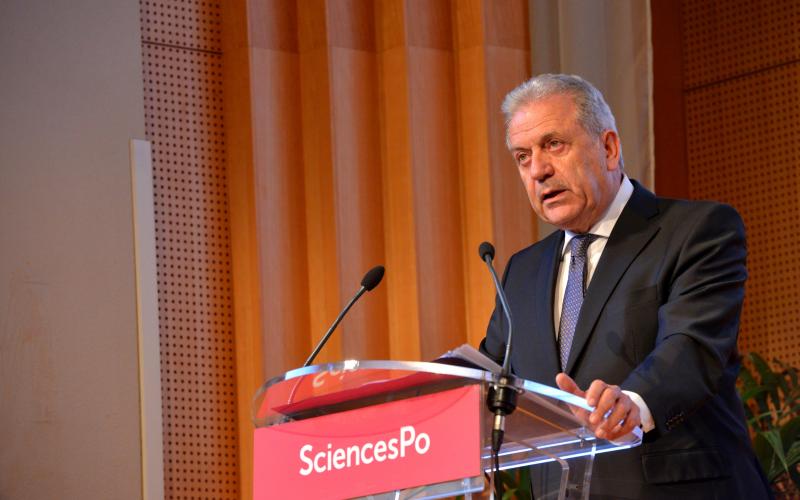
It is an honour for me to be with you at Sciences Po to open the Youth & Leaders Summit on a challenging and crucial topic: the migration crisis.
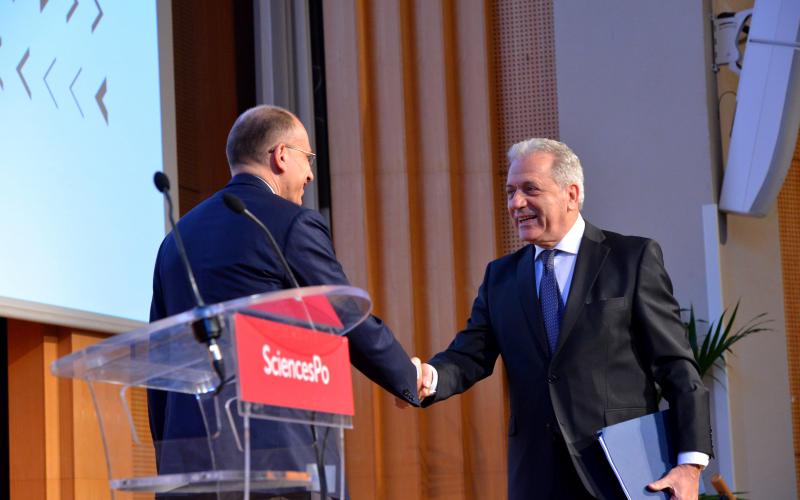
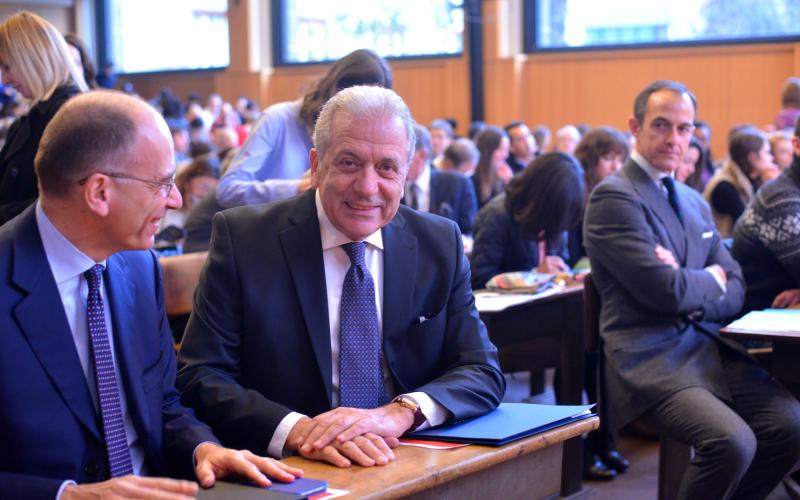
I would like to thank the Dean, Enrico Letta, for having invited me to this outstanding institution in front of such a diverse and inspiring crowd of future global leaders.
Ladies and gentlemen,
The phenomenon of migration today is seen both in Europe and around the world as one of the most difficult challenges our societies are confronted with. Today, more than 65 million people around the world are displaced from their homes.
People move to escape poverty, climate change, war and instability.
If we look at the different developments in the world today, we must be prepared that many other people will continue to be displaced.
This makes one thing crystal clear: we have entered the era of human mobility and diversity.
Understandably, not everyone is comfortable with this reality, particularly in a context of rising security and terrorism threats.
In fact, we see a resurgence of populism and xenophobia, of rhetoric that favours fences and closed borders.
Citizens want concrete solutions. They want safety and stability whether they live in France, the United States or Turkey.
But our safety and stability is not isolated, it is shared. What happens in Syria, is felt not just in Turkey, but also in Greece, Germany and Sweden.
What happens in Northern Africa is felt in Italy, in France, in Belgium, in the United Kingdom.
As our world becomes more globalised, it also becomes more interconnected.
Our main challenges today are global, and so should be our actions and solutions.
Last September an historic UN General Assembly Summit on migration took place, where global leaders came together and agreed to step up their efforts to have better migration policies together.
In the beginning of the migration crisis, our responses were uncoordinated, within Europe but also across the world.
Today, we are not where we were two years ago. Thousands of people have been resettled, to Europe, to the US, to Canada.
Thousands of people have also been saved in the Mediterranean.
The European Union has made an enormous effort to address the challenges of migration, both inside and outside Europe.
Inside the EU, we are now reforming our common asylum system to be more humane, fair and efficient.
In order to relieve the pressure from Greece and Italy, we have already relocated more than 10,000 people in urgent need of protection to other countries in the EU.
In parallel, we have reinforced the management of our external borders through the establishment of the European Border and Coast Guard last October.
In order to further reduce irregular migration, we have enhanced legal channels, not just for protection through resettlement, but also for talent from abroad to come work and live in the EU.
Finally, we cannot underestimate the importance of integration, because the cost of NOT investing in the full participation of migrants who can legally stay here, will far outweigh the investments that we make now.
History has taught us that. When we look outside Europe, the European Union is the number one donor of humanitarian aid, taking action to provide lifesaving emergency aid to refugees with more than EUR 5 billion already mobilised.
We are helping displaced people within Syria as well as Syrian refugees and their host communities in Lebanon, Jordan, Iraq, Turkey and Egypt.
The implementation of the EU-Turkey Statement of last March is part of our comprehensive approach.
It has drastically reduced both crossings but also deaths in the Aegean.
Similarly, with our new Partnership Framework we have also started a genuine political dialogue with key countries of origin and transit, mainly in Africa.
We try to help them to better manage migration holistically, focusing on the fight against criminal smugglers networks, improving border and migration management but also cooperation on readmissions of irregular migrants.
Most importantly, we want to help address the real root causes and why people leave in the first place, by investing in better opportunities and futures.
This is why we have created the EU Emergency Trust Fund for Africa, worth EUR 2.2 billion for tailor-made, flexible and quick assistance.
We have also set up a new EU External Investment Plan with the aim of unlocking at least EUR 44 billion of investments in partner countries, promoting growth and jobs and addressing the long term drivers behind migration.
While important progress has been made over the past two years, in Europe as well as globally, we are not there yet, and the refugee crisis is not over yet.
There is no quick fix to the migration challenges today. This creates increasing frustration, impatience and, most worryingly, intolerance.
At a moment when we should push through, we see the risk of withdrawal.
In the European Union, the challenges of migration have increasingly divided our unity.
They have put our core values of cohesion and responsibility under pressure, if not even at stake.
In particular, one of the major achievements of the EU: Schengen and the free movement of EU citizens without internal border controls is put into question today while many of you might take for granted.
Some of the European students here today have never known anything else than travelling freely across European borders without having to show their passport.
I am part of a generation that does remember the stamps, the queues and the uncertainty sometimes of crossing borders in Europe.
In many other places in the world today, passports are not always a privilege, and borders are not openings
as I’m sure some of you in this room will know. After peace and stability, freedom of movement is the most cherished wish of most Europeans, particularly the younger generation.
But you don’t need to be European to believe in peace, stability or free mobility.
Dear friends,
As students at the prestigious Sciences Po in Paris, you will appreciate the importance of history and the lessons it can teach us when we look at our present and our future.
You are all studying in a country which is one of the founders and pillars of the European Union and of European unity.
While this year, we celebrate the 60th anniversary of the Rome Treaty, we are not where the European Founding Fathers would have expected us to be.
Instead of proving that this Union is open, tolerant and inclusive – a true Union – we are seeing shadows from our recent past which we never thought we would see again.
We find ourselves at a historic crossroad, facing challenging times.
Most worryingly, some seem to have forgotten the very essence of why the European Union exists in the first place: to ensure peace and stability.
Instead, we see walls and fences being erected; populism and xenophobia are gaining ground and are threatening our democracies.
We find ourselves in the city that has been hit twice by atrocious terrorist attacks in one year – but it is a threat that is not limited to Paris or France alone.
We have a country – the United Kingdom – that has voted to leave the European Union, and we have new leadership across the Atlantic.
The US has been one of the main actors leading to a united Europe after World War II. Moreover, the US is made mainly of European migrants – Italians, Greeks, Irish, Germans. I hope our strong cultural and historical ties will prevail in the future in a positive spirit.
Next year we will commemorate the 100 anniversary of the end of the First World War.
In three years, we will celebrate 75 years of peace since the end of the Second World War, across the globe.
But the aftermath of this war, and this hard-fought peace and stability risk being forgotten and taken for granted.
This is why we need the future generation of leaders that is sitting in front of us here to be ready to take up the challenges we have in front of us.
And I wish to finish my speech by addressing these future young leaders in particular.
My dear friends, As you read history, as you witness political developments around you, as you start to engage actively in political and civil society, do not overlook the lessons of the past.
Use the unique transnational relationships that you have built here, to further strengthen our global society.
I hope that the values of commitment and excellence as well as of inclusion, equality, diversity and tolerance that have been impressed on you in this renowned institution will guide you in your endeavours to maintain and complete the project that we lead, and to build a better, safer, more welcoming and thriving future for all of us.