
Brussels, 20/10/2015
Dear Minister,
Your excellencies,
Honourable Members of the European Parliament,
Ladies and gentlemen,
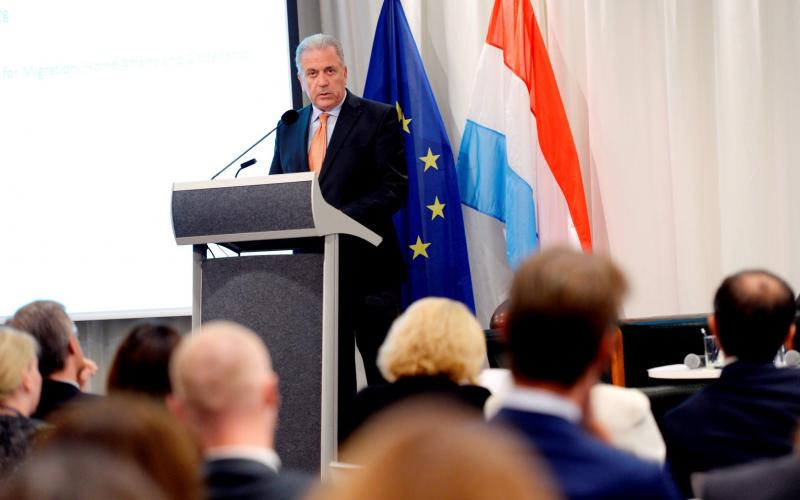
It is with great honour that I address you on the occasion of the European Union Anti-trafficking Day.
Trafficking in human beings is the selling and buying of women and men. Of girls and boys.
It is the abusing of people as commodities. This is a crime completely at odds with our European values and has no place in our societies.
For several years already, the European Union has demonstrated strong political commitment to address this phenomenon.
We have developed a comprehensive and dynamic legal and policy framework.
Our main instruments, the EU Anti-Trafficking Directive and the EU Strategy towards the Eradication of Trafficking in Human Beings underpin our ambitious work.
This is a legal and policy framework which puts victims at the centre.
Victims who must be all treated equally, irrespective of form of exploitation.
A framework anchored in fundamental rights.
A framework which takes the best interest of the child at its heart.
A framework that is gender specific.
Since 2007, the European Commission has marked the European Union Anti-Trafficking Day on the 18th of October and brought together the relevant stakeholders in this field.
Today is an opportunity for all of us to reaffirm our commitment to eradicate trafficking in human beings.
Today is an opportunity to remind ourselves that people’s lives, fundamental rights and human dignity, are at the core of addressing this crime.
Trafficking in human beings is grave violation of human rights, expressively prohibited in the EU Charter of Fundamental Rights.
We have victims we must protect, assist and ensure they have access to their rights.
I am now ensuring that actions addressing trafficking in human beings are part of the new European Agendas on both Security and Migration.
Let me be clear. Trafficking in human beings is a form of serious organised crime fuelled by the high profits for traffickers.
It is a phenomenon fuelled by the continuing demand of services provided and goods produced by exploiting victims and their vulnerabilities.
In times like ours, with the refugee crisis, we can only expect more vulnerable people, especially children, to be exposed to unscrupulous networks of traffickers.
To eradicate trafficking in human beings, we are commited to reduce demand for all forms of exploitation.
We must continue to follow the money and the perpetrators who benefit from this highly profitable yet low risk activity.
We will speed up on cracking down on the criminals, their networks and hit them where it hurts the most: their profits.
Let us not forget that EU law is clear: it obliges the Member States to prevent trafficking in human beings.
It obliges Member States to reduce the demand that fosters all forms of exploitation.
Today, I present to you a series of deliverables of the EU anti-trafficking Strategy.
First, allow me to speak for the most vulnerable.
Our children.
All children regardless of their migration status or nationality.
We are delivering a study that examines the risk and resilience factors that render children vulnerable to trafficking.
Together with the EU Fundamental Rights Agency, we also now have made available the translated version in all EU official languages of the EU Handbook on Guardianship.
Many of you know in this room that this handbook was warmly welcomed by Member States Authorities and that the European Asylum Support Office is already making use of it.
In addition, we have the new report of the EU Fundamental Rights Agency on guardianship systems across the European Union.
These are parts of our joint efforts to assist Member States in protecting the most vulnerable of all.
Of course our focus is also on all types of vulnerabilities.
That is why we are delivering today a first comprehensive study on the case law on trafficking in human beings for the purpose of labour exploitation.
We are also delivering today a study on prevention, which examines prevention initiatives on trafficking in human beings. These studies are available on our website.
All these deliverables expand our knowledge on an atrocious and inacceptable phenomenon.
Such knowledge helps us, helps you, helps all of us address this phenomenon better. But our work is unfortunately not over yet.
In March 2016, we will submit the first EU Report on the progress made in addressing trafficking in human beings.
We will also submit another report which will assess the measures taken by Member States to comply with the anti-trafficking Directive.
A third report will specifically assess the impact of existing national laws that criminalise the use of services of victims of trafficking.
The deadline for the transposition of the EU Anti-trafficking Directive expired on 6 April 2013.
The Commission continues to proactively monitor its transposition and implementation by Member States and does not hesitate to take actions.
To date, 26 Member States out of the 27 MSs bound by the legislation have officially notified the European Commission of full transposition at national level. Only Germany remains.
Now, after more than 2 years it is really time to ensure that this ambitious legislation is fully implemented.
Finally, we will follow the success of the current EU Strategy against trafficking.
We will present the European Agenda to eradicate trafficking in Human Beings post-2016.
Ladies and Gentlemen,
Trafficking in human beings is a serious form of crime and a violation of human rights that we will not tolerate.
We will follow the profits and the demand that fuel this heinous crime.
We will pursue our struggle to interrupt the activities of criminal networks.
We will work to bring the perpetrators to justice.
We will ensure victims have access to their rights.
We have everything necessary to do so: a strong legal and policy framework and the commitment to work together.
What we need now are actions.