
Ladies and Gentlemen,
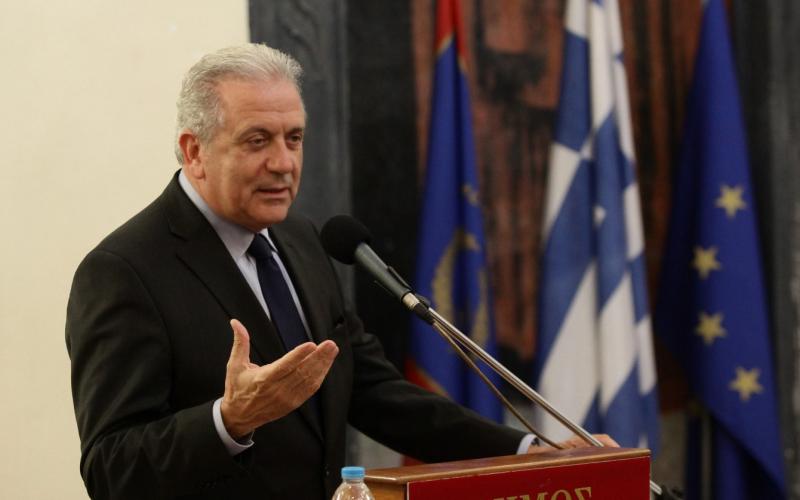
I am glad to be here with Secretary General Jagland, with Minister Xydakis, with the Mayor of Nafplion Mr Kostouros, with Representatives of Region and local authorities
and with the President of the Hellenic Society of International Law and International Relations, Mr Tsaltas.
Dear friends,
I would like to start by thanking Secretary General Jagland and the Council of Europe, the Greek Ministry of Foreign Affairs and the Panteion University for the organisation of this conference in the first capital of Greece. Discussing about human rights and values in the city of Nafplion has a symbolic dimension.
I will explain to you why: It was in Nafplion where Ioannis Kapodistrias, the first Governor of Greece, has landed on 7 January 1828 to start working on the foundation of a modern State.
Greece was not even existing as a State, ravaged by wars and divided. This did not discourage Kapodistrias: Kapodistrias was a man of vision. He started working in order to set up a state with inspiration and a fully-fledged strategy
of reforms on all areas.
Kapodistrias was assassinated, in this same city, on the steps of the church of Saint Spyridon in Nafplion on October 9th, 1831. He didn’t see his vision accomplished. Which has an equally strong symbolic importance: it reminds us of how ungrateful humans can be.
Has Kapodistrias survived the destiny of Greece would have been different. It is also good to know that Kapodistrias was a European visionary as well. The European Union, our Union, was equally founded by men of vision. The European continent was as well ravaged by wars and divided. This did not discourage the founding fathers either. They conceived and created a unique idea of a Union that ensured prosperity and peace, the longer period of peace in the European History. This has offered to our generation the privilege to be the unique generation of history not to have experienced and suffered a war.
A legacy not to be considered as granted and given. Today I am worried.
The ghosts of nationalism, of populism, of division have returned to Europe, bringing with them hatred and fanatism.
The European Idea risks to be assassinated from within. Walls are erected, borders are closing, statements that were unconceivable and remind us of the recent dark past are tolerated.
Because, as I said, human nature is ungrateful: It took only some decades of peace to forget what we owe to the European Union.
It took only some decades of wealth to forget what war, starvation, devastation is.
But above everything what solidarity is.
And let’s be honest: it only took some hundred thousand refugees asking protection, arriving in our shores, to scare us. To scare a generation who’s grandparents majority were war refugees as well.
This is why I am saying, and I will repeat it today, that the migration challenge is the catalyst that will either tear apart, or grow an even stronger European Unity.
This will depend on the way we respond to it. The Juncker Commission hasn’t hesitated for a moment. It is a Commission with vision and determination.
We responded to the challenge with a comprehensive policy, addressing all aspects of it,
based on the values of solidarity, of responsibility, and most importantly, on the respect of Human Rights.
These principles are embedded in the definition of the European Union and there was no doubt that they are guiding us in developing our migration policy as well.
Lets remind some facts. In 2015, more than 1.3 million persons applied for asylum in the EU, which put a considerable strain on several EU countries.
The refugee crisis has shown the weaknesses in our Common European Asylum System. Different national approaches have fuelled asylum shopping and irregular migration, while we have seen in the ongoing crisis that the Dublin rules have placed too much responsibility
on just a few Member States.
Let there be no doubt: those who need protection must continue to receive it. Asylum is a human right.
We are firmly committed to the promotion and protection of the human rights of migrants.
Our policies are founded on the principles of: non-discrimination, proportionality, non-refoulement, access to justice and the best interests of the child.
The principal of non-refoulement It is not only a moral but also a legal obligation by which the EU and Member States are bound.
However, applicability of the principle of non-refoulement does not mean that the persons concerned automatically gain a right to enter and remain on the territory of the Member State.
Let me stress that in all our efforts our chief concern is to save lives, to protect the right to life, this most basic and fundamental right of every human being. Increasing our ability to stem the migration flows, ensuring legal paths to Europe, preventing secondary movements has one fundamental aim: to avoid an unnecessary and preventable loss of life.
This includes fighting smugglers.This means preventing situations when people put their life in danger, placing them in the hands of ruthless smugglers.
One of the themes of your conference is “Determining the right to international protection and the process of return of irregular migrants”.
In that context let me say a few words about the revision of the Dublin Regulation that we have recently proposed.
Let me stress that having an efficient system of allocation of responsibility is a condition for ensuring the effective right to international protection in Europe.
Making the procedure swift and more efficient means the applicant will have quicker access to protection. This is our priority.
The current uneven distribution is clearly unsustainable. For the legitimacy and efficiency of the EU’s asylum system over the longer term, we proposed a corrective allocation mechanism that will relieve Member States confronted with disproportionate number of applications.
Our Dublin proposal also contains quite a few provisions which aim to strengthen the rights of applicants, for example: Appeals will have automatic suspensive effects meaning no transfers will be carried out while the appeal is ongoing;
The right to liberty and freedom of movement will be reinforced by shortening the time limits under which a person may be detained in exceptional cases and only if it is in line with the principles of necessity and proportionality;
We have extended the definition of the family members by including siblings of the applicant and families formed also outside the country of origin (but before arriving to the EU).
The rights of unaccompanied minors have been strengthened through making it obligatory to determine the best interests of the child by qualified staff in all circumstances implying the transfer of a minor.
And indeed in the current crisis we should have particularly in mind the protection of vulnerable groups, which is another topic you will discuss in your conference.
We are determined to enforce our legal standards regarding those groups.
In particular children require special attention from their arrival at our borders, during their stay and eventually, in the case of return.
Additional safeguards are provided for children, in particular unaccompanied minors, as regards access to international protection.
The reforms we are undertaking, and implementing speedily, have as their aim to safeguard the basic human rights of migrants and guarantee access to protection to those who need it.
We take due account of our legal human rights obligations while reforming our system.
Let me finish in a very realistic tone.
We know that the situation is not perfect in all reception centers around and close to Europe.
We know that children are still arriving alone on boats. We know that we cannot cut down all the smugglers immediately, in and outside Europe. We see images that are still shameful for our civilisation.
This Commission and me personally, try to remind in every way that only by common and coordinated effort we will be able to uphold our values. I want to assure you that I will continue to do my part.
This Commission won’t give up to its moral and legal obligations. To its duty as Guardian of the Treaties of the Union. Treaties, explicitly based on the principles of Solidarity and Responsibility.
We have already mobilized every possible financial support, expertise, we have sent our people on the ground, we are putting political and legal pressure to the Member States to play equally their role.
Partners to this are the Council of Europe and International Organisations, representatives of which I see here present today.
Here I would like to make a special reference to the Secretary General Jagland.
A personality globally respected and fully committed to his noble mission.
Ladies and Gentlemen,
We can however be proud for many thousands lives saved by our Coast Guards of Italy, of Greece, but also of all Member States that are participating in the operations of FRONTEX.
It has to be noted that many refugees have already found shelter in Europe and started building a new life here.
We should show respect for the citizens here, in Greece and elsewhere, who opened their hearts and houses to welcome the migrants.
We are touched by the images of solidarity of volunteers who work daily to offer health care, food, services and relief. Still, every life lost, is one too many. Because right now as we talk people are drowned in the Mediterranean.
And when we talk about the refugee crisis, we should not mention numbers as most are doing.
We should think of the humans, of their personal adventures, of the desperates behind every tragedy.
This will keep us going to do our duty: to make our best to ensure the respect of the life and dignity of every migrant.
Because we do that in the name of Europe. In the name of our values and our civilisation.
Upholding the values of the European Union is the only way to feel, think, act as Europeans.
Dear Friends, thank you for your attention.
I wish you every success for the work of your conference and I look forward to your remarks, proposals and conclusions.