
Developments in the Middle East and the wider Eastern Mediterranean region are shaping an environment of heightened uncertainty and geopolitical fluidity. The crisis involving the United States, Israel, and Iran does not concern only the countries directly involved. It is reshaping the overall balance of power, affecting critical sea lanes and energy flows, testing the resilience of economies, and bringing back into focus the role of states located at the geopolitical crossroads of the region.
In this environment, Greece and Cyprus are gaining even greater importance. The Republic of Cyprus is not a distant geographical reference. It is a member state of the European Union, a pillar of stability in the Eastern Mediterranean, and an integral part of the broader strategic space of Hellenism. Greece’s support for Cyprus is not a matter of circumstance. It is a historical, political, and strategic responsibility, an institutional imperative, and a constant axis of our national continuity.
The recent movement by Greece to strengthen security in the region, through the presence of naval and air assets, does not have an offensive character. Its aim is to reinforce deterrence and prevent further escalation. Deterrence works when it is clear, measured, and integrated into a defensive framework, not when it is misinterpreted as a display of power. The message must be clear: protection, stability, and avoidance of involvement in offensive operations. At a time when the region is experiencing high tension, Greece’s role is not to fuel the fire, but to help contain it—while keeping our own space secure and reinforcing the protection of Cyprus.
Within this landscape, Turkey is observing developments with attention and a certain degree of unease. Ankara’s official reaction remains restrained, although some media outlets claim that the strengthening of the defensive “umbrella” from Karpathos to Cyprus creates pressure on Turkey or causes it to “suffocate.” Such interpretations do not reflect reality. Turkey understands that direct involvement in a crisis of this magnitude would carry significant political and economic costs. At the same time, however, it will attempt to make use of the new environment in order to strengthen its geopolitical utility, present itself as a player able to communicate with all sides, and—if an opportunity arises—offer mediation “services,” as it has tried to do in other crises. This is a familiar Turkish practice: transforming uncertainty into negotiating capital.
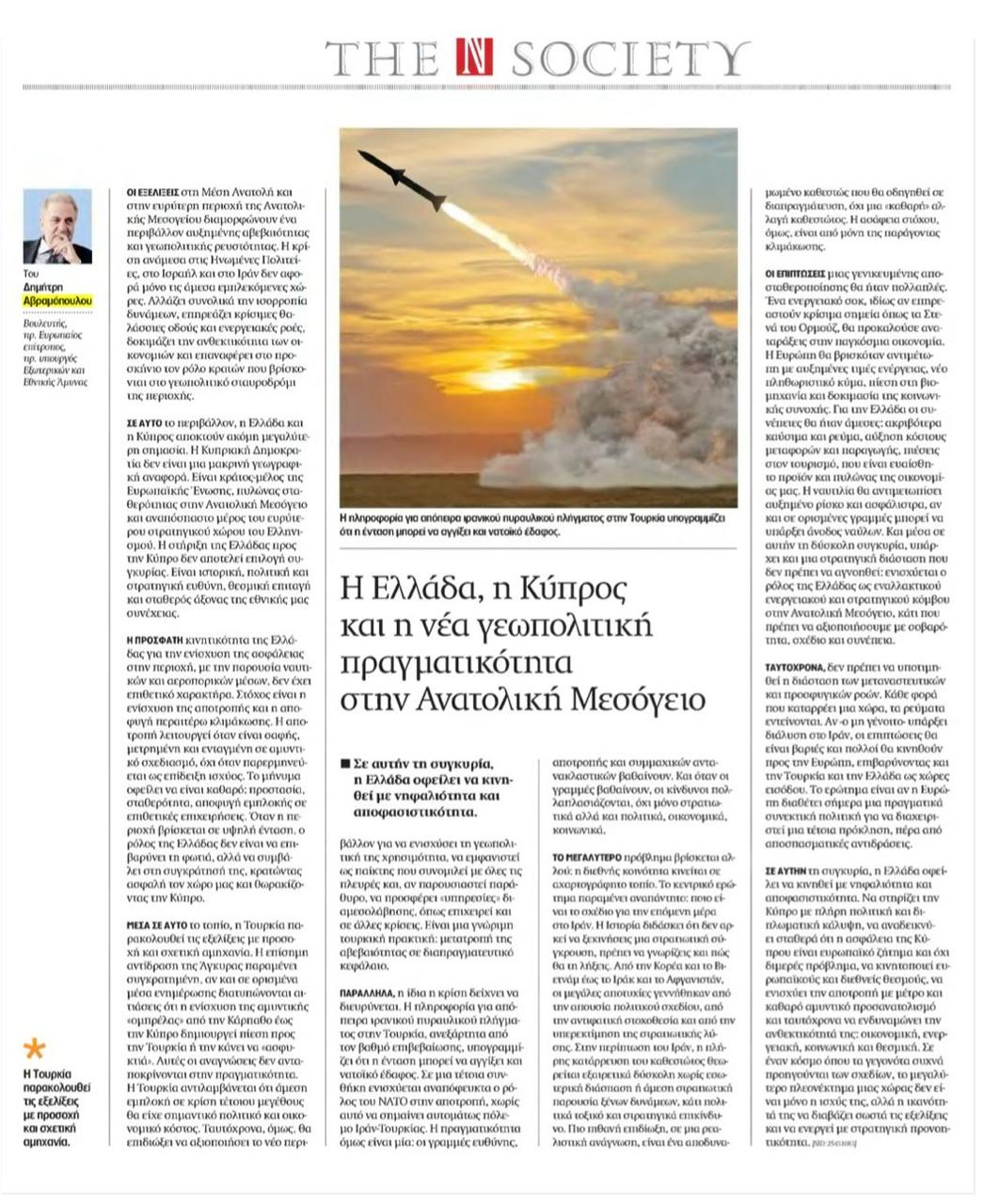
At the same time, the crisis itself appears to be widening. Information about an attempted Iranian missile strike against Turkey—regardless of the degree to which it has been confirmed—highlights that tensions could reach NATO territory as well. Under such circumstances, NATO’s role in deterrence is inevitably reinforced, without this automatically implying a war between Iran and Turkey. The reality, however, is clear: the lines of responsibility, deterrence, and allied reflexes are deepening. And when these lines deepen, risks multiply—not only militarily, but also politically, economically, and socially.
The most serious problem lies elsewhere: the international community is moving through uncharted territory. The central question remains unanswered: what is the plan for the day after in Iran? History teaches that it is not enough to begin a military conflict; one must also know how it will end. From Korea and Vietnam to Iraq and Afghanistan, major failures have emerged from the absence of a political plan, from contradictory objectives, and from the overestimation of military solutions. In the case of Iran, the complete collapse of the regime is considered extremely difficult without internal fragmentation or the direct military presence of foreign forces—something politically toxic and strategically dangerous. A more realistic objective may be a weakened regime that is eventually led to negotiations, rather than a “clean” regime change. Yet the ambiguity of the objective is itself a factor of escalation.
The consequences of a generalized destabilization would be multiple. An energy shock—especially if critical points such as the Strait of Hormuz were affected—would cause turbulence in the global economy. Europe would face rising energy prices, a new inflationary wave, pressure on industry, and a test of social cohesion. For Greece, the consequences would be immediate: more expensive fuel and electricity, rising transportation and production costs, and pressure on tourism, which is both a sensitive product and a pillar of our economy. Shipping would face increased risk and higher insurance costs, although on certain routes freight rates might rise. And within this difficult context there is also a strategic dimension that should not be overlooked: the role of Greece as an alternative energy and strategic hub in the Eastern Mediterranean is strengthened—an opportunity that must be utilized with seriousness, planning, and consistency.
At the same time, the dimension of migration and refugee flows should not be underestimated. Whenever a country collapses, migration pressures intensify. If—heaven forbid—there were to be a breakdown in Iran, the consequences would be severe, and many people would move toward Europe, placing additional pressure on both Turkey and Greece as entry countries. The question is whether Europe today possesses a truly coherent policy to manage such a challenge, beyond fragmented reactions.
In this context, Greece must act with composure and determination. It must support Cyprus with full political and diplomatic backing, consistently highlight that the security of Cyprus is a European issue rather than a bilateral problem, mobilize European and international institutions, strengthen deterrence with restraint and a clear defensive orientation, and at the same time reinforce its own resilience—economic, energy-related, social, and institutional. In a world where events often precede plans, the greatest advantage of a country is not only its power, but also its ability to read developments correctly and act with strategic foresight.