
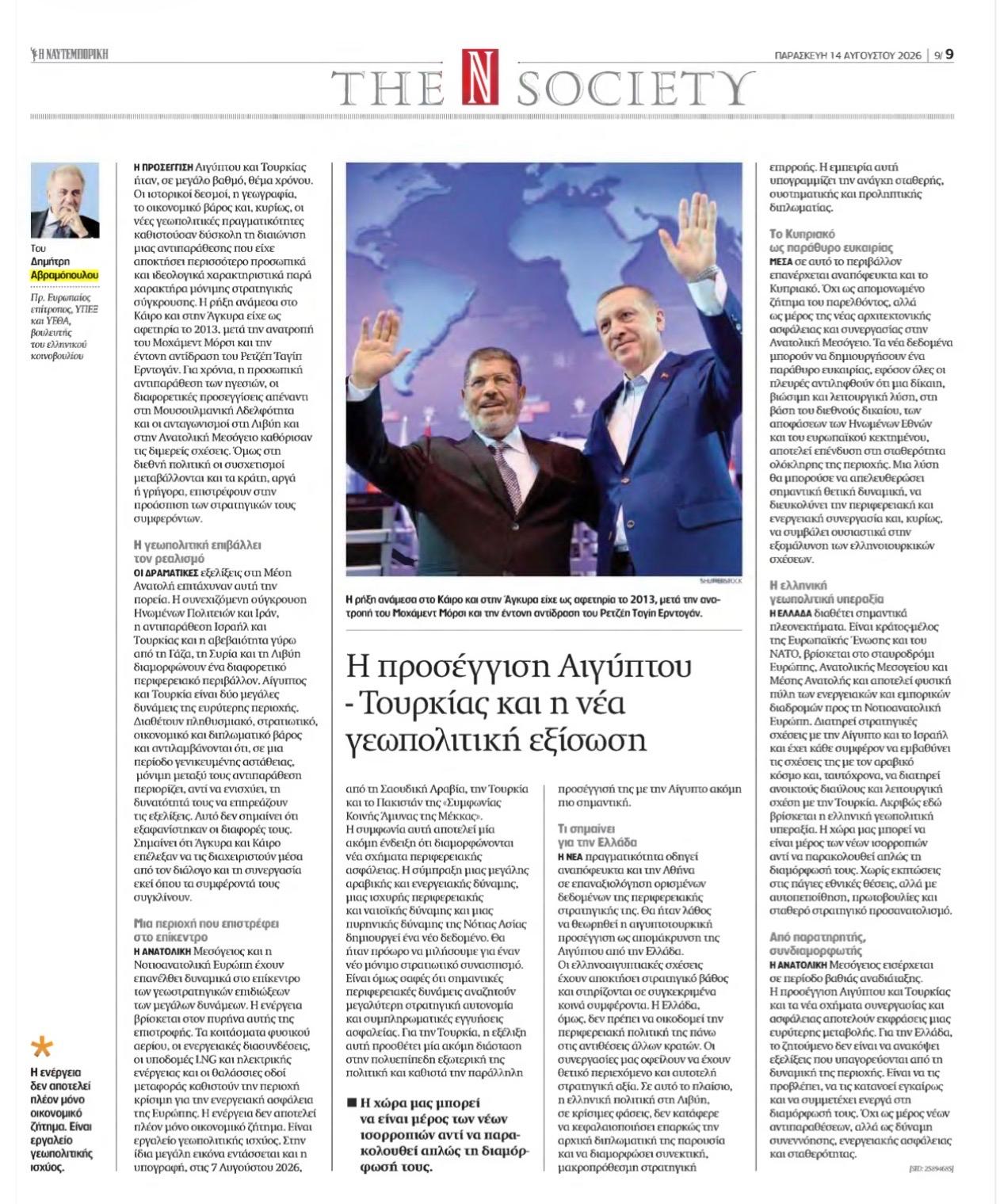
The rapprochement between Egypt and Türkiye was, to a large extent, only a matter of time. Historical ties, geography, economic weight and, above all, the new geopolitical realities made it increasingly difficult to perpetuate a confrontation that had acquired more personal and ideological characteristics than those of a permanent strategic conflict.
The rupture between Cairo and Ankara dates back to 2013, following the ousting of Mohamed Morsi and the strong reaction of Recep Tayyip Erdoğan. For years, the personal rivalry between the two leaderships, their differing approaches towards the Muslim Brotherhood, and their competing interests in Libya and the Eastern Mediterranean shaped bilateral relations.
Yet in international politics, balances of power change, and states, sooner or later, return to safeguarding their strategic interests.
Geopolitics Calls for Realism
The dramatic developments in the Middle East have accelerated this process. The ongoing conflict between the United States and Iran, the confrontation between Israel and Türkiye, and the uncertainty surrounding Gaza, Syria and Libya are shaping a different regional environment.
Egypt and Türkiye are two major powers in the wider region. They possess demographic, military, economic and diplomatic weight and recognise that, in a period of widespread instability, permanent confrontation between them limits, rather than enhances, their ability to influence developments.
This does not mean that their differences have disappeared. It means that Ankara and Cairo have chosen to manage them through dialogue and cooperation wherever their interests converge.
A Region Returning to the Forefront
The Eastern Mediterranean and Southeastern Europe have once again emerged as a major focus of the great powers’ geostrategic ambitions.
Energy lies at the heart of this renewed focus. Natural gas reserves, energy interconnections, LNG and electricity infrastructure, and maritime transportation routes make the region critical to Europe’s energy security. Energy is no longer merely an economic issue. It is an instrument of geopolitical power.
The signing, on 7 August 2026, by Saudi Arabia, Türkiye and Pakistan of the “Mecca Joint Defence Agreement” should also be viewed within this broader picture.
This agreement is yet another indication that new regional security frameworks are taking shape. The partnership between a major Arab and energy power, a strong regional and NATO power, and a nuclear power in South Asia creates a new strategic reality. It would be premature to speak of a new permanent military alliance. It is nevertheless clear that significant regional powers are seeking greater strategic autonomy and complementary security guarantees.
For Türkiye, this development adds another dimension to its multi-layered foreign policy and makes its parallel rapprochement with Egypt even more significant.
What It Means for Greece
The new reality inevitably requires Athens to reassess certain aspects of its regional strategy.
It would be a mistake to interpret the Egyptian-Turkish rapprochement as Egypt distancing itself from Greece. Greek-Egyptian relations have acquired strategic depth and are based on concrete shared interests.
Greece, however, should not build its regional policy around the differences between other states. Our partnerships must have a positive substance and independent strategic value.
In this context, at critical stages, Greek policy towards Libya failed to sufficiently capitalise on its initial diplomatic presence and to develop a coherent, long-term strategy for building influence. This experience underscores the need for consistent, systematic and proactive diplomacy.
Cyprus as a Window of Opportunity
Against this backdrop, the Cyprus issue inevitably returns to the fore. Not as an isolated issue of the past, but as part of the new security and cooperation architecture in the Eastern Mediterranean.
The new circumstances could create a window of opportunity, provided that all sides recognise that a fair, sustainable and viable solution, based on international law, United Nations resolutions and the European acquis, constitutes an investment in the stability of the entire region.
A solution could unleash significant positive momentum, facilitate regional and energy cooperation and, above all, make a substantial contribution to the normalisation of Greek-Turkish relations.
Greece’s Geopolitical Added Value
Greece possesses significant advantages. It is a member state of the European Union and NATO, is located at the crossroads of Europe, the Eastern Mediterranean and the Middle East, and serves as a natural gateway for energy and trade routes towards Southeastern Europe.
It maintains strategic relations with Egypt and Israel and has every interest in deepening its relations with the Arab world while, at the same time, maintaining open channels and a functional relationship with Türkiye.
This is precisely where Greece’s geopolitical added value lies.
Our country can be part of the new balances taking shape rather than merely observing their emergence. Without compromising its established national positions, but with confidence, initiatives and a consistent strategic orientation.
From Observer to Co-Shaper
The Eastern Mediterranean is entering a period of profound realignment. The rapprochement between Egypt and Türkiye, together with the new frameworks for cooperation and security, are expressions of a broader transformation.
For Greece, the objective is not to obstruct developments driven by the dynamics of the region. It is to anticipate them, understand them in good time and actively participate in shaping them.
Not as part of new confrontations, but as a force for dialogue, energy security and stability.