
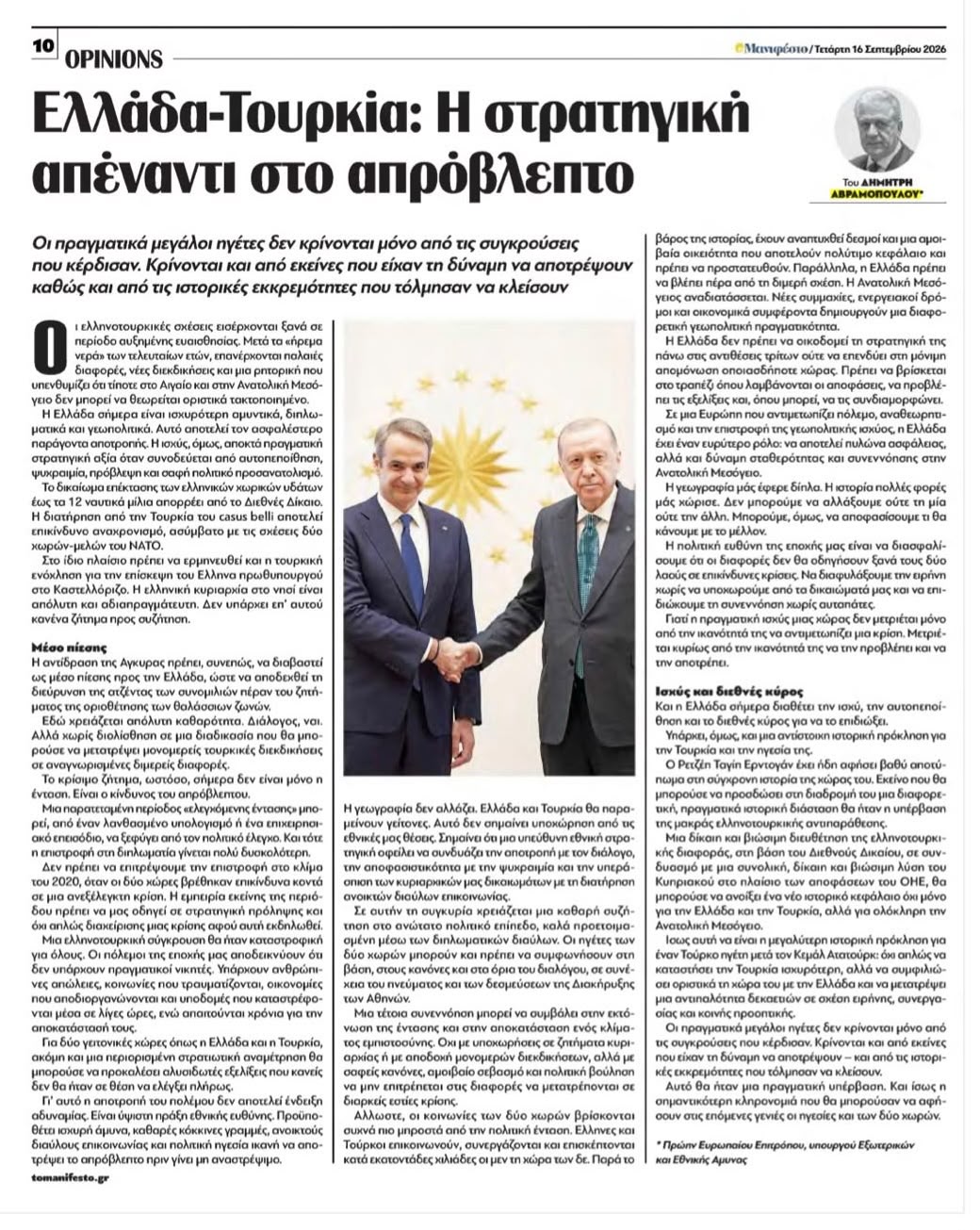
Greek-Turkish relations are once again entering a period of heightened sensitivity.
After the “calm waters” of recent years, old differences, new claims, and rhetoric that reminds us that nothing in the Aegean and the Eastern Mediterranean can be considered definitively settled are resurfacing.
Today, Greece is stronger in terms of defence, diplomacy, and geopolitics. This constitutes the safest deterrent factor. Strength, however, acquires real strategic value when it is accompanied by confidence, composure, foresight, and clear political direction.
The right to extend Greece’s territorial waters to 12 nautical miles derives from International Law. Turkey’s continued maintenance of the casus belli constitutes a dangerous anachronism, incompatible with relations between two NATO member states.
It is in the same context that Turkey’s irritation over the Greek Prime Minister’s visit to Kastellorizo should be understood. Greek sovereignty over the island is absolute and non-negotiable. There is no issue to be discussed on this matter.
A Means of Pressure
Ankara’s reaction should therefore be understood as a means of exerting pressure on Greece to accept an expansion of the agenda of the talks beyond the issue of the delimitation of maritime zones.
Here, absolute clarity is required. Dialogue, yes. But without slipping into a process that could turn unilateral Turkish claims into recognised bilateral disputes.
The critical issue today, however, is not only tension. It is the risk of the unpredictable. A prolonged period of “controlled tension” could, as a result of a miscalculation or an operational incident, slip beyond political control.
And when that happens, returning to diplomacy becomes much more difficult. We must not allow a return to the atmosphere of 2020, when the two countries came dangerously close to an uncontrolled crisis.
Prevention Rather Than Crisis Management
The experience of that period should lead us towards a strategy of prevention rather than merely managing a crisis after it has erupted. A Greek-Turkish conflict would be catastrophic for everyone.
The wars of our time demonstrate that there are no real winners. There are human losses, societies that are traumatised, economies that are disrupted, and infrastructure that is destroyed within hours, while years are required for reconstruction.
For two neighbouring countries such as Greece and Turkey, even a limited military confrontation could trigger a chain of developments that no one would be able to fully control. That is why preventing war is not a sign of weakness. It is an act of the highest national responsibility.
It requires strong defence, clear red lines, open channels of communication, and political leadership capable of preventing the unpredictable from becoming irreversible.
Deterrence and Dialogue
Geography does not change. Greece and Turkey will remain neighbours. This does not mean retreating from our national positions.
It means that a responsible national strategy must combine deterrence with dialogue, determination with composure, and the defence of our sovereign rights with the preservation of open channels of communication.
At this juncture, what is needed is a clear discussion at the highest political level, well prepared through diplomatic channels. The leaders of the two countries can and should agree on the foundation, rules, and limits of dialogue, in continuation of the spirit and commitments of the Athens Declaration.
Such an understanding could contribute to easing tensions and restoring a climate of trust. Not through concessions on matters of sovereignty or acceptance of unilateral claims, but through clear rules, mutual respect, and the political will to prevent differences from becoming permanent sources of crisis.
Societies Ahead of Politics
After all, the societies of the two countries are often ahead of political tensions. Greeks and Turks communicate, cooperate, and visit each other’s countries in the hundreds of thousands.
Despite the weight of history, bonds and a sense of mutual familiarity have developed that constitute a valuable asset and must be protected.
At the same time, Greece must look beyond the bilateral relationship. The Eastern Mediterranean is being reshaped. New alliances, energy routes, and economic interests are creating a different geopolitical reality.
Greece should not build its strategy on the rivalries of third parties, nor should it invest in the permanent isolation of any country. It must be at the table where decisions are made, anticipate developments, and, wherever possible, help shape them.
In a Europe facing war, revisionism, and the return of geopolitical power, Greece has a broader role: to be a pillar of security, but also a force for stability and understanding in the Eastern Mediterranean.
Strength and International Standing
Geography brought us together. History has often divided us. We cannot change either. We can, however, decide what we will do with the future.
The political responsibility of our time is to ensure that differences do not once again lead the two peoples into dangerous crises. To safeguard peace without retreating from our rights, and to pursue understanding without illusions.
Because a country’s true strength is measured not only by its ability to deal with a crisis. It is measured above all by its ability to anticipate and prevent one.
And Greece today possesses the strength, confidence, and international standing to pursue this goal. There is, however, a corresponding historic challenge for Turkey and its leadership.
Recep Tayyip Erdoğan has already left a deep imprint on the modern history of his country. What could give his legacy a different, truly historic dimension would be to overcome the long-standing Greek-Turkish confrontation.
A fair and sustainable settlement of the Greek-Turkish dispute, based on International Law, combined with a comprehensive, fair, and sustainable solution to the Cyprus issue within the framework of United Nations resolutions, could open a new historic chapter not only for Greece and Turkey, but for the entire Eastern Mediterranean.
Perhaps this is the greatest historic challenge for a Turkish leader since Mustafa Kemal Atatürk: not merely to make Turkey stronger, but to definitively reconcile his country with Greece and transform a decades-long rivalry into a relationship of peace, cooperation, and a shared future.
Truly great leaders are not judged only by the conflicts they won. They are also judged by the conflicts they had the strength to prevent—and by the historic outstanding issues they had the courage to resolve.
That would be a genuine act of statesmanship. And perhaps the most important legacy that the leaders of both countries could leave to future generations.