
Ladies and Gentlemen,
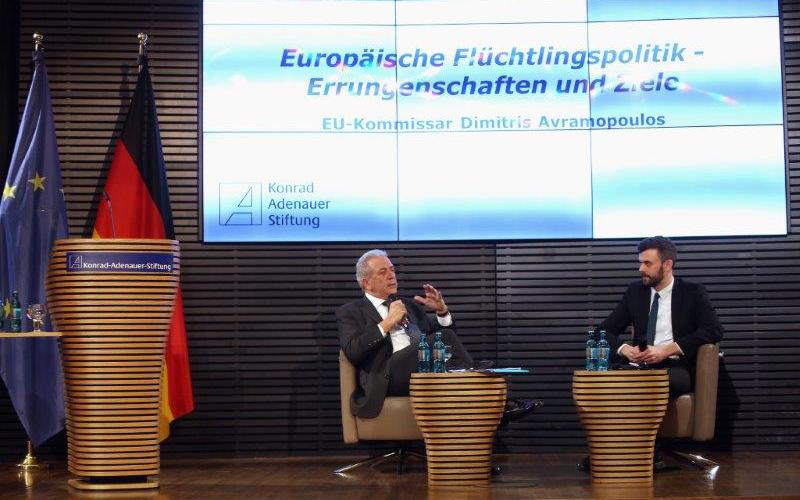
It is an honour for me to be here with you today at the Konrad Adenauer Foundation in Berlin.
Europe owes a lot to Konrad Adenauer, who was one of the founding fathers of the European Union, in the immediate aftermath of the Second World War.
Today more than ever we should remember the origins of the European project and its primary mission: to create and sustain peace and stability.
With the celebration of 60 years of the Rome Treaty this year in March, we will remember this institutionalised peace, stability and unity.
This is all the more important at present, when we continue to have instability and conflict in our neighbourhood.
Today, more than 65 million people around the world are displaced from their homes, fleeing poverty, climate change, war and instability.
Migration is seen in Europe and around the world as one of the most difficult challenges our societies are confronted with.
In the last two years, the European Union has made an enormous effort to build concrete, shared solutions, both inside and outside Europe.
Germany in particular has made enormous efforts. During the refugee crisis, the German population has shown a great sense of European solidarity and openness.
We have come a long way since 2015. But I am well aware that important challenges remain.
Let me assure you that the Commission stands ready to support Germany and all other Member States in these efforts.
Europe will only be able to address the migratory challenges successfully – both those in the short term as well as in the long term,
if we work together, and in solidarity. Allow me to paraphrase a well-known idiom when I say that “no country is an island”.
What happens in Syria, is felt not just in Turkey, but also in Greece, Germany and Sweden.
No country can deal with the refugee crisis alone. This means that our actions need to be global too.
It also means that:
– we must offer protection to those in need,
– we must better integrate those who have a right to stay here,
– we must equally return those who have no right to stay here,
– we must fight smugglers and those who facilitate irregular migration,
– we must continue to address the root causes
and better understand why people migrate in the first place,
– and we must better protect our borders while guaranteeing mobility.
In the span of two years, we have evolved from a scattered and uncoordinated approach on migration to a European and comprehensive response.
Since 2015, more than 400,000 people have been saved in the Mediterranean and the Aegean seas.
Inside the EU, we are now reforming our common asylum system, to make it more humane, fair and efficient.
A system which is generous to those in need and strict towards potential abuses.
We have proposed simpler, clearer and shorter procedures, which also strengthen and guarantee individual rights.
Solidarity lies at the very heart of this. At that solidarity cannot be short-term but must be built-in for the long term.
Today, the frontline Member States are Italy and Greece.
To relieve the pressure there, we have relocated to other countries in the EU almost 13,000 people in urgent need of international protection.
But we can and we must do more. In the short term, the pace of relocations from Italy and Greece has to be increased.
In the middle and long run, we must find an agreement on a truly European common asylum system, to be able to respond more quickly when future crises occur.
Today Member States like Italy, Greece and Germany are under pressure, but in the future, other countries might be affected too.
This is why we must have a truly European migration and asylum system, which is fair and balanced, across the entire EU.
In parallel, we are reinforcing the management of our external borders. This is the only way to get back to a Schengen area without internal borders.
We have recently established the European Border and Coast Guard – this is a milestone in the history of European border management.
It is an official recognition that the external border of one Member State is the external border of all Member States.
A rapid reaction pool of 1500 border guards can now be deployed in five days to support national coast guards.
Hotspots were set up at the most critical entry points. Thanks to them, fingerprinting of arriving migrants is now almost at 100%.
We will also have systematic checks for all those who cross our external borders, whether they are EU citizens or not.
In addition, we have proposed an EU Entry-Exit System to speed-up and reinforce border check procedures for non-EU nationals, as well as a European Travel Information and Authorisation System to check for potential security but also migration threats for visa-free third-country nationals coming to the EU.
All these elements are contributing to a better protection and strengthening of our external borders, which will allow us to return to a normal functioning of the Schengen area soon.
In order to further reduce irregular migration, we have also enhanced legal channels for people to come to Europe in an orderly and safe way.
We have already resettled almost 14000 people in need of protection from countries like Turkey, Lebanon and Jordan in one year, and should hopefully reach the 22000 that Member States committed to by this summer.
But we are also thinking in the long term. That is why we have proposed to have an EU Resettlement Framework to channel and harmonise resettlement to the EU for the future.
People don’t come to Europe for protection only. European labour markets will need talent from abroad, something that Germany understands very well.
This is why we have proposed a better, more attractive and more European Blue Card system to facilitate the process for highly skilled third country nationals to come and work in the EU.
Once people have a right to stay in Europe, we should also offer them that right in every way possible, so they can participate from the very beginning.
The investment in integration has for too long been neglected and underestimated.
Many countries are paying the price for that today: high unemployment rates for certain migrant groups, sometimes marginalized communities, and in the worst cases: radicalisation.
And at the same time, European societies are becoming increasingly diverse. We should embrace that diversity, not fight it.
As I mentioned in the beginning: the European door remains open for those who need our protection and for those who have a right to stay, but it cannot be open for everyone.
We have to become better at returning those who have no right to stay – and avoid abuses in the asylum system, unnecessary or lengthy detention, or clandestine residence or employment.
An effective return policy is an essential element of any comprehensive migration system, making it more humane and ultimately also safer.
We encourage Member States to make the best use of the EU return legislation, to fully use the flexibility it offers to have at the same time an efficient return policy that respects the fundamental rights and the dignity of the migrants.
Speaking about return brings me to the external dimension of our policy on migration.
If we want to address the root causes of migration, if we want to resettle on a global scale, if we want to fight smuggling, if we want to make sure that people who have no right to stay are effectively returned, our cooperation with countries of origin and transit is quintessential.
We can see that our work with third countries is already bearing fruit. The implementation of the EU-Turkey Statement has drastically reduced irregular arrivals in the Aegean, thereby also reducing lives lost.
Arrival figures to Greece have dropped by 98% since the EU-Turkey Statement was agreed.
Thanks to the work with Turkey, we stopped the chaotic and irregular migration along the Western Balkans route, and replaced it with legal and safe routes.
Similarly, with our new Partnership Framework we have started genuine political dialogues with key countries of origin and transit, mainly in Africa.
Through immediate operational measures we try to help them reduce the number of irregular migrants and save lives at the same time.
We also support them in fighting criminal smugglers networks and improving border protection.
We cooperate on readmissions of irregular migrants.
Recently we have also stepped up our efforts in the Central Mediterranean and notably with Libya, endorsed at the recent EU Summit in Malta.
EU and its Member States will continue patrolling the Central Mediterranean waters, but we will also support the Libyan authorities’ capacity to take their part of the responsibility in preventing irregular departures and save lives at sea.
In cooperation with IOM and the UNHCR, we will also push and help Libyan authorities’ to give a more dignified treatment, respectful of the international standards and human rights, to the migrants and asylum seekers arriving to Libya.
We will also help them to offer them humanitarian assistance for the vulnerable, and support for local integration, resettlement abroad, or voluntary return back home, depending on their status.
But most importantly, we want to help address the root causes of migration, by investing in better opportunities and a better future.
This is why we have created the EU Emergency Trust Fund for Africa, worth EUR 2.2 billion, which promotes economic and equal opportunities, security and development.
In addition, we have set up a new EU External Investment Plan with the aim of unlocking at least EUR 44 billion of investments in partner countries.
In parallel to that, the European Union remains the number one donor of humanitarian aid, taking action to provide life-saving emergency aid to refugees with more than EUR 9 billion already mobilised.
We are helping displaced people within Syria, as well as Syrian refugees and their host communities in Lebanon, Jordan, Iraq, Turkey and Egypt.
Ladies and gentlemen,
Europe is at a historical crossroad today, where its fundamental values of unity, and cohesion are at stake.
I want to make one thing very clear: protecting the life and rights of migrants and refugees inside and outside the EU is at the heart of the European project.
It is a fundamental value of the democracies that form the European Union to protect people in need.
Migration is a part of our rich and diverse culture and it has always had a positive impact on the development of the European continent.
While we must continue our work to make the EU and the world a safer place, these efforts must never come at the expense of our openness.
Today one of the biggest threats to the unity and future of Europe are the rise of populism, nationalism and xenophobia. These voices fuel our citizens’ fears and worries.
On top of that, Europe continues to face the threat of terrorism.
Berlin unfortunately has not been spared from the atrocious attacks that hit Europe last year.
But it is precisely in times like these that we should not give in to the voices of intolerance, exclusion or isolation.
Today, Europe risks losing its vigour, its sense of direction.
This is why we must remember our shared past, in order to be reminded of our shared destiny.
In times of increasing mobility and migration flows, of globalisation, of terrorism, the only way forward is together.
Thank you.